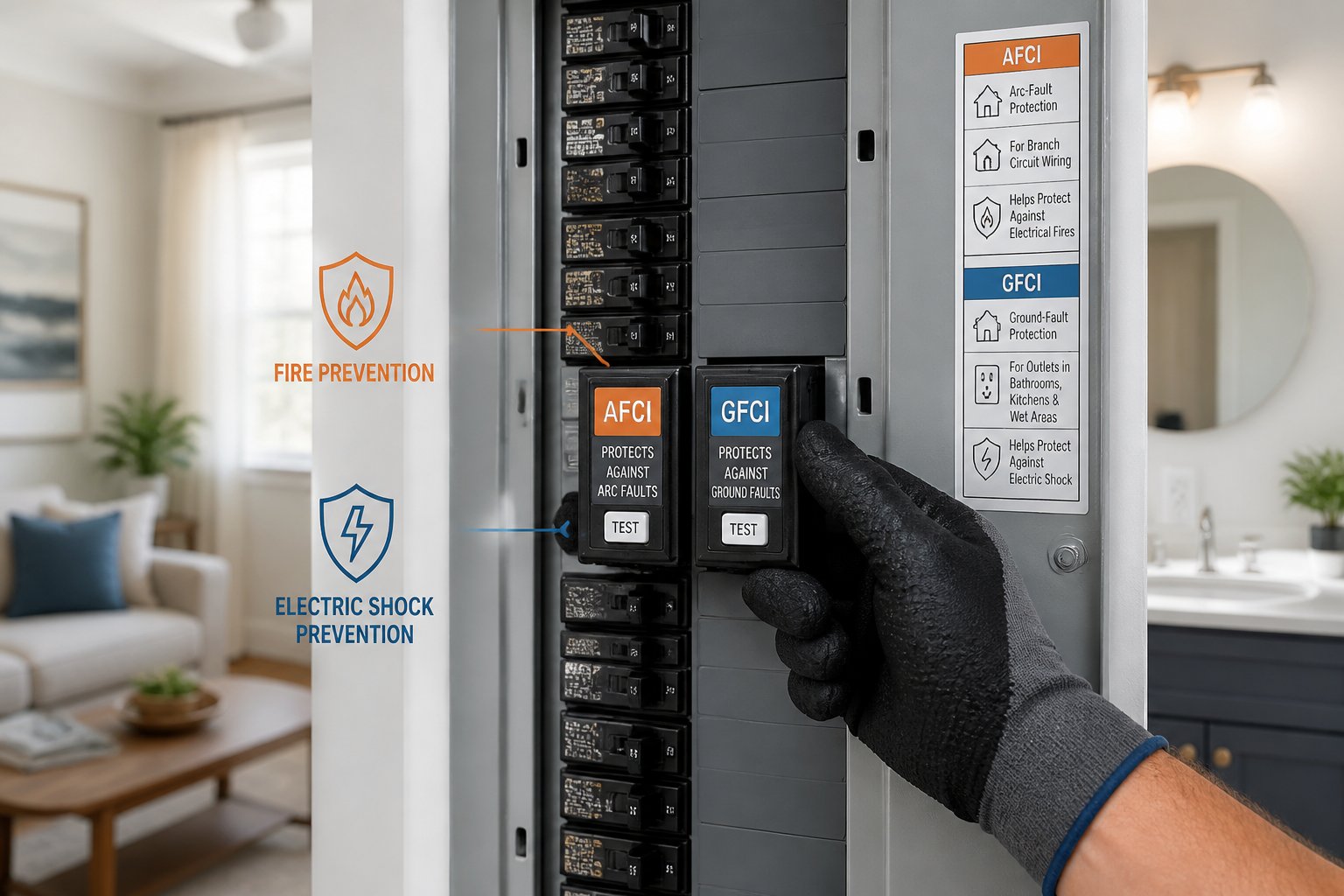
GFCI and AFCI breakers might look almost identical in your panel, but they guard against two very different hazards. A GFCI (ground fault circuit interrupter) cuts power fast when electricity tries to escape the circuit and head for the ground—sometimes through a person. That keeps you safe from electric shock. An AFCI (arc fault circuit interrupter), on the other hand, protects your home from fire by shutting off power when it senses those telltale, erratic sparks from damaged wires or loose connections.
So, which one should you have? In most homes, you'll want both, just in different spots. Kitchens, bathrooms, laundry rooms, garages, and outdoor outlets need GFCI protection because water or grounded surfaces are close by. Bedrooms, living rooms, hallways, and other living spaces call for AFCI protection, since hidden wiring and cords are more likely to fail there. Sometimes, like at your kitchen countertop outlets, you need both—this is where a dual-function AFCI/GFCI breaker comes in.
If you live in an older home around Sacramento, Elk Grove, Roseville, Austin, or Round Rock, your panel might have neither. Here’s how each device works, where code expects them, what upgrades usually cost, and why a tripping breaker can mean something more serious.
The Safety Difference Between Ground Faults and Arc Faults
A ground fault means electricity’s leaking off its normal path. Just 5 milliamps of leakage can injure or kill. An arc fault is electricity jumping a gap, sometimes getting hot enough to set wood framing or insulation on fire. Standard circuit breakers ignore both—they only react to overloads and dead shorts.
How Ground Faults Create Shock Hazards
Normally, the same amount of current flows out on the hot wire and back on the neutral. A ground fault happens when some current finds another path—maybe through a wet floor, a metal sink, a damaged appliance, or even your body.
A GFCI checks the current on hot and neutral dozens of times per second. If they differ by about 4 to 6 milliamps, it kills the power almost instantly. That’s well below the level that can stop your heart, which is why GFCI outlets are required anywhere electricity and water might meet.
How Dangerous Arcing Can Start Electrical Fires
Arcing means sparks jump across a break or gap in a wire. You might see this from a nail through a cable, insulation chewed by rodents, a cord pinched under furniture, loose screws at an outlet, or old, brittle wiring.
There are two types. Parallel arc faults happen between hot and neutral or hot and ground, usually drawing enough current to trip a regular breaker. Series arcs happen within a single wire—like a cracked conductor with the ends barely touching. According to electrical safety guides, series arcs often draw less than 5 amps, not enough to trip a standard 15 amp breaker. That small arc can smolder unseen for weeks. AFCI breakers use electronics to read the current’s shape and spot that arcing pattern; technical comparisons explain that waveform analysis is what sets them apart from regular breakers.
What Standard Circuit Breakers Still Protect Against
Standard circuit breakers do one thing well: they protect wiring from too much current. They trip for overloads (think space heater and hair dryer on the same circuit) and short circuits between hot and neutral.
That’s important, but it won’t protect people from shock or stop fires from small faults. A regular breaker lets 4 milliamps flow through your arm and ignores a 3 amp series arc. AFCI and GFCI breakers add their own sensing on top of the usual overload and short-circuit protection.
How Each Protective Device Works
You can get GFCI protection as a receptacle with test/reset buttons or as a breaker in the panel. That choice changes how much of the circuit gets covered. AFCI protection almost always comes as a breaker, and if you see CAFCI on it, that doesn’t mean you’re also getting ground-fault protection.
GFCI Receptacles and GFCI Breakers
A GFCI receptacle goes right in the outlet box. Wired correctly to the line and load terminals, it protects itself and any standard outlets wired downstream. If it trips, you reset it right there.
A GFCI breaker lives in the panel and covers the entire branch circuit—every outlet, light, and bit of cable. This overview points out that breakers cost more but cover more, while receptacles are cheaper and easier to reset. Both need a proper neutral connection, and GFCI breakers use a white pigtail that connects to the panel’s neutral bar.
AFCI Breakers and Combination AFCI Protection
Usually, you’ll get AFCI protection from an AFCI breaker at the panel, since that’s the only way to watch the whole circuit, including hidden wiring. AFCI outlets exist and can protect wiring downstream, but they can’t guard the cable between the panel and the first outlet.
The current standard is the combination arc fault circuit interrupter (CAFCI). “Combination” here means it catches both parallel arcs and low-current series arcs down to about 5 amps. Older branch/feeder AFCIs only caught the higher-current parallel type.
Why Combination AFCI Does Not Mean Dual Function
This one trips up a lot of folks at the hardware store. A combination AFCI only provides arc-fault protection. A dual-function AFCI/GFCI breaker gives you both arc-fault and 5 milliamp ground-fault protection in one.
Breakers must also match your panel brand and bus design. Square D, Eaton, and Siemens breakers don’t swap, and some older panels have no listed AFCI or dual-function breaker at all. Panel compatibility is one of the first things a licensed electrician checks before quoting a job.
Where Homes Commonly Need GFCI, AFCI, or Both
The National Electrical Code splits these rules: NEC 210.8 covers GFCI protection in wet, damp, and appliance locations, and NEC 210.12 covers AFCI protection on 15 and 20 amp circuits in living spaces. Kitchens, laundry rooms, and finished basements often need both.
Wet and Damp Locations That Typically Need GFCI Protection
NEC 210.8(A) expects GFCI protection for 125 volt receptacles in these areas:
- Bathrooms and any outlet within 6 feet of a sink
- Kitchens, including all countertop receptacles
- Laundry areas
- Garages and accessory buildings
- Outdoors (rooftop outlets, boathouses)
- Crawl spaces at or below grade
- Basements (finished or unfinished)
- Indoor damp and wet spots
The 2023 NEC also requires ground-fault protection for more hardwired appliances: dishwashers, ranges, wall ovens, microwaves, and clothes dryers. This location-by-location guide can help you see how far these rules reach.
Living Areas That Commonly Need AFCI Protection
NEC 210.12 requires AFCI protection on 15 and 20 amp, 120 volt branch circuits for almost every habitable room:
- Bedrooms
- Living rooms, family rooms, dining rooms, parlors, dens
- Kitchens
- Recreation rooms, finished basements
- Hallways, closets, libraries
- Laundry areas, sunrooms
Basically, if people sleep, sit, cook, or store things there, you’ll need arc-fault protection. Unfinished basements, garages, and outdoor circuits usually aren’t on the AFCI list.
Circuits That May Need Dual-Function Protection
Where the two lists overlap, you need both. That means kitchen countertop outlets, laundry area receptacles, finished basement outlets, and dishwasher circuits.
You’ve got two ways to get there: install a dual-function AFCI/GFCI breaker at the panel, or pair an AFCI breaker with a GFCI receptacle at the outlet. Comparisons of dual-function versus split protection note that one breaker is simpler to test and troubleshoot, while the split approach can save money on circuits with just a couple protected outlets.
Choosing the Right Upgrade for Your Circuit
The best choice depends on how much of the circuit needs coverage, whether your panel can accept modern breakers, and what shape your wiring is in. Older Sacramento and Austin homes bring extra headaches, like missing ground wires, shared neutrals, or obsolete panels that nobody supports anymore.
When a Breaker Protects the Whole Circuit
Pick a breaker if you want to protect everything on the circuit: cable inside the walls, hardwired lights, smoke alarms, and any hidden junction box.
Breakers make sense when a circuit has outlets spread across rooms, when the first outlet is tough to reach, or when you need arc-fault protection. For AFCI, the panel is really the only place to do it right.
When a Receptacle Can Protect Downstream Outlets
A GFCI receptacle works well when just a few outlets need protection and you can easily find the first box in the circuit. Connect the incoming wires to the line terminals and the rest to the load terminals—downstream outlets get covered.
This is common for a single bathroom, an outside outlet, or one garage receptacle. It’s also handy if your panel can’t take a GFCI breaker. Don’t stack GFCIs, though. Feeding one from another just causes nuisance trips and extra reset headaches.
Panel Compatibility and Older Wiring Concerns
Homes built before the mid-1960s often have two-wire circuits with no equipment ground. GFCI devices still work and are allowed as replacements, but you have to label them "No Equipment Ground."
Older homes might have multi-wire branch circuits with shared neutrals, where two hot wires share one neutral. Standard single-pole AFCI or GFCI breakers will nuisance trip on that setup, so you’ll need a two-pole device or a rewire. Obsolete panels—like Zinsco and Federal Pacific—show up a lot in Sacramento County and Central Austin, and no listed AFCI or dual-function breakers exist for many of them. That usually means a panel upgrade. Long runs to detached garages or backyard outlets add another wrinkle, since electricians check conductor size and voltage drop before adding protection.
Typical Cost Factors for Electrical Safety Upgrades
Costs vary by home, panel, and region, so treat these as rough ballpark figures:
WorkTypical installed range GFCI receptacle swap$150 to $300 per outletAFCI or dual-function breaker$200 to $450 per circuitMultiple breakers at onceLower cost per circuit after the firstTroubleshooting a persistent fault$150 to $500 depending on timePanel replacement (obsolete or full panel)$2,500 to $5,000 and up
What affects the price: how many circuits you need to protect, your panel brand and space, whether the panel’s full or unsafe, drywall access, permit and inspection fees, and if hidden damaged wiring turns up once you open the circuit.
Tripped Breakers, Testing, and When to Call an Electrician
Test GFCI outlets and breakers monthly with the built-in test button. Unplugging things can help you narrow down a problem device. But if a breaker keeps tripping after you reset it, or you need to open the panel, that’s electrician territory—those trips often mean damaged wiring inside a wall.
Safe Checks a Homeowner Can Perform
Test every GFCI outlet and AFCI or GFCI breaker once a month. Hit TEST, make sure power drops, then press RESET. If it doesn’t trip or reset, it’s time to replace the device. Step-by-step test and reset instructions walk you through what to expect.
You can also unplug everything on a circuit, reset the breaker, then plug things in one at a time. Troublemakers often include vacuums, treadmills, old fridges, cheap LED drivers, and space heaters. Check outside and garage boxes for water or critters. Don’t go further. Never open the panel cover, and don’t swap an AFCI or GFCI for a standard breaker just to stop nuisance trips.
What Repeated Trips May Indicate
If your breaker keeps tripping, it’s actually doing what it’s supposed to. Real causes usually include a nail or staple that pierced a cable, insulation chewed by rodents, a loose wire at an outlet or switch, moisture in an outdoor box, a dying appliance motor, or even a shared neutral that someone miswired during an old remodel.
Some electronics can cause nuisance tripping, and troubleshooting guides for AFCI and GFCI nuisance tripping can help track those down. But “nuisance” isn’t something you just guess—it’s what an electrician figures out after testing.
When a Licensed Electrician Should Diagnose the Circuit
Call a licensed electrician if your breaker trips more than once, won’t reset, smells like burning plastic, or if you notice a warm or discolored outlet or cover plate, flickering lights when appliances start, or any scorch marks. These signs point to dangerous arcing, a real ground fault, or heat that could start a fire.
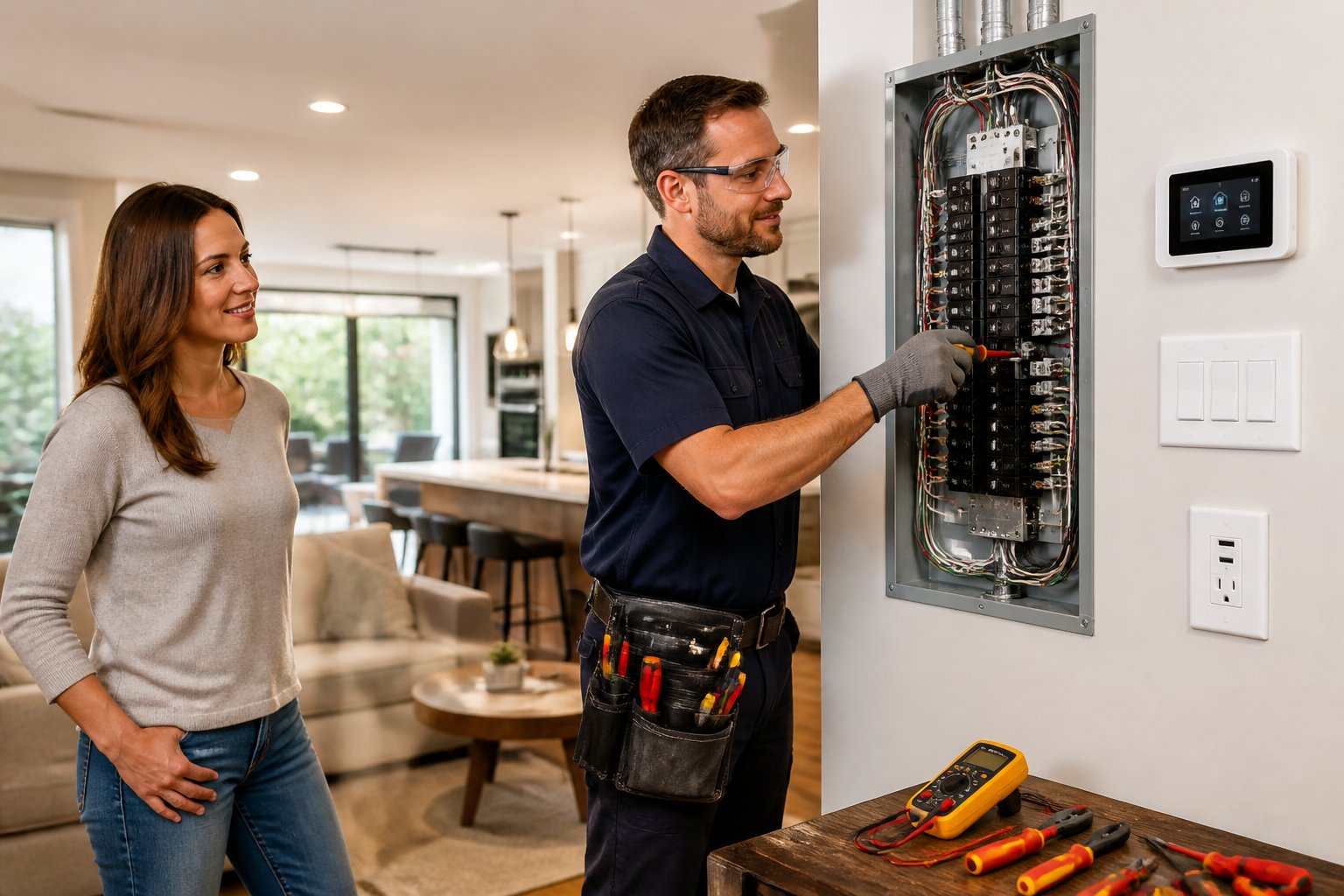
Don’t buy breakers for an older panel before talking to a pro. Electricians warn about swapping protected breakers—replacing a tripping AFCI with a standard breaker removes the protection but leaves the actual problem. Panel work means dealing with live bus bars that stay energized even when you turn off the main breaker. That’s not a safe DIY job.
Local Permits and Inspections in Sacramento and Austin
California follows the California Electrical Code, which builds off the NEC with its own amendments. Swapping out a bad receptacle for the same type usually doesn’t require a permit, but adding circuits, changing breakers in some places, and any panel replacement almost always does. Inspections come from your city or county building department. If you’re in the Sacramento area, check with your local permit office—rules change between the City of Sacramento, unincorporated Sacramento County, Roseville, and Folsom.
Texas licenses electricians at the state level, but Austin issues permits through its own development services department. Usually, a licensed contractor pulls the permit. Panel upgrades in Austin often need utility coordination for a temporary disconnect. Permit rules in Round Rock, Cedar Park, and Pflugerville aren’t the same, so always check before starting work. Cities adopt different code editions, and updating circuits in older homes may mean you have to bring more wiring up to current standards. Using a permitted contractor also helps protect your insurance claim if something ever goes wrong.
Frequently Asked Questions
Quick answers to what homeowners ask most about arc-fault and ground-fault protection—from where you need them to why a breaker won’t stay on.
What is the difference between AFCI and GFCI protection?
GFCI protection stops electric shock by cutting power if about 5 milliamps of current leaks out of the circuit—usually through water or a person. AFCI protection helps prevent fires by picking up on the sparking pattern from damaged wires or loose connections and shutting things down. Side-by-side breaker comparisons put it simply: GFCI protects people, and AFCI protects the building.
Where are AFCI breakers required in a home?
NEC 210.12 requires AFCI protection on 15 and 20 amp, 120 volt circuits serving bedrooms, living rooms, family rooms, dining rooms, dens, kitchens, hallways, closets, laundry areas, sunrooms, and finished basements. That covers almost every space you’d actually use. Unfinished basements, garages, and outdoor circuits usually aren’t included.
Where are GFCI breakers required by electrical code?
NEC 210.8 calls for ground-fault protection for outlets in bathrooms, kitchens, laundry areas, garages, crawl spaces, basements, outdoors, rooftops, boathouses, and anywhere within 6 feet of a sink. The 2023 NEC added more appliances, like dishwashers, ranges, microwaves, and dryers. You can use a GFCI breaker at the panel or a GFCI receptacle at the outlet to meet the rule.
When should an AFCI/GFCI combination breaker be used?
Use a dual-function breaker on circuits that need both protections, like kitchen countertops, laundry areas, dishwasher circuits, and finished basement outlets. One device handles both hazards and you can test it from the panel. Guidance on dual-function AFCI/GFCI breaker use points out that the 2023 NEC expanded where you need these, so more remodels call for them now.
Do kitchen appliances such as refrigerators and microwaves need AFCI or GFCI protection?
Kitchen circuits fall under AFCI protection in 210.12, so a refrigerator on that circuit is covered. The 2023 NEC says microwaves, ranges, wall ovens, and dishwashers also need GFCI protection, which is why new kitchen circuits often use dual-function breakers. Which rules apply in your kitchen depends on the code your city enforces, so check with your electrician about what’s required locally.
Why does an AFCI breaker trip, and how can the cause be identified?
An AFCI breaker trips when it detects arcing—think a nail through a wire, a mouse-chewed cable, a loose screw at a terminal, a frayed cord, or maybe a motor that's seen better days. Try unplugging everything on that circuit, then plug things back in one at a time. If one device triggers the trip, there's your culprit. But if the breaker trips even with everything unplugged, the wiring itself probably has an issue. At that point, you really need a licensed electrician with the right tools to track it down.
If your breaker keeps tripping or your panel doesn't have arc-fault or ground-fault protection, reach out to a licensed pro. For homeowners in Sacramento, CA or Austin, TX, you can request a free estimate through the electrical services page at aaaes.com. A qualified electrician will test your circuit, check your panel for compatible breakers, and give you a clear price before starting any work.