

Choosing the best ceiling fans with lights means looking beyond appearance. The right fixture should fit the room, hang from properly supported structure, provide useful light, and work with the controls in your home. For Sacramento-area homeowners, comparing these details before ordering can help avoid a mismatch or a surprise during installation.
Request ceiling fan installation
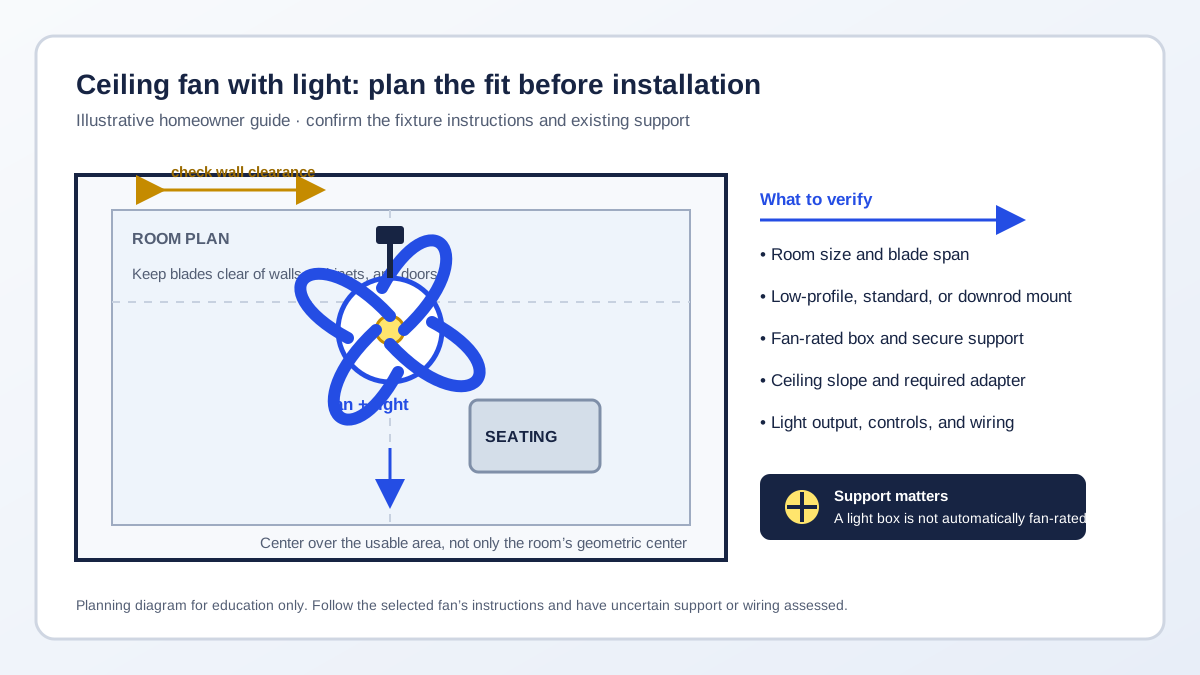
What should the best ceiling fans with lights do in your room?
Start with the room’s everyday use. In a bedroom, quiet operation, a gentle airflow setting, and dimmable light may matter most. In a kitchen or family room, broad light coverage and convenient controls may be higher priorities. A covered patio needs a fan rated for the conditions where it will be installed; an indoor fixture is not automatically suitable outdoors.
Evaluate the fan and light separately, even though they share one housing. The fan should move air comfortably and fit without crowding. The light should provide useful output in the right direction and color for the space. A model can look good in a product photo yet disappoint if its light leaves the main seating area dim or its airflow is uncomfortable.
Sketch the room before shopping. Mark the bed, dining table, sofa, work surface, and the spots where people spend time. Note existing lamps and ceiling lights, too. This simple map helps you judge whether one central fixture will serve the room or whether the ceiling fan should be part of a wider lighting plan.
How do you match fan size to the room?
Measure the room and note its shape. A long, narrow room may be better served by more than one appropriately placed fan than by an oversized fixture in the center. In a compact room, a fan that is too large can dominate the space and may not clear nearby walls, cabinets, or doors.
Use the manufacturer’s room-size guidance as a starting point, then check your actual layout. Consider ceiling height, seating locations, light placement, beams, and sloped areas. The blade span should suit the room while preserving the clearances in the product instructions. Do not assume a larger fan is automatically more effective; size and placement need to suit the space.
For example, a square bedroom with a bed near the middle may work well with one appropriately sized fan centered over the usable area. A long family room with a dining zone at one end and a seating zone at the other may have different airflow and lighting needs in each area. Measure each zone and compare the manufacturer’s guidance rather than choosing from the total square footage alone.
Ceiling height affects both fit and comfort. A high ceiling may call for a compatible downrod to position the fan appropriately. A low ceiling may call for a low-profile model. Check the manufacturer’s approved mounting options and required clearances before buying. Do not choose a mount solely because it looks sleek: the structure and approved mounting method must work together.
Which mounting style fits your ceiling?
| Mounting option | Often considered for | What to verify |
|---|---|---|
| Standard mount | Flat ceilings with typical height | Fan-rated support, clearances, and instructions |
| Low-profile mount | Rooms with limited ceiling height | Blade clearance and model approval for this setup |
| Downrod mount | Higher ceilings | Compatible downrod length, support, and blade height |
| Angled-ceiling mount | Sloped ceilings | Ceiling-angle compatibility and any required adapter |
These categories are not interchangeable in every situation. Check the product documentation for approved mounting configurations. If the ceiling is sloped, unusually high, or difficult to access, have the installation conditions assessed before purchasing. A fan that supports angled mounting may still require a particular adapter or downrod.
Also consider nearby doors, tall furniture, open stairways, and built-in shelving. Make a note of obstructions and compare them with the fan’s dimensions and installation instructions. If the fan will sit near a beam or a ceiling transition, confirm that the blades can turn freely and that the selected mount is suitable for that surface.
What light features should you compare?
For an integrated LED light, check whether the light source is replaceable or built into the fixture. Review the stated light output and available color settings. A bright ceiling light can still leave shadows in corners, so think about how it works with lamps and other fixtures. If you want dimming, confirm that the fan, light, wall control, and bulbs are designed to work together.
Fans with replaceable bulbs can give you flexibility, but the fixture’s maximum wattage and bulb type still apply. Integrated lighting can create a streamlined appearance, while a bulb-based kit may make future replacement more familiar. Neither is right for every homeowner. Choose based on your maintenance preferences, desired appearance, and the room’s lighting needs.
Think through the tasks that happen in the room. A soft setting may suit relaxing in the evening, while reading or preparing food may call for more useful task lighting. If you expect the fan light to be the only source, consider the room’s size, wall colors, furniture, and how much daylight it gets. If the fixture is mostly for airflow, it may be sensible to keep separate lighting for specific tasks.
Compare energy use, sound, warranty terms, and whether the light kit is included. Consumer Reports’ ceiling fan buying guide discusses energy-efficiency labels among factors shoppers can consider. Compare similar models and check the details in their documentation; a feature matters only if the mounting and electrical setup suit your home.
How should you choose controls?
Common options include a wall switch, pull chains, a remote, or app-based controls. A wall switch can be convenient when the wiring supports the functions you want. Pull chains provide direct control at the fan. A remote can help when the fan is out of reach, while smart features may depend on compatible equipment and a network connection.
Before buying, read the control requirements. Some fans have separate controls for the light and motor; certain combinations need specific wiring or a compatible receiver. Do not assume an existing single wall switch can operate every feature independently. If separate wall control for fan and light matters to you, tell the installer before work begins.
Consider who will use the controls and where. If the wall switch is the household’s usual way to operate a room, a remote-only setup may feel inconvenient. If the fan is over a high ceiling, pull chains may be hard to reach. Decide which control should be easiest to use, then verify that the model and wiring can provide it.
Smart controls deserve the same compatibility check. Confirm whether the fan needs a particular receiver, hub, app, or wireless connection and whether the light and motor can be controlled separately. Avoid assuming that a general-purpose dimmer or smart switch will work with a fan motor. Use only controls specified as compatible by the manufacturer.
What should you check before ordering?
- Measure the room and ceiling. Record room dimensions, ceiling height, slope, and nearby obstructions.
- Confirm the mounting plan. Identify whether the model needs a low-profile, standard, downrod, or angled-ceiling configuration.
- Review the light. Check output, dimming compatibility, bulb or LED serviceability, and whether other fixtures are needed.
- Choose controls. Decide whether you want a wall switch, pull chain, remote, or smart control, then confirm compatibility.
- Inspect the existing location. A ceiling fixture box is not automatically suitable to support a fan. The box and mounting arrangement must be rated and secured for fan use.
- Check the package. Confirm whether the light kit, hardware, downrod, remote, and angled-ceiling parts are included or available for that model.
- Save product details. Keep the model number, instructions, dimensions, and control diagram available for the installer.
If you are replacing an existing fan, note whether the new unit’s weight, mounting arrangement, and controls differ. If the location currently has only a light fixture, the electrical box may need replacement or additional work. Do not assume that a familiar-looking ceiling box can safely carry a fan.
Before checkout, compare the total package rather than the headline price. A model may require a separate downrod, remote, light kit, or angled-ceiling accessory. Those parts can also affect compatibility, so confirm that each is approved for the fan you selected. Keep return terms in mind if the actual ceiling conditions have not yet been checked.
Why do support and wiring matter?
A ceiling fan moves and vibrates while operating. Its support must be suitable for that use and securely attached to the building structure according to the installation instructions and applicable electrical requirements. Do not treat a decorative light box or an uncertain mounting point as fan-rated just because it is already in the ceiling.
Wiring conditions vary. A location may have separate conductors for the fan and light, a shared control, or wiring that does not match the new fixture’s instructions. Older wiring, damaged insulation, loose connections, or an unknown circuit can make a replacement more involved. Keep power off at the breaker while work is being evaluated; do not rely only on a wall switch.
If wiring needs to change, the box is not fan-rated, the ceiling is difficult to reach, or you are unsure how to verify that the circuit is de-energized, stop and contact a licensed professional. AAA Electrical Services handles ceiling fan installation and other residential electrical work in the Sacramento area. Learn about professional fan installation and discuss the existing box, controls, and fixture you have selected.
When you call, share what is known rather than guessing about the wiring. Useful details include whether a fan is already present, how many wall controls operate it, the approximate ceiling height, whether the ceiling slopes, and the new fan’s model number. Clear information helps the team understand the setup before arriving, though an on-site check may still be needed to confirm the support and wiring.
What can affect the installation plan?
A direct replacement may be possible when the existing location has suitable fan-rated support, compatible wiring, and an appropriate control. Additional work may be needed if the box must be replaced, the location is new, wiring or switching needs adjustment, or the ceiling calls for special mounting hardware. A larger or heavier fixture may also change what support is required.
Consider two examples. In one, an existing fan is replaced with a compatible model at the same location, with sound support and controls that match the new fixture. In another, a homeowner wants a fan where there is only a light, plus independent wall controls and a longer downrod. The second setup raises different support, wiring, and mounting questions, so it should not be assumed to be the same job as a straightforward swap.
Do not judge the scope by the number of steps in a product manual. The installer needs to consider the home’s actual wiring and ceiling structure. A clear assessment helps establish the work and price before it begins. If a new circuit or other electrical change is proposed, ask what it addresses and how it changes the plan.
AAA Electrical Services is a family-owned Sacramento residential contractor serving local homes. The company is fully licensed and insured, and its team members are background-checked and drug-tested. The team provides upfront pricing before work begins. Ask about the terms of the 100% satisfaction guarantee for the specific service.
How can you compare fan options fairly?
Compare the same practical details across models rather than relying on one feature or product image. A checklist can keep the decision focused:
- Is the fan approved for your ceiling type and mounting style?
- Does its size make sense for the room and available clearances?
- Can the light provide the brightness and control you want?
- Are controls compatible with the wiring and your preferred operation?
- Are replacement bulbs, LED components, remotes, or parts available as needed?
- Does the package include the mounting pieces and light kit you expect?
- Are warranty and energy details clear?
Then compare each model against the actual location. For example, a fixture with a remote may suit a high ceiling but still fail your preference for independent wall control. An integrated LED may have the clean look you want, but you may prefer a model with a replaceable light source. A low-profile shape may look ideal for a low ceiling, yet the product’s required clearances and fan-rated support still need to fit.
A lower-cost fixture may require separate accessories or a different mounting arrangement. A feature-rich model may not suit the available wiring. Write down your must-haves and acceptable trade-offs before shopping. The right choice is the one that meets the room’s needs and can be installed safely, not simply the model with the longest list of features.
Plan professional fan installation
When should you ask an electrician to assess the location?
Get professional input before proceeding if the fan is going in a new location, the existing support is unknown, the ceiling is sloped or unusually high, the wiring is old or damaged, or the circuit behaves unexpectedly. Stop if you see scorching, smell burning, notice exposed conductors, or a breaker trips repeatedly. Do not keep resetting a breaker to test a suspected wiring problem.
For a replacement, verify that the support is suitable for a fan and that the new fixture’s instructions match the wiring and controls. If you are uncertain, an on-site evaluation is safer than guessing from the appearance of the box. AAAES also provides electrical troubleshooting and panel safety inspection when broader electrical concerns need review.
If you already bought a fan, keep the box and all supplied parts together until the installation conditions are confirmed. Share any missing accessories or control preferences before scheduling. If you have not chosen a model yet, ask what information the team needs to help assess the location; do not buy an accessory based only on a guess about the ceiling angle or wiring.
Frequently asked questions
Are ceiling fans with integrated LED lights better?
They can suit homeowners who want an integrated design, but serviceability differs by model. Check whether the LED module is replaceable, what light settings are available, and what the warranty says. A fixture using standard replaceable bulbs may offer more flexibility in bulb choice.
Can I install a fan where a ceiling light is now?
Possibly, but the existing box and support must be rated and secured for a ceiling fan, and wiring must work with the fan and light controls. A standard light box should not be assumed to support a fan. Have the location assessed if its rating or attachment is unclear.
What if I want separate controls for the fan and light?
Check the fan’s wiring diagram and control requirements before buying. Separate wall controls may depend on the conductors already present, while some models use a receiver or remote. Ask an electrician to confirm what changes, if any, the home’s wiring requires.
Can one fan cool a large or open-plan room?
It depends on the room’s dimensions, shape, ceiling height, and where people spend time. Use the manufacturer’s coverage guidance as a starting point and consider whether multiple fans or other airflow solutions are more suitable. Avoid selecting solely by appearance.
How do I arrange installation?
Share the fan model, ceiling height and type, existing controls, and whether the location currently has a fan or light. AAA Electrical Services serves homeowners in Sacramento and surrounding communities. Call to confirm scheduling and discuss the installation details.
Book professional ceiling fan installation
A well-chosen fan and light should suit the room and the electrical conditions behind the ceiling. Confirm those details before buying so the finished installation is useful and properly supported.