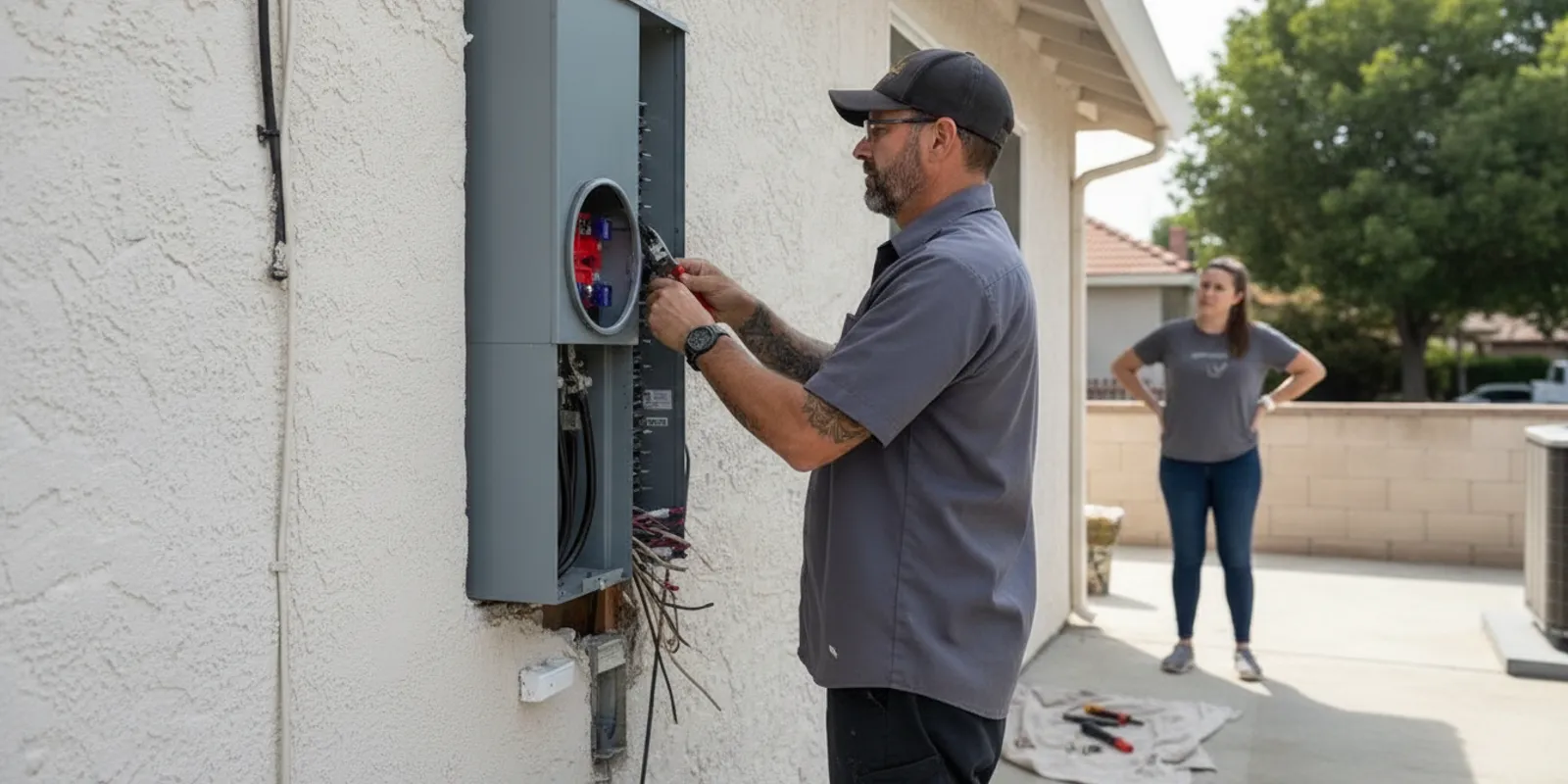
If breakers keep tripping, lights flicker when large appliances run, or a panel shows visible damage, it may be time to talk with an electrician for electrical panel replacement. Those signs do not prove a panel must be replaced; the cause could be a circuit, appliance, wiring, or panel component. For Sacramento homeowners, the practical first step is a professional evaluation followed by a clear explanation of options and a written scope.
Call to describe the concern and confirm scheduling
Which panel symptoms deserve a closer look?
Electrical panels distribute power to branch circuits and provide overcurrent protection. A symptom can have several causes, so look for patterns and report what you observe instead of trying to diagnose equipment yourself. Note when the issue occurs, which rooms or devices are affected, and whether it has become more frequent. A brief log can be useful: write down the date, the appliance in use, the breaker label if visible from outside, and whether the problem affected one room or several. Do not remove the cover to find a circuit label or inspect internal parts.
- Repeated breaker trips: A trip can result from overload, a fault, a connected appliance, or a breaker problem. Do not repeatedly reset a breaker to keep a circuit running.
- Warmth, burning odor, or discoloration: These may signal a hazardous condition. Keep clear and seek prompt professional advice. If there is smoke or fire, leave the home and contact emergency services.
- Buzzing, crackling, or visible damage: Do not remove the panel cover or touch internal parts. Arrange qualified help.
- Lights dimming when equipment starts: A brief change may have multiple explanations. If it is frequent, worsening, or affects several areas, ask for an evaluation.
- New electrical loads planned: An EV charger, heat pump, major appliance, or addition can require load and circuit planning. A panel upgrade is not automatic; compatibility and capacity need to be assessed.
- An older or identified panel type: Age alone does not prove failure. If the equipment is a Federal Pacific or Zinsco type, ask a qualified electrician to assess its condition and appropriate options.
If you smell burning, hear crackling, see arcing, or notice unusual heat, stay away from the equipment and contact a professional for direction. Do not open the panel, probe wiring, or attempt repairs inside it. If a breaker will not stay reset, leave it off rather than forcing it to remain on. If the condition seems urgent, explain the exact signs when you call so the team can advise on the appropriate next step.
Does a tripping breaker mean the panel needs replacement?
Not by itself. A breaker may trip because a circuit is carrying too much load, an appliance has a fault, wiring is damaged, or the breaker or panel has a problem. Replacing the whole panel without identifying the cause may leave the original issue unresolved.
A useful diagnosis follows the symptom. The electrician may ask which breaker trips, what is connected to that circuit, when the trip happens, and whether it began after a new appliance or other change. You can gather this context safely without opening equipment. For example, write down whether trips happen only when a microwave and kettle run together, or whether the breaker trips even when ordinary loads are off. That history can help guide testing, but it is not a substitute for it.
If the issue is isolated to one circuit, a repair or breaker-related correction may be appropriate. If the panel is damaged, unsuitable for the home's assessed needs, or cannot safely support planned loads, replacement may be discussed. Ask what finding supports the recommendation and what reasonable alternatives were considered. For related troubleshooting context, see residential electrical troubleshooting.
What should an electrician evaluate before recommending replacement?
A panel replacement is more than changing the enclosure. The suitable scope depends on the existing equipment, service capacity, wiring, grounding and bonding, the home's electrical load, and planned changes. A homeowner should be able to understand the key findings without needing to interpret technical jargon. Ask the electrician to connect each proposed task to a condition, requirement, or future load rather than treating a long parts list as self-explanatory.
- Equipment condition: Ask whether the panel has corrosion, overheating, physical damage, evidence of improper work, or an equipment concern that affects the recommendation.
- Service and load needs: Ask what the existing service rating is and how the home's calculated load compares with current and planned use. A new appliance does not automatically require a larger service.
- Panel location and access: Site conditions, working clearance, and the route for the service conductors can affect planning.
- Circuits and wiring: Clarify which circuits can remain and which need repair, extension, labeling, or other attention.
- Grounding and bonding: Find out whether related corrections are needed and whether they are included.
- Utility coordination: Ask whether the service must be disconnected and reconnected and who coordinates that work.
- Permits and inspection: Confirm what approvals apply locally, who obtains them, and how inspection is arranged.
- Future plans: Mention an EV charger, workshop, heat pump, addition, or other expected load before equipment is selected, even if the project is not immediate.
For a focused condition review, read about electrical panel safety inspections. If the findings point to capacity or equipment changes, compare them with the scope described for an electrical panel upgrade. An inspection, repair, upgrade, and replacement can overlap in conversation, but the written scope should state exactly what work is proposed.
How do repair, upgrade, and replacement differ?
These words are sometimes used loosely, so ask the electrician to define them for your specific job. A repair addresses a diagnosed fault or damaged component. An upgrade usually changes capacity or capability to meet assessed needs. Replacement describes removing existing panel equipment and installing new equipment, though the project may also include upgrades or related corrections.
| Option | Typical purpose | Questions for the proposal |
|---|---|---|
| Repair | Correct a specific diagnosed issue when existing equipment remains suitable. | What failed, what will be repaired, and what is not included? |
| Panel replacement | Replace panel equipment because of its condition or other project findings. | Which equipment and breakers are included, and what happens to existing circuits? |
| Capacity or service upgrade | Address assessed electrical capacity or planned-load requirements. | What load calculation or project need supports the change, and what utility work is involved? |
| Replacement with related corrections | Replace equipment while addressing necessary grounding, wiring, labeling, or access issues. | Which corrections are included, and how are concealed conditions handled? |
The right choice depends on the findings, not on a label alone. If a proposal says “upgrade” but only lists a like-for-like replacement, ask for clarification. If it recommends more capacity, ask what current or planned loads call for it and whether the existing service conductors and related equipment also need work. The goal is a scope that fits the home, not a larger project by default.
How can you compare proposals fairly?
Compare the work described rather than the bottom-line number alone. Exact pricing depends on the panel, service, access, circuits, permit requirements, and related repairs, so a phone estimate cannot replace an on-site diagnosis. AAA Electrical Services provides upfront pricing after diagnosis so homeowners can review the job price before work begins. A careful comparison starts with the same information for each contractor: the equipment condition, the proposed capacity, the circuits involved, and the planned additions or renovations.
- Diagnosis and rationale: Does the contractor connect the recommendation to observed conditions or the home's needs?
- Equipment details: Are panel type, rating, included breakers, and relevant components identified?
- Included circuit work: Does the scope state what happens to existing circuits, grounding, labeling, and any required repairs?
- Permit and inspection: Does it identify who handles applications, coordination, and required inspection steps?
- Utility coordination and outage: Does it explain any utility involvement and likely power interruption, without assuming a universal schedule?
- Exclusions and changes: Does it say how concealed conditions are reported, priced, and approved before added work proceeds?
- Warranty and closeout: Are applicable workmanship or equipment terms and closeout documents provided in writing?
For example, Proposal A may include grounding corrections and circuit labeling while Proposal B covers only panel equipment. A lower number may therefore represent less work, not better value. Ask each contractor to identify differences in scope, and get revisions in writing. Do not approve work you do not understand. To learn about the provider and its stated approach, see about AAA Electrical Services.
One practical method is to mark each proposal with three categories: included, excluded, and unresolved. If one contractor includes permit handling and another leaves it unclear, ask both the same question. If one anticipates a possible repair behind the panel, ask whether investigation is included and how added work will be presented for approval. This makes a comparison more useful than relying on different contractors' shorthand terms.
Why do licensing and permits matter?
Panel work affects the home's electrical distribution and should be performed by qualified professionals under applicable requirements. AAA Electrical Services lists CSLB license #635556. Before authorizing a significant project, verify the contractor's license status and classification through the California Contractors State License Board. Ask whether the proposed work requires a permit, who will obtain it, and how inspection will be completed; requirements can depend on the scope and local jurisdiction.
A permit is not a substitute for asking questions, and an inspection does not mean every future electrical issue is ruled out. The practical value is that the project follows the applicable approval process and has a defined closeout path. Ask for the permit status and inspection documentation when the job is complete, and keep those records with home documents. The company serves residential customers and provides electrical and HVAC service in the Sacramento area; homeowners can review its customer reviews as one part of their contractor research.
Confirm that the person doing the work is properly qualified and that the license details on the proposal match the contractor you are hiring. Also ask who will be on site, who can answer technical questions, and how the team will explain any change to the agreed scope. Clear responsibility matters: homeowners should not have to guess whether the contractor, utility, or local authority is handling a particular step.
What happens during panel replacement?
The exact sequence varies with equipment, permit conditions, site access, and utility coordination. These stages are common, but the contractor should explain which apply to your home.
- Assessment: The electrician reviews the panel, service, circuits, grounding, and planned loads, then explains findings and options.
- Written proposal: You review included equipment and labor, related work, exclusions, price, and terms before approving.
- Planning: The contractor addresses permit and inspection steps and coordinates utility involvement where needed.
- Installation: Power may need to be interrupted while the work is completed. Confirm expected timing and arrangements directly with the team.
- Testing and closeout: The electrician checks completed work, labels circuits as appropriate, and explains any inspection or documentation still pending.
Prepare by clearing a safe route to the panel and moving stored items away from the work area. Plan for a power interruption: consider refrigerated food, internet, remote work, and any medical device that depends on electricity. If someone at home relies on powered medical equipment, discuss a safe plan with the relevant care provider and contractor before scheduling. Confirm the expected outage and whether utility work affects the timing. Do not assume every installation takes the same amount of time.
Before the appointment, make a simple list of questions: What rooms or circuits will lose power? Should sensitive electronics be unplugged? How will the team access the panel? Who should be present to approve a change if an unexpected condition is found? Having these answers in advance reduces confusion on the work day and helps keep decisions tied to the agreed scope.
It also helps to prepare the household in practical ways. Save work that depends on a desktop computer, charge phones and battery packs, and arrange another place for any task that cannot pause during an outage. Keep pets and children away from the work area. Do not move, disconnect, or cover equipment yourself unless the electrician has specifically instructed you to do so. If the panel is in a garage or storage area, clear access without stacking items near the equipment.
What should Sacramento homeowners plan for?
Local homes differ in age, prior remodels, service equipment, and electrical loads. A panel that served an earlier set of needs may need review when a homeowner adds a high-demand appliance or remodels. If you plan an EV charger, discuss capacity and circuit requirements during the evaluation. See the local EV charger installation information for Folsom for an example of a related project.
Think through the project in stages. First, describe the current symptom or planned change. Second, ask for the electrician's findings and the reasoning behind the recommendation. Third, compare the written scopes, including permit, utility, and related work. Finally, schedule only after you understand the expected interruption and how changes will be approved. This sequence is useful whether you are dealing with an immediate concern or planning a remodel several months ahead.
For a planned remodel, bring the project details to the panel evaluation: appliance specifications if available, expected additions, and any contractor's electrical plan. A kitchen renovation, heat pump, EV charger, and workshop may each affect circuit planning differently. The electrician can assess the combined situation rather than treating each proposed load as a separate yes-or-no question. If plans are preliminary, say so; early discussion can identify what information still needs to be confirmed before equipment is selected.
Do not assume a rebate, permit timeline, or utility process applies to every address. Ask what applies to your project and confirm local requirements with the appropriate authority. If you live in Sacramento, Carmichael, Fair Oaks, Elk Grove, Folsom, Rocklin, Orangevale, North Highlands, or Citrus Heights, call to confirm service availability and appointment timing.
When should you request service?
Arrange an evaluation when a breaker trips repeatedly, you see panel damage, or you are planning a substantial new electrical load. Burning odors, unusual heat, crackling, or arcing warrant prompt professional advice; keep clear and do not attempt work inside the equipment. If there is smoke or fire, leave and contact emergency services.
AAA Electrical Services is a residential electrical, HVAC, and solar service provider for Sacramento-area homeowners. Same-day electrical service is available only when the team confirms it, and appointment timing should be confirmed directly. Explain what you observed, when it happens, and whether there are urgent warning signs. The team can assess whether the next step is repair, replacement planning, or another response.
Explore Sacramento panel electricians
Frequently asked questions
Can a panel be replaced without replacing the home's wiring?
Sometimes existing wiring can remain, depending on its condition, compatibility, and the work required. The electrician should identify wiring repairs, extensions, or other corrections in the written scope rather than leaving assumptions unstated.
Will power be off during replacement?
Power generally needs to be interrupted for panel work. The timing and duration depend on the project and any utility coordination, so confirm the plan before the appointment and make arrangements for essential equipment.
Can an electrician give an exact replacement price by phone?
Not reliably. Price depends on the panel, service, circuits, access, permit requirements, and related repairs. An on-site diagnosis allows the contractor to identify the scope and provide the upfront job price before work begins.
Should I reset a breaker that keeps tripping?
Do not keep resetting it after it trips again. Note what was running and when it happened, and contact a qualified electrician for guidance. Stay away from a circuit or panel showing heat, odor, damage, or arcing.
How do I choose an electrician for panel replacement in Sacramento?
Verify licensing, request a clear diagnosis and written scope, confirm permit and inspection responsibilities, and compare included work and exclusions. Choose a qualified professional who explains the recommendation and provides the price before work begins.
Careful evaluation helps distinguish a panel problem from a circuit or appliance issue and makes the proposed work easier to assess. Call AAA Electrical Services to describe the concern and confirm scheduling for your Sacramento-area home.