
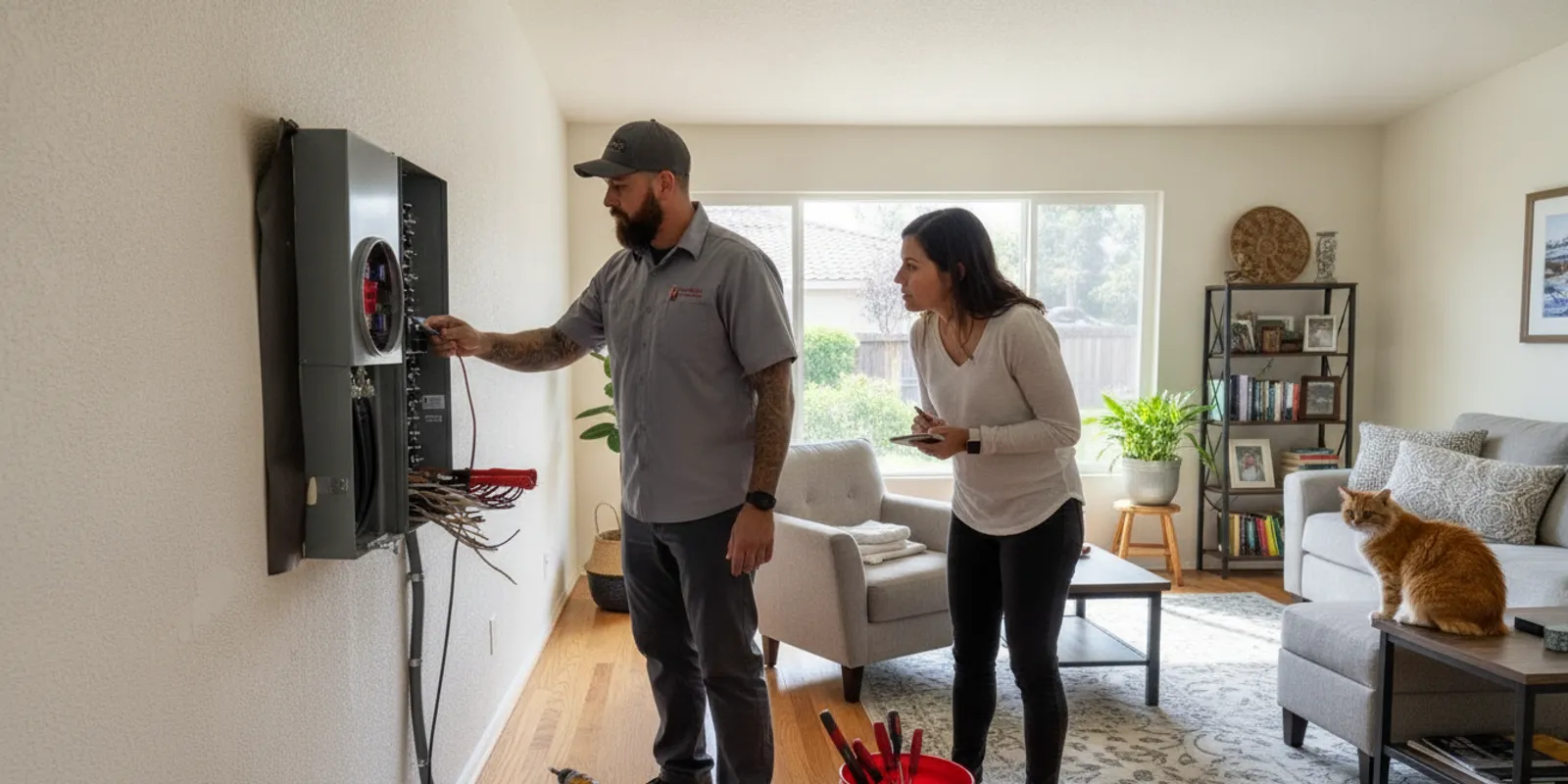
When you search for electricians in my area, the closest listing is not automatically the right fit. Sacramento-area homeowners should check licensing, residential experience, safety practices, and how a contractor explains the diagnosis and price before work begins. A few careful questions can help you choose a professional whose service area and work match your home’s needs.
Call to discuss your electrical service needs
What should you confirm before choosing an electrician?
Begin with the basic fit. Confirm that the contractor serves your city, works on residences, and handles the type of issue or project you have. Electrical troubleshooting, a panel assessment, new wiring, an EV charger, and whole-home rewiring are not interchangeable requests. A company may offer some services but not others, so describe the work in plain terms rather than assuming a general listing covers every job.
Check licensing with the California Contractors State License Board (CSLB). AAA Electrical Services lists CSLB #635556, with C-10 Electrical and C-20 Heating & Air credentials. Ask that the license and scope match the work you are discussing. If the project involves several parts of a home system, make sure the contractor can explain which trade or work category applies.
Ask who will come to your home and what screening or safety standards the business describes. AAAES says its team members are licensed, insured, background-checked, and drug-tested, and its professionals wear uniforms. Those statements help you understand the company’s practices, but you can still ask how identification works, who will perform the job, and what to expect when the technician arrives.
It is also reasonable to ask how the company handles your appointment and communicates changes. Will the team confirm an arrival window? Who should you contact if the problem changes before the visit? Which information should be ready? Clear answers make it easier to coordinate access to the home and avoid confusion about what the appointment is intended to address.
How can you describe an electrical problem clearly?
Describe what you observed without trying to diagnose the cause. Instead of saying only “the power is bad,” mention the room, equipment, and pattern. For example: “The kitchen lights dim when the microwave starts,” or “The breaker for the back bedroom has tripped twice this week.” Note when the issue began, whether it is constant or intermittent, and whether other rooms or devices are affected.
These observations do not identify the repair by themselves. A flickering light can have more than one explanation; a breaker that trips can also have different causes. The point is to give the electrician useful context and help the visit focus on the conditions you have noticed. Avoid taking apart a switch, receptacle, fixture, or panel to gather more information.
Before you call, make a short list: the affected location, the symptom, when it occurs, and any recent changes you already know about. A recent appliance installation, renovation, or new equipment may be relevant. If several circuits or rooms are involved, list each one rather than treating the entire home as one symptom. Mention whether the concern is active right now and whether there is heat, smoke, a burning smell, or visible damage.
AAAES provides electrical troubleshooting for homeowners who need help identifying a problem. If you are unsure whether your issue fits that description, explain what is happening and ask the team to help determine the appropriate service visit.
When is an electrical concern urgent?
Some symptoms call for prompt attention. Smoke, flames, sparking, a burning odor, exposed conductors, or equipment that appears hot or damaged should be treated as a safety concern, not an invitation to investigate. Keep people away from the affected area. If there is a fire, smoke, or immediate danger, contact emergency services. Do not touch damaged equipment or try to remove a cover.
If you can safely identify a clearly labeled breaker without approaching the hazard, you may switch it off. Do not put yourself at risk to reach it, and do not repeatedly reset a breaker that continues to trip. Leave panel covers and internal components alone. If you are uncertain whether it is safe to operate a switch or breaker, stay back and ask for qualified guidance.
Not every electrical issue is an emergency. A single nonworking outlet with no heat, smoke, or visible damage may be less urgent than repeated trips, a burning smell, or multiple areas losing power. Still, recurring or unexplained symptoms deserve attention. Tell the service team the exact warning signs and ask what to do while waiting; do not assume an online description can establish a safe diagnosis.
AAA Electrical Services offers emergency electrical service, but on-site availability and dispatch timing must be confirmed with the team. Live phone answering is available around the clock; that is not a promise that a technician can arrive at every hour. When there is immediate danger, contact emergency services rather than waiting near the equipment.
What should happen during a diagnostic visit?
A useful diagnostic starts with questions about the symptoms and the home, followed by an inspection appropriate to the problem. Tell the technician what you saw, how often it happens, what was operating at the time, and whether any earlier repair or change may be relevant. If you have written down the pattern, share the notes. The details can help the technician decide what to examine, but testing and inspection are needed to identify the cause.
The checks depend on the concern. A dead receptacle, an intermittently tripping circuit, a panel issue, and an outdoor lighting problem do not call for the same inspection. The technician should explain what was found in language you can follow, connect the finding to the reported symptom where possible, and outline the proposed work. If there are several possible explanations, ask which ones were confirmed and which remain uncertain.
At AAAES, a paid diagnostic identifies the repair path and the upfront price. Ask the team to explain the diagnostic arrangement and applicable terms when you schedule. The exact job price is established after the condition and scope are understood, not from a quick phone description. Before authorizing repair work, you should have a clear price and understand what that price covers.
A thorough explanation should distinguish diagnosis from repair. The visit may establish that a particular part needs repair or replacement, or it may show that the problem requires broader investigation. Ask whether the proposed work addresses the symptom you called about, what is included, and whether testing follows the work. If a recommended repair uncovers another concern, ask the technician to explain it separately instead of assuming it was part of the original scope.
How do common service requests compare?
This table can help you organize what to report when you contact a contractor. It is not a diagnosis or a promise that a particular repair will be required. Describe the observed facts, and let the electrician determine what evaluation is appropriate.
| What you notice | Useful details to report | What to ask about next |
|---|---|---|
| One outlet or switch is not working | Room, devices affected, whether there is heat, noise, discoloration, or visible damage | Whether a residential troubleshooting visit can evaluate the condition |
| A breaker trips repeatedly | Which area loses power, what was operating, and when it trips | How to keep the area safe and arrange qualified diagnosis |
| Lights flicker or dim | Whether it affects one fixture, a room, or several areas, and when it happens | What observations would help the technician investigate the pattern |
| Panel concern | Visible damage, unusual sounds or heat, and any known prior assessment | Whether to schedule a panel safety evaluation; do not open the panel |
| Several rooms or circuits are affected | Which locations, whether the issue is constant, and when it began | Whether a broader evaluation is needed to look for a shared cause |
| Planned installation or rewiring | Equipment or rooms involved, project timing, and any known electrical constraints | What information or site review is needed to define the proposed scope |
How should you compare recommendations and estimates?
Compare the work being proposed, not just the total at the bottom of a page. Two contractors may recommend different scopes because they found different conditions or because their proposals include different materials, testing, or follow-up. Ask each provider to describe the observed condition, the work that addresses it, and any related work that is not included.
- Ask what was observed. Request a plain-language explanation and how the finding relates to the symptom. If something is uncertain, ask what has and has not been verified.
- Confirm the scope. Have the contractor identify what will be repaired, replaced, or installed. Ask whether associated parts, labor, testing, cleanup, and restoration are included when they apply.
- Understand alternatives. If more than one approach is suitable, ask how the options differ, what each resolves, and what tradeoffs matter for your home. Do not assume a more extensive option is automatically necessary.
- Get the price before work begins. AAAES says it provides upfront pricing. Review the proposed price and scope, and ask questions before deciding whether to authorize the work.
- Clarify scheduling and follow-up. Ask what appointment window is available, how timing will be confirmed, and whether any inspection or follow-up is part of the proposal.
A careful estimate should let you understand what you are approving. If the explanation relies on pressure, leaves the scope vague, or does not answer basic questions, pause and ask for clarification. At the same time, an exact job price from a brief phone call may not account for hidden conditions or the actual work required. An on-site diagnostic can establish the condition and the proposed repair path.
When comparing two written recommendations, line them up item by item. For instance, if one proposal replaces a component and another suggests a larger system change, ask what evidence supports each scope and whether both address the same observed issue. You can then compare like with like, rather than treating unlike plans as competing prices. Keep a copy of the findings and ask for any changes to the authorized work to be explained before proceeding.
What does a panel concern require?
A panel distributes electricity to circuits in the home, but a symptom near the panel does not automatically mean the panel must be replaced. Repeated breaker trips, visible damage, unusual heat, or concern about a particular older panel are reasons to ask about an evaluation. Do not remove the panel cover, touch internal parts, or try to tighten connections yourself. Some electrical components can remain hazardous even when a breaker is off.
A panel assessment should consider the observed condition and the home’s electrical needs. Ask what the technician found, whether the concern can be addressed through a repair or calls for another option, and what the proposed work includes. If you have plans to add equipment or renovate, share them. Future needs may affect what questions should be considered, but they do not by themselves prove that an upgrade is required.
If you are concerned about a Federal Pacific or Zinsco panel, have the equipment assessed rather than making a decision from a label alone. AAAES offers electrical panel safety inspections and Federal Pacific and Zinsco panel service. For a project that may require additional capacity, review the information on electrical panel upgrades and ask which options fit the actual condition of your home.
What should Sacramento-area homeowners expect when scheduling?
When you call, share your city, the type of work, and a concise symptom description. Say whether there is an urgent safety concern and whether the issue is currently active. This lets the team understand the request and confirm whether the service area and work type fit. AAAES serves Sacramento-metro communities including Sacramento, Carmichael, Fair Oaks, Elk Grove, Folsom, Rocklin, Orangevale, North Highlands, and Citrus Heights.
Ask the team to confirm the appointment window, how it will communicate arrival details, and what you should do if the condition changes before the visit. Same-day electrical service may be available when the team confirms it; it is not guaranteed. Live phone answering is available 24/7, but this should not be confused with round-the-clock on-site response. Confirm the details for your location and request rather than relying on a general service statement.
Make the visit easier by arranging a safe path to the affected area and identifying the equipment or rooms involved. If the electrical panel is in a garage, closet, or utility space, let the team know about access. You do not need to open equipment, move unsafe objects, or attempt repairs before the appointment. If the issue involves a specific appliance, simply be ready to tell the technician its location and when the symptom occurs.
For broader residential work, such as rewiring, ask how the contractor will define the project scope before work begins. AAAES provides whole-home rewiring. A useful conversation covers the areas involved, the findings that led to the recommendation, how work will be staged, and what the homeowner should expect during the project. Confirm details directly with the team, since every home's layout and condition differ.
What questions are worth asking before you book?
Keep the conversation focused on fit, process, and the decision you will need to make. These questions are useful for a routine troubleshooting visit or a larger project:
- Do you serve my city, and does this request fit your residential service scope?
- What information should I have ready before the technician arrives?
- How is the diagnostic handled, and what will it establish?
- When will I receive the price for the proposed repair or project?
- Will the technician explain the findings and any practical alternatives?
- What appointment window is available, and how will it be confirmed?
- What should I do if the symptom changes or becomes a safety concern while I wait?
Write down the answers and keep them with the estimate or service notes. If you consult more than one contractor, use the same description of the problem with each one. Compare what each provider actually observed and the work each proposes. If the scopes do not match, ask why; the difference may come from a different diagnosis, different included work, or a need for more information.
When is it time to call an electrician?
Contact a qualified electrician when an electrical symptom repeats, affects several areas, involves a breaker or panel, or cannot be assessed safely through simple observation. Do not attempt work on damaged wiring or inside a panel. Even if a problem seems intermittent, describing when it happens can help the team decide what kind of evaluation to arrange. If there is smoke, fire, sparking, or immediate danger, keep away and contact emergency services.
AAA Electrical Services is a residential contractor serving Sacramento and surrounding communities with electrical and heating and air services. Homeowners can ask about troubleshooting, panel inspections, rewiring, and other electrical needs, then confirm service availability and scheduling directly. For an overview of local help, visit Sacramento electrical services.
Call to request service and confirm scheduling
Frequently asked questions
How do I find electricians in my area who serve my home?
Check the contractor’s service area, residential work scope, and licensing, then confirm directly that your city and type of project are covered. Share a concise description of the symptoms and ask what scheduling options are available.
Can an electrician give me an exact repair price over the phone?
An exact job price usually depends on the condition and scope of work. A diagnostic visit can identify the repair path; ask for the upfront price and what it includes before authorizing work.
Does a breaker that trips mean I need a new panel?
Not necessarily. A tripping breaker can have different causes, and the symptom alone does not establish that the panel needs replacement. Do not keep resetting it; arrange qualified troubleshooting if it continues.
Is same-day electrical service guaranteed?
No. Same-day service may be available, but the team must confirm scheduling and dispatch timing for your location and concern. Live phone answering does not guarantee an on-site appointment at every hour.
What should I do if I see sparks or smell burning?
Keep people away and do not touch the equipment. If there is smoke, fire, or immediate danger, contact emergency services. Otherwise, stay clear of the affected area and contact a qualified professional for guidance.
A good choice starts with a clear description of the issue, a qualified residential electrician, and an explanation of the findings and price before work begins. Call AAA Electrical Services to discuss your Sacramento-area home and confirm the right next step.