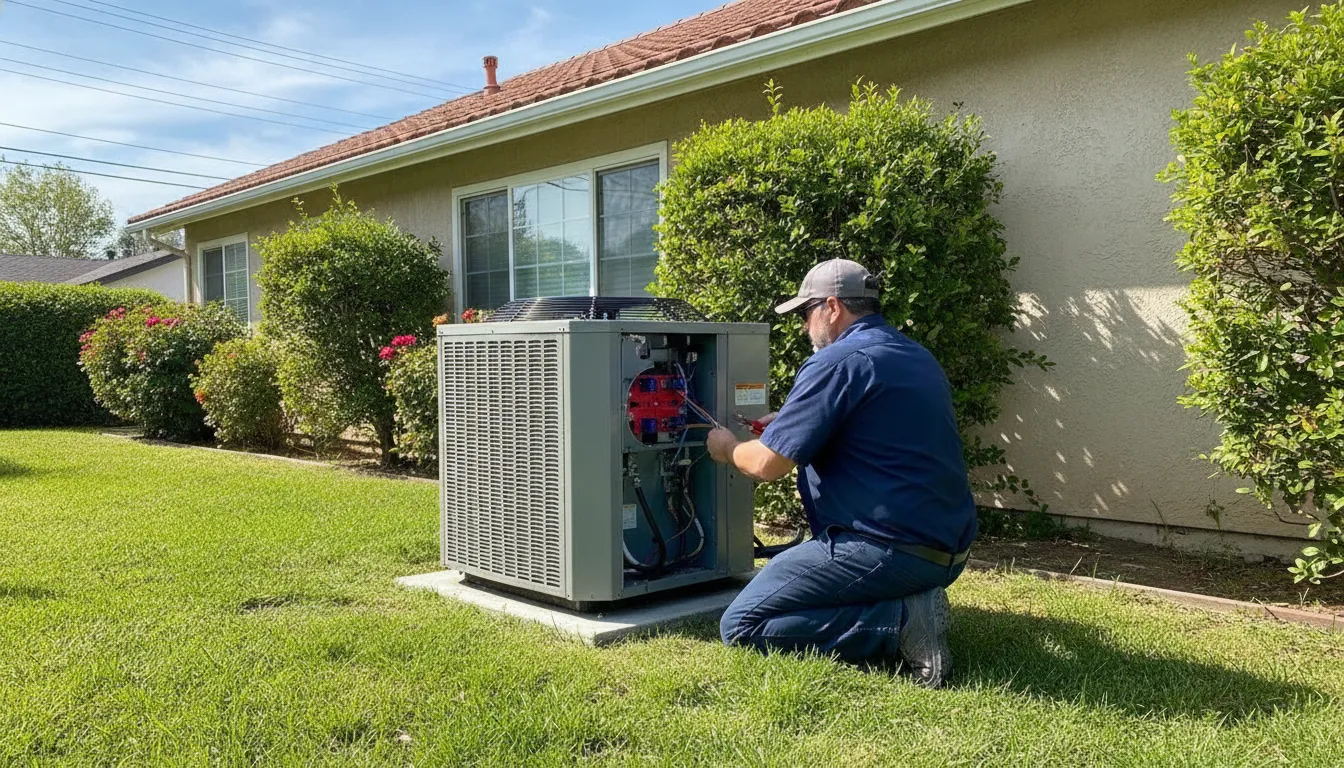
What is an AC tune up? It is a planned visit, not a repair call. A technician inspects your cooling system and cleans the parts that collect dirt. They test whether the unit starts, runs, and shuts off the way it should. You book it before the first long stretch of Sacramento heat, while the system is still working. The goal is a clear picture of condition, not a promise that the air conditioner will never fail.
This guide walks through the checks a technician makes on a central air conditioner in a Sacramento home. It covers what you can do before the visit and how a tune-up differs from a repair. It also covers when a heat pump needs a slightly different visit. If the system is already warm on one side of the house, start with the guide to an AC that is not cooling. Do not wait on a seasonal appointment for that.
What an AC tune up covers
An AC tune up is preventive maintenance for the cooling side of your home. The technician looks at the outdoor condenser and the indoor air handler or furnace cabinet. They also check the thermostat and the drain that carries water away from the coil. The visit is about condition and operation. It is not a full rebuild. It is not a diagnosis of a system that has already stopped cooling.
ENERGY STAR describes a typical pre-season check as a set of safety and performance steps. The contractor checks thermostat settings and tightens electrical connections. They measure voltage and current on motors. They lubricate moving parts that need it and inspect the condensate drain. They also confirm the system starts, runs, and shuts off properly. Cooling-specific work adds coil cleaning, a refrigerant check, and blower airflow. You can read the full list on the ENERGY STAR maintenance checklist.
Those steps are the national baseline. They are not a fixed menu for every house. A 15-year-old split system in a Land Park bungalow does not get the same attention as a newer heat pump in Elk Grove. AAA Electrical Services shapes the visit around the equipment you have and the manufacturer's guidance. Ask which checks are included for your system, and how any findings will be shared, before the technician starts.
A useful visit ends with plain notes. You should know what was cleaned, what was measured, and whether anything needs a separate repair conversation. Maintenance is not a promise that equipment will never fail. If a problem needs repair, that work is a different scope and needs its own approval.
What the technician checks outside
The outdoor unit does the heat-rejection work. On a Sacramento afternoon it sits in full sun, often behind shrubs that have grown in since last spring. The technician starts there because a dirty or blocked condenser makes the whole system run longer.
Condenser coil and clearance
Dirt, cottonwood, and pollen mat onto the coil fins. ENERGY STAR notes that dirty coils reduce cooling and make the equipment run longer. That raises energy use and shortens equipment life. The technician cleans the coil and looks at fin damage. Bent fins block airflow even after the dirt is gone.
Clearance matters as much as cleanliness. Leaves, stored bins, and a hedge planted against the cabinet all starve the fan. You can pull plants back and rinse loose debris from the outside of the cabinet before the visit. Leave the service panel closed. Opening it is electrical work, not yard work.
Fan, electrical connections, and the disconnect
The outdoor fan motor and the compressor both depend on tight, sound connections. ENERGY STAR calls out loose electrical connections as a cause of unsafe operation. They also shorten the life of major parts. The technician tightens connections and looks at the contactor. They measure voltage and current on the motors. A weak capacitor or a pitted contactor is a finding. It is not something to patch over during a routine visit without telling you.
The outdoor disconnect is the shutoff next to the unit. The technician confirms it is the right type for the equipment and that the whip and fittings are intact. You should not flip it on and off to "test" the system. If the breaker has tripped, leave it off and say so when you book. Resetting a breaker that trips again is a repair question, not a tune-up step.
Refrigerant is a check, not a top-off habit
A central air conditioner is a sealed system. The charge should stay put. ENERGY STAR says too much or too little refrigerant makes the system less efficient, raises energy costs, and shortens equipment life. The technician checks the level and adjusts it only when the equipment and the readings call for it.
A system that needs refrigerant every spring is leaking. Adding refrigerant without finding the leak does not finish the job. On newer equipment the refrigerant type and the handling rules are specific. Treat a low charge as a finding to discuss. Do not ask for a top-off as the whole visit.
What the technician checks inside
The indoor half of a split system is where the air you feel gets cooled. It is also where water from that cooling has to leave the house. Most of it sits in a closet, attic, or garage. Access is the difference between a complete visit and a partial one.
Filter, blower, and airflow
The filter is the one part ENERGY STAR assigns to the homeowner. Inspect, clean, or change it monthly on a central air conditioner, furnace, or heat pump. A dirty filter raises energy use and can damage equipment. Your contractor can show you the right size and which way the arrow points. Bring the last filter you used, or a note of its size, if you are not sure.
The blower moves air across the indoor coil and out through the ducts. ENERGY STAR says airflow problems can cut system efficiency by up to 15 percent. The technician cleans and adjusts blower components so the system moves the air it was designed to move. A blower packed with dust will not be solved by a new filter alone. Neither will a wheel that wobbles.
You can help before the visit by walking the house. Open supply and return vents that were closed for winter. Note rooms that ran warm last August. Closed vents and a buried return are home layout issues, not coil problems. They still change what the technician measures.
Evaporator coil and the condensate drain
The indoor coil is where moisture comes out of the air. It also collects the dust that gets past the filter. ENERGY STAR includes cleaning the evaporator coil with the condenser coil. A dirty indoor coil makes the system run longer and cool less. On many air handlers the coil is behind a panel. That is technician work.
The condensate drain carries that water outside or to a floor drain. A plugged drain can cause water damage and throw indoor humidity off. In a Sacramento attic install, a slow clog often shows up as a ceiling stain. A float switch that keeps shutting the system off is the other clue. The technician inspects the drain and clears a simple blockage when that is part of the visit. They tell you if the pan, pump, or slope needs a separate repair.
Thermostat and the operating cycle
The thermostat is the control you live with, so the check starts there. ENERGY STAR wants settings that keep the house comfortable when you are home and save energy when you are away. The technician confirms the thermostat is calling for cooling, that the temperature it shows is plausible, and that the system answers the call.
Then the system is run through a real cycle. It should start, reach a steady operating state, and shut off when the call ends. Short cycling is a finding. So is a blower that keeps running with no cooling, or a unit that will not shut off. They may point to a control, a sensor, or a refrigerant issue. Those are explained before anyone talks about parts.
If you have a smart thermostat, leave it in a normal cooling schedule for the visit. Vacation holds and open windows make the readings hard to trust. Write down any error codes you have seen, even if they cleared.
How a tune-up differs from a repair
Homeowners often book a tune-up because something already feels wrong. The two visits answer different questions. A tune-up asks whether a working system is clean, safe, and operating as designed. A repair starts from a symptom: warm air, a tripped breaker, water on the floor, or a system that will not start.
| Question | AC tune-up | AC repair visit |
|---|---|---|
| When do you book it? | Book before the heavy cooling season, while the system still runs. | Book when cooling has failed or a symptom will not wait. |
| What is the technician there to do? | They inspect, clean, measure, and test a normal cycle. | They find the cause of a specific problem and price the fix. |
| What should you get at the end? | You get notes on condition. You also get any items that need a separate decision. | You get a diagnosis and an upfront price before repair work begins. |
| What is not included? | It is not a promise the equipment will never fail. It is not a stack of unapproved parts. | It is not a full seasonal cleaning of every component by default. |
AAA Electrical Services treats those scopes as separate. A tune-up can uncover a worn contactor, a draining problem, or a refrigerant leak. The finding is explained, and the repair is its own conversation. You get a clear price before that work begins. The tune-up itself is not a blank check for parts.
The same split applies when the system is already down. Do not wait for a seasonal slot if the house is overheating or you smell something burning. Call for repair. The air conditioning repair page is the right next step for a system that will not cool. A tune-up can wait until the equipment is running again.
Live phone answering is available 24 hours a day at 916-972-7515. Appointment and dispatch times are confirmed with the team. A tune-up is planned work, so do not expect a same-day maintenance slot just because the phone is answered at night.
What changes the visit on a Sacramento home
The checklist above is the core. The house and the equipment change how long it takes and which extra checks belong in the notes.
Heat pumps need both modes
A heat pump heats and cools, so a cooling-only checklist is incomplete. Tell the technician it is a heat pump, and share the model if you have it. In cooling mode the condensate drain, coils, and airflow still matter. The reversing valve, defrost behavior, and supplemental heat still belong in the notes. That is true even when you booked the visit for summer. A separate heat pump guide on this site explains how the equipment moves heat. This article stays on the maintenance visit.
Mini-splits need the same honesty about scope. Wall cassettes have washable filters and a coil a homeowner can see. Line sets and controls stay closed. Say how many indoor heads you have when you book so the visit matches the house.
Attics, closets, and older electrical gear
Many Sacramento homes keep the air handler in an attic that is miserable by June. Say so when you schedule. The technician needs a safe path, a working light, and enough time. A closet install with boxes in front of the panel gets a shorter visit than you wanted. The panel cannot be opened until that path is clear.
Older homes sometimes have Federal Pacific or Zinsco panels, aluminum wiring, or a disconnect that no longer matches the condenser. Those are electrical findings. AAA Electrical Services holds a C-10 electrical license and a C-20 heating and air license, CSLB #635556. The person on site can flag both the HVAC condition and the electrical gear that feeds it. A tune-up does not become a panel replacement. It becomes a clear note about what should be looked at next. The furnace safety and CO check page is the related visit for a fuel-burning furnace. Use it when you want combustion and venting reviewed before winter.
Filters, ducts, and rooms that never caught up
A one-inch filter changed twice a summer is a different system from a thick media filter on a schedule. Write down the filter size and the last time you changed it. If a room never cools, say which one. The technician can compare that complaint with airflow at the handler. Duct repairs and room-by-room balancing are not automatic tune-up tasks. Naming the room keeps the finding useful.
What you can do before the appointment
A tune-up goes faster when the technician is not hunting for the air handler. The notes are better too. These steps are homeowner work. They stop at panels, refrigerant, and wiring.
- Change the filter if you can do it without tools, or have a new filter of the right size on hand.
- Clear three feet around the outdoor unit. Pull back shrubs, and hose loose cotton and leaves off the outside of the cabinet only.
- Open supply and return vents. Move furniture that has been blocking a return grille.
- Make a path to the indoor unit. Move storage out of the closet and confirm the attic ladder and light work.
- Write down noises, short cycling, warm rooms, water stains, and any error codes. Note the last service date if you have it.
- Set the thermostat to a normal cooling schedule. Leave windows closed for a few hours beforehand if you want the readings to mean something.
- Keep kids and pets inside while the outdoor panel is off. Do not reset a tripped breaker more than once, and do not open any service panel yourself.
If the symptom list already sounds like a failure, use the not-cooling guide first. It sorts what is safe to observe from what should be a repair call. Bringing that history to a tune-up is still useful. Pretending a dead system is "just due for maintenance" wastes the visit.
How often to plan one, and what it cannot promise
ENERGY STAR recommends a pre-season check by a contractor. Review cooling in the spring and heating in the fall, before the busy season. A practical way to remember is to book near the spring and fall time changes. For a cooling-only air conditioner in the Sacramento Valley, the spring visit protects the months you actually run the system hard. Triple-digit afternoons are a bad time to discover a plugged drain or a weak capacitor.
A heat pump or a dual-fuel system earns a look before heating season as well. The heating check is a different list. Gas connections, burners, and the heat exchanger belong to a furnace visit, not to a cooling tune-up. If winter is the season that worries you, say so. The furnace and heating repair page covers heating equipment that already has a problem. Confirm a planned heating check when you book. This cooling article does not pretend to include it.
Manufacturer guidance still wins. Some equipment wants a specific interval, a specific filter, or a dealer start-up record to keep a warranty intact. Ask the technician what your model calls for. A skipped year is not always a crisis. It does mean the first visit back may find more than a light cleaning.
Be careful with promises you read elsewhere. A tune-up can catch a dirty coil, a loose connection, a weak drain, or a charge that is off. It cannot make an undersized system cool a west-facing addition. It also cannot reverse a compressor that is already failing. AAA Electrical Services will not promise a set number of extra years because the unit was cleaned. You should get an honest condition report and a recommendation you can accept or decline.
Price is a separate question from this checklist. What a Sacramento quote includes, and what changes it, belongs in a cost article rather than here. When you call, ask what is included for your equipment and what would be a separate approval. The team quotes the visit before the work begins.
When to book, and when to call for repair instead
Book a tune-up when the system still cools and you want it looked at before the season you depend on it. Spring is the default for cooling. Early fall is the default if you also want heating reviewed. Mention the equipment type, where it sits, and any room that struggled last year.
Call for repair instead when the system is already failing you. Warm air, ice on the lines, or water under the air handler are not tune-up items. A burning smell or a breaker that trips again is not one either. Shut the system off if you see ice or smell something hot, and call. Same-day electrical or HVAC response is available only when the team confirms it. Do not count on a guaranteed same-day slot.
Replacement is a third conversation, and only after someone has seen the equipment. Age, a repeating leak, or a major part that costs more than the system is worth can all lead there. The AC and furnace replacement page is where that discussion lives. A tune-up should not be used to push a new system on a unit that only needed a drain cleared and a filter.
When you are ready for a planned cooling visit, book AC tune-up service or call 916-972-7515. Tell the team what equipment you have and when it was last serviced. You will get a clear next step before anyone starts work.
Frequently asked questions
What happens during an AC tune-up?
The technician inspects the outdoor condenser and the indoor air handler. They clean dirty coils and check electrical connections. They confirm airflow and the condensate drain, then run a start and stop cycle. You should leave with notes, not a surprise list of parts already installed.
What is included in an AC tune-up checklist?
A solid cooling checklist covers the thermostat and the electrical connections. It includes lubrication where the manufacturer calls for it. Add both coils, the refrigerant charge, blower airflow, the condensate drain, and a full operating cycle. ENERGY STAR publishes that pattern for contractors. Your exact visit should still follow the equipment in your home. Ask what is included when you book.
How often is an AC tune-up needed?
Plan a professional cooling check once a year in the spring, before the Sacramento hot season. Check or change the filter monthly during the months you run the system. Add a fall visit if you have a heat pump or a furnace you want reviewed before winter. Follow the manufacturer's schedule when it is stricter than that.
Is an AC tune-up the same as a repair?
No. A tune-up maintains a system that is still running. A repair diagnoses a failure and prices a fix. If the tune-up finds a bad part or a leak, that repair is a separate conversation with its own upfront price. You approve it before the extra work starts.
Can I do an AC tune-up myself?
You can change the filter, keep vents open, and rinse loose debris off the outside of the condenser. Leave coils behind panels, electrical connections, refrigerant, and the blower to a licensed technician. Those steps are where homeowners get hurt or void a warranty. AAA Electrical Services is licensed for both electrical and heating and air work, CSLB #635556.