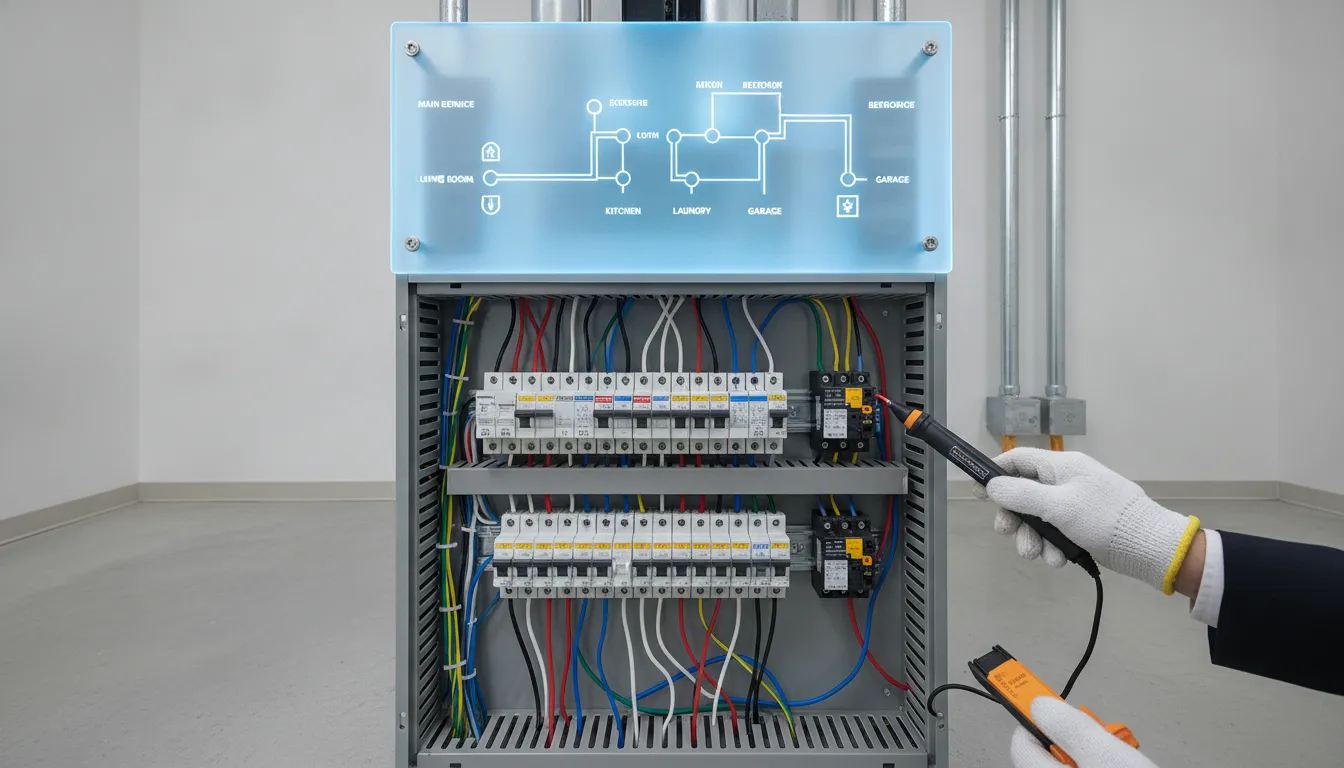
Trying to figure out which breaker serves a room or appliance? A breaker panel wiring diagram can offer helpful clues, but it serves a different purpose from the directory on your panel door. A diagram shows electrical connections; a directory lists circuit names or locations. Either one can be unclear or outdated, especially after renovations or electrical work. This article explains what diagrams commonly include and how to review them without opening the panel. It also covers why labels, breaker ratings, and load information matter. If your panel information doesn’t match what you see or you’re considering a new circuit, let a licensed electrician verify the equipment and installation.
Key Takeaways
- Use the diagram as a reference, not a guarantee: Confirm it matches the panel model, and treat circuit labels as clues that may need verification.
- Keep your review to exterior labels: Don’t remove the panel cover or touch wiring, even if the main breaker is off.
- Get professional help when details are unclear or warning signs appear: Contact a licensed electrician about repeated trips, planned upgrades, heat, buzzing, moisture, or visible damage.
What Is a Breaker Panel Wiring Diagram?
A breaker panel wiring diagram is a visual reference for understanding how a panel and its circuits are arranged. It can help an electrician assess a home’s electrical system, but it isn’t a set of instructions for making panel changes. The details shown depend on the panel and the home’s wiring.
How the panel distributes power and protects circuits
A breaker panel, also called an electrical panel or circuit box, receives electricity from the utility service and distributes it to branch circuits throughout your home. These circuits power specific areas and equipment, such as lighting, kitchen outlets, or an EV charger.
Circuit breakers are safety devices designed to interrupt power when a circuit draws more current than it should. This helps protect the circuit wiring from overheating. A wiring diagram may show the panel’s components, connections, and how power reaches different loads. The information should match the specific equipment and installation. You can learn more about how panels distribute electricity in this electrical terminology guide.
How a wiring diagram differs from a panel schedule or circuit directory
A wiring diagram shows electrical connections. It uses symbols and lines to represent components and how they connect, helping an electrician understand how a circuit is configured. The diagram may apply to a particular panel model or show the wiring in a specific installation. This guide to wiring diagram symbols explains how common visual conventions help readers follow a system.
A panel schedule or circuit directory has a simpler job: it identifies which breaker is assigned to each circuit or area. For example, a directory might label a breaker “hall lights” or “laundry outlets,” but it generally won’t show the wiring path or internal connections. Labels can become outdated after electrical work, so treat them as a reference rather than confirmation of what a circuit serves. An electrician can check the directory against the actual installation.
Why accurate labels, ratings, and load information matter
Clear circuit labels make it easier to identify the breaker associated with a room or appliance when you report an issue or schedule electrical work. Breaker ratings matter, too. A breaker must be appropriate for the connected wiring and equipment. If its rating is too high for the wire, the wire could overheat before the breaker trips. This overview of common panel-work mistakes explains why mismatched ratings can create serious hazards.
Load information helps an electrician assess whether the panel and its circuits can support the home’s electrical needs. Adding equipment, such as an EV charger, may call for a review of the panel and available capacity. If a diagram is missing, unclear, or doesn’t match your panel, ask a licensed electrician to check it. AAA Electrical Services provides panel services for Sacramento-area homeowners.
What Does a Breaker Panel Diagram Show?
A breaker panel diagram gives a visual overview of how electrical components and circuits are arranged. Depending on its purpose, it may show the incoming service conductors, main breaker, branch circuit breakers, bus bars, neutral and grounding connections, and protective devices. Labels and symbols help explain how these parts connect, while a legend defines the marks used in that specific drawing.
Diagrams vary by panel model and level of detail. One might show the location and rating of breakers, while another provides more technical information about conductor connections. A diagram can help you understand the panel’s intended layout, but it cannot confirm that the equipment in your home was installed correctly or that its circuit labels are accurate.
If the drawing is missing, difficult to read, or appears inconsistent with the panel, avoid guessing. A licensed electrician can compare it with the equipment and installation. Sacramento-area homeowners can learn about AAA Electrical Services’ panel repair and installation services if they have questions about a panel or are considering changes.
Service conductors, main breaker, and panel rating
Service conductors carry power from the utility service equipment to the electrical panel. A diagram may show where they enter and connect to the panel. When the panel has a main breaker, the drawing may identify its location and rating. Switching off the main breaker can disconnect power to branch circuits, but parts on the supply side may remain energized.
The panel rating describes the equipment’s designed capacity. It is not a measure of how much electricity your home is using at a particular moment. A guide to electrical terminology explains how a breaker panel distributes incoming power to branch circuits. If you cannot identify the panel rating or understand how it relates to the main breaker, ask an electrician rather than relying on appearance alone.
Circuit breakers, amperage ratings, and branch circuits
A branch circuit carries power from a breaker to the outlets, lights, or equipment it serves. A diagram may identify each breaker by its position, rating, or circuit name. The panel’s circuit directory may list the areas or appliances connected to each circuit, but labels can be incomplete or out of date.
A breaker’s rating must suit the wiring and the circuit’s design. Using an incorrectly rated breaker can leave wiring without the intended protection and create an overheating hazard. This guide to common panel-work mistakes explains why breaker and wire ratings need to be compatible. Don’t use a diagram to choose or replace a breaker yourself. Have a licensed electrician verify the circuit and equipment before making changes.
Bus bars and hot, neutral, and grounding conductors
Bus bars are conductive components that distribute power within the panel and connect with circuit breakers. A diagram may also show hot conductors, which carry power to a circuit, neutral conductors, which provide a return path during normal operation, and grounding conductors, which help provide a path for fault current. The layout depends on the panel and the type of drawing.
Electrical diagrams use symbols to represent components and connections, rather than showing every part as it looks in real life. This overview of electrical symbols can help explain that visual shorthand. Remember that a diagram shows an intended arrangement. It does not prove that the wiring in your home matches the drawing, so leave inspection of internal panel components to a qualified electrician.
Neutral and grounding bars, bonding points, and grounding connections
A diagram may show bars for neutral and grounding conductors, bonding points, and connections to the grounding system. Their arrangement depends on the panel’s role and location in the electrical system. Neutral and grounding conductors have different functions, so they should not be treated as interchangeable.
Labels, wire numbers, and connection symbols help readers trace where conductors go. This wiring diagram reference describes how clear labeling can make components and connections easier to follow. If the diagram’s bonding details are unclear, don’t infer the correct setup from a general drawing. An electrician can review the panel’s instructions and installation to determine whether its connections are appropriate.
AFCI and GFCI breakers and how they protect circuits
A diagram may identify breakers with arc-fault circuit interrupter (AFCI) or ground-fault circuit interrupter (GFCI) protection. AFCI protection is designed to detect certain electrical arcing conditions that can create a fire risk. GFCI protection responds to certain current imbalances to help reduce the risk of electric shock. Some breakers provide both types of protection.
Symbols and abbreviations can vary by manufacturer, so check the diagram’s legend instead of relying on a symbol’s appearance alone. This circuit breaker symbol guide describes how diagrams can represent different breaker functions. If you are unsure which circuits have AFCI or GFCI protection, ask an electrician to identify them. Don’t remove the panel cover to inspect the breakers or wiring.
Symbols, line styles, labels, and diagram legends
A panel diagram uses symbols, lines, and labels to show electrical components and their connections. Line styles may distinguish conductors from other connections, while a dot or other mark may indicate where lines connect. Conventions differ, so consult the legend for the specific diagram rather than assuming a symbol has the same meaning in every drawing.
Labels might identify breaker numbers, circuit names, wire connections, or equipment. They are useful only when they accurately describe the installation. This overview of electrical symbols explains how visual marks can make complex electrical information easier to follow. If a symbol or label is unclear, don’t guess what it means. An electrician can compare the drawing with the panel and confirm what each circuit serves.
Follow wire color conventions, but don’t identify conductors by color alone
Electrical diagrams may use color conventions to distinguish conductor types, but color alone is not a reliable way to identify a wire. Practices can vary with the system, equipment, and installation history. Wiring may also have been modified, and labels can be missing or inaccurate.
Use the diagram legend and written identification as references, not as permission to touch or test conductors. Numbering and labels can help trace connections, as this wiring diagram guide explains, but a qualified professional should verify what is actually installed. If a conductor’s color or marking does not match the diagram, or you cannot identify a connection, leave it alone and contact a licensed electrician.
How Do You Read a Breaker Panel Wiring Diagram?
A breaker panel wiring diagram is a reference for understanding how electrical components and circuits are intended to connect. It is not necessarily a picture of the equipment’s physical layout, and it may not reflect changes made since the panel was installed. Before drawing conclusions, check that the document matches the panel and read its legend.
Work through the drawing methodically: identify its symbols, trace one circuit at a time, and compare the information with the panel directory and equipment labels. A diagram can help you spot missing information or prepare questions for an electrician, but it cannot confirm that a circuit is wired correctly or has capacity for additional equipment.
Keep your review to documents and labels you can access safely from outside the panel. Do not remove the cover, touch wiring, or rely on a diagram to guide electrical work. Panels can contain energized parts even when the main breaker is off. If a diagram conflicts with what you see, or the panel has signs of damage, stop and have a licensed electrician check it.
Identify the diagram type, panel model, and legend
Start by confirming what document you have. A wiring diagram shows electrical connections, while a panel schedule or circuit directory lists circuits and their descriptions. Check the manufacturer, panel model, and document number, then compare them with the labels on the panel exterior. A diagram for a similar-looking model may show different components or connections.
Read the legend before following any lines. It explains the symbols, abbreviations, and line styles used in that particular drawing. Don’t assume symbols mean the same thing across every manufacturer or diagram. This guide to electrical panel diagrams explains why the legend is an essential starting point. If the documentation is missing, unclear, or for a different model, ask an electrician to find the right reference.
Trace each circuit from its breaker to the load
Follow one circuit at a time, starting with the breaker shown in the diagram and tracing the line toward its destination, or load. A load might be a lighting circuit, receptacle, appliance, or other equipment. Note the circuit number and any devices shown along the path, such as a GFCI or AFCI breaker.
A diagram may show electrical relationships without representing the physical positions of wires in the panel or walls. Use it to understand the intended circuit path, not to locate or handle conductors. Learning how diagram symbols represent electrical components can make the drawing easier to follow. If a circuit’s destination is unclear, don’t guess or remove the panel cover to investigate; have an electrician verify it.
Distinguish connected wires from lines that cross
Lines usually represent conductors, but a crossing does not always mean two wires connect. Depending on the diagram’s conventions, a dot may mark a junction, while lines that cross without a dot may remain separate. Check the legend to see how connections and crossings are shown in that specific document.
Crowded drawings can make these details hard to distinguish. Follow each line from end to end, checking labels along the way instead of assuming that nearby paths join. Misreading a crossing can make two separate circuits appear connected, or obscure a connection shown in the drawing. This overview of wiring-diagram conventions explains why symbols and line styles deserve a close look. If the drawing is blurry or ambiguous, don’t use it to make decisions about the panel’s wiring.
Recognize common split-phase and less common three-phase layouts
Many U.S. homes have split-phase service that supplies 120-volt and 240-volt circuits. A 120-volt circuit typically uses one hot conductor and a neutral; a 240-volt circuit typically uses both hot conductors. The exact arrangement depends on the equipment and circuit, so use the panel documentation rather than relying on a simplified drawing or general assumptions.
Three-phase service is less common in single-family homes, though it may be present in some larger residential buildings. Its configuration differs from split-phase service, so a familiar-looking diagram should not be taken as proof of the supply type. Breaker pole count alone is not enough to identify a service. Check the panel’s documentation and ask an electrician to explain any unfamiliar layout. Breaker symbols can also differ by standard, as shown in this guide to circuit breaker symbols.
Compare diagram details with circuit labels, then verify them against the installation
Compare circuit numbers and descriptions on the diagram with the panel directory. A label such as “kitchen” may cover several outlets or appliances, while a dedicated circuit may serve one specific load. Treat descriptions as useful clues, not confirmation of everything connected to a circuit. Directories can become outdated after renovations or electrical work.
Also check that the diagram matches the panel model and installed equipment. If the panel has been replaced, modified, or expanded, an older drawing may no longer describe its current configuration. Homeowners can compare documents and exterior labels, but an electrician should verify the wiring itself. A clear, consistent labeling system helps make circuits easier to identify and maintain; this guide explains how to label electrical diagrams.
Avoid common mistakes: outdated directories, unclear symbols, assumed wire colors, and incorrect load assumptions
An old circuit directory may identify a room or appliance that no longer matches the circuit. Symbols can vary between drawings, so check the legend instead of guessing. Wire colors can also be inconsistent or misrepresented in a diagram. Never identify a conductor by color alone, and don’t touch wiring to find out what it serves.
Avoid assuming that a breaker’s rating shows the load currently on the circuit, or that every outlet in a room shares one breaker. A diagram may omit later changes and usually does not provide enough information to determine whether a circuit can safely support added equipment. Misreading symbols or connections can lead to unsafe conclusions, as noted in this overview of common wiring-diagram errors. If labels conflict, symbols are unclear, or you suspect the panel has changed, ask a licensed electrician to check it.
How Can You Review a Panel Diagram Safely?
A breaker panel wiring diagram can help explain how a home’s electrical system is arranged, but it cannot show whether the panel is safe to touch or confirm that its wiring matches the diagram. Homeowners should limit their review to the panel’s exterior labels and circuit directory. Leave inspection, testing, and work inside the enclosure to a licensed electrician.
Start by checking that the documentation matches the panel’s manufacturer and model. Compare it with the directory on the panel door, but treat labels as clues, not proof that a circuit serves a particular room or appliance. If information is missing, unclear, or inconsistent, don’t remove the cover to investigate. Parts of a panel may remain energized even when the main breaker is switched off.
Keep the area around the panel dry and clear as you read the labels. If you notice heat, buzzing, corrosion, water, or visible damage, step away and call an electrician. Sacramento homeowners can contact AAA Electrical Services about panel repair and installation. These steps can help you review available information while keeping your family’s safety first.
Use the manufacturer’s documentation and diagram legend
Check that the diagram belongs to the panel’s specific manufacturer and model. A similar-looking panel may use different components or connections. You can read the exterior label without removing the cover, then use the documentation’s legend to understand its symbols, abbreviations, and line styles. Don’t assume that symbols mean the same thing in every manufacturer’s materials.
If the diagram is missing, damaged, or hard to interpret, don’t guess. Look for documentation on the manufacturer’s official website or ask an electrician to identify the correct information. Manufacturer instructions are an important reference, but they don’t confirm that the panel was installed correctly or that its current wiring matches the diagram.
Consult trusted electrical safety and code resources
Use reputable sources for general electrical safety information. The Electrical Safety Foundation International’s homeowner guidance can help you recognize common hazards. For questions about permits or local requirements, contact your local building department. Requirements can depend on the panel, the work being done, and the details of the home’s electrical system.
Avoid relying on diagrams or advice intended for a different panel. If you’re unsure whether a breaker, circuit, or planned change is appropriate, pause and contact a licensed electrician. General information can explain common terms, but it can’t replace an assessment of your specific equipment and installation.
Limit homeowner checks to the panel exterior and circuit directory
Read only information visible without opening the panel enclosure. You can check the circuit directory and exterior labels, and note whether a breaker appears to be in a tripped position. Don’t remove the cover, reach inside, or use tools to probe or test wiring. If you’re unsure what a label means, leave it for an electrician to verify.
Directories can be outdated or incomplete, so don’t treat them as confirmation of what a circuit controls. If a breaker trips repeatedly, avoid repeatedly resetting it. Note what happened and contact a licensed electrician to identify the cause.
Keep the area dry, well lit, and clear; never touch exposed wiring
When reading the directory, make sure the space around the panel is dry, well lit, and free of stored items. Good lighting can help you read labels without handling the enclosure. Keep children and pets away, and move liquids and cleaning products away from the area.
If you see exposed wiring, a missing cover, or visible damage, don’t touch it or try to cover it yourself. Move away and contact an electrician. A clear, dry space does not make it safe to work inside a panel. It only helps reduce avoidable hazards while you review information from outside the enclosure.
Don’t remove the panel cover or assume the main breaker makes every part safe
The panel cover shields you from electrical components that can cause severe shock or burns. Removing it may expose energized parts, including components that can remain live even when the main breaker is off. Don’t open the panel or rely on a diagram to decide that a wire or component is safe to touch.
A diagram shows how equipment is intended to be arranged, but it can’t confirm the panel’s current condition. If the cover is loose, missing, or damaged, keep clear and call a licensed electrician. Don’t try to secure or repair it yourself.
Stop and call an electrician if you find heat, buzzing, corrosion, water, damage, or unclear wiring
A hot panel surface, buzzing or crackling, rust, corrosion, water, scorch marks, or physical damage can signal an electrical hazard. Don’t touch the panel, remove its cover, or attempt a repair. Keep others away and contact a licensed electrician. If you see smoke or fire, leave the area and call emergency services.
Stop if the diagram and directory conflict or the wiring information is unclear. Don’t investigate by opening the enclosure. Tell the electrician what you noticed from a safe distance. When you contact AAA Electrical Services, describe the visible signs so the team can recommend an appropriate next step.
Ask a licensed electrician to verify diagrams, labels, and panel work against equipment instructions and local codes
A licensed electrician can check whether the diagram matches the panel, assess the installation, and verify whether the circuit directory is accurate. This can be especially helpful when labels are missing, breakers have been changed, or renovations may have affected the wiring. An electrician can also determine whether proposed work follows the equipment manufacturer’s instructions and applicable local requirements.
Don’t use a diagram alone to plan a panel change or add a circuit. The right approach depends on the equipment and the home’s electrical system. For panel concerns or planned work in the Sacramento area, review AAA Electrical Services’ panel repair and installation services and request professional guidance.
When should Sacramento homeowners call AAA Electrical Services about panel concerns or changes?
Contact AAA Electrical Services if the directory seems inaccurate, a breaker trips repeatedly, you’re planning an electrical upgrade, or you notice heat, buzzing, corrosion, moisture, or damage. Don’t open the panel or try to diagnose an internal problem yourself. Share what you can see from outside the enclosure and ask how to proceed safely.
AAA Electrical Services serves homeowners across the Sacramento metropolitan area with residential electrical services, including panel repair and installation. The company’s technicians are licensed, background-checked, and drug-tested. AAA Electrical Services also offers same-day service and clear upfront pricing, so you can discuss the concern and understand the next steps before work begins.
Related Articles
- How to Wire a Circuit Breaker
- Main Breaker Panel Replacement Made Easy
- Panel Repair
- Panel Install
- Breaker Panel Troubleshooting Rancho Cordova
Frequently Asked Questions
Can a breaker panel wiring diagram tell me which breaker controls a specific outlet?\ It may show how circuits are intended to connect, but it might not identify every outlet or reflect later changes. Check the panel directory for a clue, then ask an electrician to confirm if the label is unclear or outdated.
Is a wiring diagram the same as the circuit directory on my panel door?\ No. A wiring diagram shows electrical connections, while a circuit directory names breakers by area or equipment. Neither one confirms that the panel’s current wiring matches the information shown.
Can I use a panel diagram to replace a breaker or add a circuit?\ No. A diagram is a reference, not a guide for panel work. Breaker selection and new circuits require a review of the panel, wiring, equipment, and applicable requirements. Have a licensed electrician assess the work.
Is it safe to remove the panel cover if I switch off the main breaker first?\ No. Some parts inside the panel may still be energized when the main breaker is off. Read exterior labels only, and leave the cover in place.
When should I call an electrician about my panel or its diagram?\ Call if the diagram is missing or doesn’t match the panel, a breaker trips repeatedly, you’re planning an electrical upgrade, or you notice heat, buzzing, moisture, corrosion, or damage. Sacramento-area homeowners can contact AAA Electrical Services for panel repair and installation.