Before replacing an outlet or working on a light fixture, you need to know which breaker controls the circuit. A circuit breaker finder can help identify that connection without opening the panel or tracing wires through the walls. It sounds simple, but electrical systems do not always behave predictably. Shared neutrals, multiple panels, GFCI devices, older wiring, and incorrect labels can create confusing readings. That is why a finder should serve as a helpful starting point, not your only safety check. We’ll cover the tool’s main uses, common mistakes, important features, and the signs that mean it is time to call AAA Electrical Services.
Key Takeaways
- Treat a circuit breaker finder as an identification tool: It can match a powered outlet with a likely breaker, but it cannot diagnose wiring faults or confirm that a circuit is safe to touch.
- Verify the result before starting work: Calibrate the finder, scan the full panel, rescan the strongest signal, switch off the suspected breaker, and use a properly rated voltage tester.
- Contact a licensed electrician when results are unclear: Professional help is essential for damaged panels, repeated trips, conflicting readings, multiple circuits, or installations involving EV chargers, generators, solar, or new circuits.
What Is a Circuit Breaker Finder and How Does It Work?
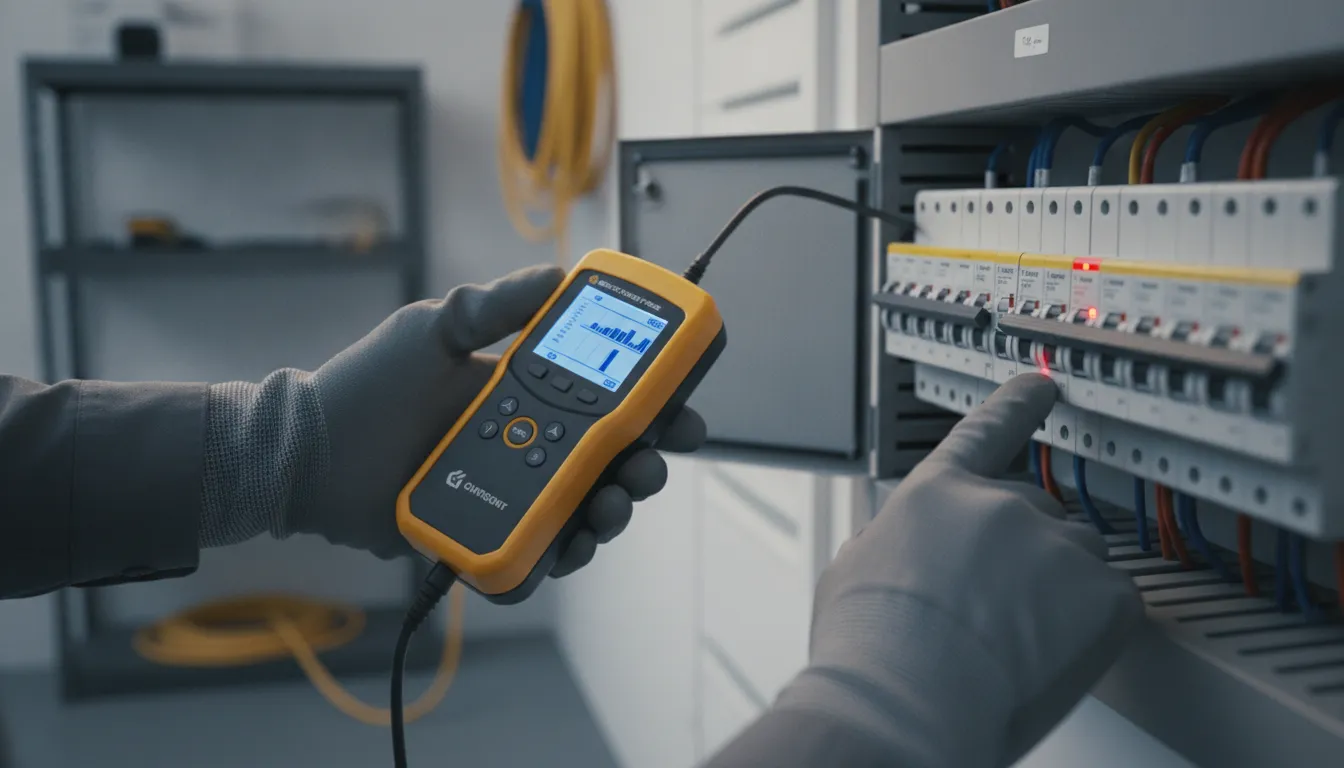
A circuit breaker finder is a handheld tool that helps identify which breaker controls a specific outlet, light, or wired circuit. Most models have two parts: a transmitter that sends a signal through an energized circuit and a receiver that scans the electrical panel for that signal.
This makes it easier to label an unlabeled panel or identify the breaker connected to an outlet before maintenance. According to Kaiweets’ explanation of circuit breaker finders, the receiver typically beeps or flashes when it detects the matching signal.
A breaker finder is useful, but it is not a complete electrical safety device. It can help you locate the likely breaker, but it cannot prove that every conductor is de-energized or that a circuit is safe to work on. Always verify the result with a properly rated voltage tester before beginning electrical work. If the panel or wiring is damaged, confusing, or outdated, contact AAA Electrical Services for professional assistance.
How the plug-in transmitter sends a circuit signal
The transmitter plugs into a powered receptacle and sends an identifying signal through the circuit wiring. The receiver then searches for that signal at the electrical panel. Some models include adapters for light sockets or other connections, but these applications may require additional care and electrical knowledge.
The circuit must have a live electrical path for the transmitter to work. As a result, a dead outlet, tripped GFCI receptacle, disconnected circuit, or wiring fault may prevent the finder from producing a useful signal.
Some transmitters also include a basic receptacle tester. It may indicate conditions such as reversed polarity or a missing ground, but those lights do not provide a complete evaluation of the circuit. Do not use an outlet that is loose, cracked, wet, warm, or discolored. Arrange an electrical inspection if anything looks unusual.
How the receiver matches tones, lights, and breakers
At the panel, move the receiver across the breakers according to the manufacturer’s instructions. When it detects the transmitter’s signal, the receiver may beep, flash, or show a stronger reading. The breaker with the clearest response is usually the one connected to the test outlet.
Scan the entire panel instead of stopping at the first sound or light. In a crowded panel, nearby breakers may produce weaker responses. After identifying the likely breaker, switch it off and return to the outlet. Then use a properly rated voltage tester to check whether power is still present.
A breaker finder can also help you create clearer panel labels. Accurate labels make future troubleshooting easier and give an electrician useful information during panel repair or installation. If the receiver produces several similar readings or the outlet remains energized, do not rely on the finder alone.
How calibration, sensitivity, and signal strength affect results
Many breaker finders require calibration before each use. During this step, the receiver scans the panel and establishes a baseline for normal electrical conditions. Follow the instructions for your specific model, since the calibration process and sensitivity controls vary.
Sensitivity affects how clearly the receiver separates the correct breaker from nearby ones. A setting that is too high may trigger responses from several breakers, while a setting that is too low may miss the signal. Metal panel covers, crowded wiring, electrical noise, and parallel signal paths can also affect the reading.
Scan slowly and hold the receiver at a consistent distance from each breaker. Rescan the panel if the results change or more than one breaker responds strongly. A circuit breaker finder review explains why calibration and adjacent signals can affect results.
Treat the strongest signal as a starting point, not final confirmation. Turn off the suspected breaker and test the outlet with a voltage tester.
How a circuit breaker finder compares with a circuit tracer, GFCI tester, and voltage tester
These tools have different jobs:
- Circuit breaker finder: Identifies the breaker associated with a signal from a live outlet or circuit.
- Circuit tracer: Provides more advanced tracing functions and may follow wiring through walls, ceilings, or conduit, depending on the model.
- GFCI tester: Checks certain receptacle wiring conditions and can trip a compatible GFCI device.
- Voltage tester: Indicates whether voltage is present. A non-contact tester offers a quick check, while a properly rated contact tester provides more direct confirmation.
As Pro Tool Reviews explains, basic breaker finders locate the breaker connected to a transmitter, while circuit tracers offer broader wire-tracing functions.
A breaker finder should not be your only safety check. Shared neutrals, multiple circuits in one box, and incorrect wiring can leave conductors energized even after you switch off the suspected breaker. Work involving a new circuit installation should be handled by a licensed electrician.
What a circuit breaker finder can and cannot confirm
A circuit breaker finder can help connect an outlet, fixture, or appliance to a breaker. It can also help you create a panel directory and identify which breaker to switch off before a basic inspection. You still need to verify the result with a voltage tester before touching wiring.
The tool cannot confirm that every conductor in an electrical box is de-energized. It may not work on a dead outlet, disconnected circuit, tripped GFCI device, or circuit with unusual wiring faults. It also cannot determine whether a breaker is correctly sized, whether the panel is overloaded, or whether the wiring meets current safety requirements.
If a breaker trips repeatedly, the panel shows corrosion or heat damage, or the finder gives inconsistent readings, stop testing. Do not repeatedly reset the breaker or remove the panel cover. AAA Electrical Services panel services can help with circuit identification, panel repairs, replacements, and other electrical concerns.
What Are Circuit Breaker Finder Uses and Limits?
A circuit breaker finder helps match an energized receptacle or fixture with the breaker that controls it. The tool usually includes a plug-in transmitter and a handheld receiver. Once the transmitter sends a signal through the circuit, the receiver helps identify the breaker with an audible tone, lights, or a display. This can make panel labeling, outlet identification, and basic circuit checks more organized.
Some models also include a GFCI tester, which can provide basic information about receptacle wiring and GFCI response. Even so, a circuit breaker finder is an identification tool, not a complete electrical diagnostic device. It may not detect every wiring fault, confirm that all conductors are de-energized, or explain why a breaker trips.
Signal strength can change when circuits share wiring, pass through multiple panels, or contain older components. Use the finder as one part of a careful process. Turn off the suspected breaker, test the outlet, and verify the absence of voltage with a properly rated voltage tester before starting electrical work. For uncertain or complex conditions, AAA Electrical Services can inspect and repair residential electrical systems throughout the Sacramento area.
Map and label an unlabeled breaker panel
An unlabeled panel can make routine electrical work slower and less predictable. A circuit breaker finder lets you connect a transmitter to a powered receptacle, identify the matching breaker, and record the result. Repeat the process for each accessible outlet, fixture, or appliance until you have a more complete circuit map.
Use specific labels, such as “Kitchen counter outlets” or “Upstairs hallway lights,” instead of vague descriptions like “back room.” Record the breaker number and the locations it serves. Fluke’s circuit breaker finder guide recommends keeping detailed circuit records and checking the tool on a known circuit to help confirm that it remains reliable.
Do not remove the panel cover or handle exposed wiring to trace a circuit unless you are qualified to do so. If labels remain unclear or the panel shows signs of damage, arrange a professional inspection.
Identify outlets, fixtures, and appliances
A finder can help determine which breaker supplies a three-prong receptacle, switched outlet, lamp outlet, or connected appliance. This is useful when several breakers appear to serve the same room or when an outlet is located far from the electrical panel. Identify one location at a time, then switch off the suspected breaker and confirm that the device loses power.
Some fixtures and appliances cannot accept a plug-in transmitter. Hardwired lighting, exhaust fans, built-in appliances, and switched fixtures may require another testing method. A receiver may also provide an unclear result when a switch is off or an appliance contains electronic controls.
If you need help with lighting installation and repair, a licensed electrician can trace the circuit, inspect the connections, and confirm that the installation meets basic safety requirements.
Verify circuits before repairs and remodeling
Before replacing an outlet, installing a light fixture, or beginning minor remodeling, use a finder to identify the likely controlling breaker. This gives you a starting point and may reveal that a room contains more than one circuit. It is especially helpful when panel labels are incomplete or previous owners have modified the electrical system.
The receiver’s tone, light, or display does not prove that a circuit is safe to touch. Turn off the suspected breaker, test the receptacle, and verify the absence of voltage with a properly rated tester. Check nearby outlets and other conductors that could remain energized.
If the work involves a new circuit, concealed wiring, panel changes, or a higher-powered appliance, contact a licensed electrician for new circuit installation. A finder cannot determine whether a circuit has enough capacity for a new load.
Check GFCI protection and basic receptacle wiring
Many circuit breaker finders include a transmitter that also works as a basic GFCI receptacle tester. It may indicate whether the hot, neutral, and ground appear to be connected in the expected arrangement. You can also press the test button to see whether a GFCI receptacle or an upstream GFCI device trips.
These results are useful, but limited. A tester may not identify every grounding problem, loose connection, bootleg ground, or defect elsewhere on the circuit. A receptacle can show an acceptable basic wiring pattern and still have a dangerous fault.
Never treat a GFCI test as proof that the entire circuit is safe or properly protected. If an outlet will not reset, feels warm, sparks, or shows an abnormal reading, arrange professional switch and outlet service.
Troubleshoot dead outlets and disconnected circuits
A circuit breaker finder can help determine whether a dead outlet belongs to a particular breaker, but it generally needs an energized circuit to transmit a signal. If the receptacle has no power, the transmitter may not work. Start by checking whether a breaker has tripped, whether an upstream GFCI receptacle needs resetting, and whether nearby outlets are also dead.
If the circuit is open, disconnected, or miswired, the finder may provide no useful result. It cannot reliably locate a broken conductor inside a wall or explain why power stops at one point. A dead outlet may also result from a loose connection, damaged device, failed GFCI, or problem at another receptacle.
Avoid repeatedly resetting a breaker that trips immediately. This pattern can indicate a short circuit, overload, damaged device, or another fault that requires inspection.
Account for shared neutrals, miswiring, overloads, and older homes
Circuit finders generally follow a signal through a circuit, not the complete condition of every wire. Shared neutrals, incorrect connections, and parallel paths can make one breaker appear to control more than expected. A signal can also reach nearby conductors and create an unclear reading, especially in crowded panels.
Older homes may have two-prong receptacles, unusual wiring methods, outdated panels, or outlets that do not match modern tester requirements. Do not force an adapter into place or assume an adapter creates a grounding path. An adapter changes the connection method, not the condition of the electrical system.
Overloads and damaged wiring may not affect the finder’s signal. If you notice frequent breaker trips, flickering lights, scorch marks, buzzing, or warm outlets, schedule a professional panel inspection or repair.
Manage multiple panels, electrical noise, and parallel signal paths
A home with a main panel, subpanel, detached garage panel, or generator equipment can produce confusing results. Before scanning, identify which panel may serve the receptacle and consider whether the circuit passes through another distribution point. A basic finder may locate the strongest signal without showing the complete path between the outlet and panel.
Electrical noise from chargers, dimmers, LED drivers, electronic equipment, and nearby energized wiring can also affect the receiver. Turn off unnecessary equipment and rescan if the result changes. Hold the receiver at a consistent distance and compare the signal at every breaker rather than stopping at the first beep.
For wires hidden in walls, conduits, or ceilings, use a suitable circuit tracer or have an electrician investigate. A basic finder is not designed to show a complete wire path or identify every parallel signal route.
Test breakers manually and document the panel
Manual breaker testing can support the finder’s result. With the transmitter connected to a working receptacle, scan the panel and identify the strongest response. Switch off the suspected breaker, then confirm that the receptacle loses power. Check nearby devices as well, since more than one outlet or fixture may share the circuit.
Record the breaker position, room or fixture, receptacle type, GFCI location, and any unusual behavior. If the panel contains tandem breakers, double-pole breakers, or unclear labels, document those details rather than guessing. Keep the panel directory readable and update it after renovations, panel work, or new appliance installations.
If the results conflict, stop testing instead of relying on the most convenient reading. AAA Electrical Services offers electrical inspections and can document circuit conditions without requiring you to work inside an energized panel.
Which Circuit Breaker Finder Features Matter Most?
The best circuit breaker finder is not necessarily the model with the longest feature list. Start with the basics: accurate readings, clear feedback, compatibility with your home’s electrical system, and a design that is easy to use safely. A straightforward tool may be enough for labeling several outlets, while a more advanced model can help identify GFCI protection, wiring alerts, and circuits that produce weaker or less consistent signals.
Accuracy matters because a finder only identifies the breaker that appears to match its transmitter. It does not prove that every outlet, fixture, or appliance on that circuit is de-energized. You still need a properly rated voltage tester before electrical work begins. A circuit finder also cannot diagnose every wiring problem, confirm that a panel is safe to open, or replace an electrical inspection.
Before purchasing, compare the tool’s voltage rating, supported receptacle types, calibration process, signal indicators, and included accessories. Read the manufacturer’s instructions and check independent testing, such as this circuit breaker finder guide from Bob Vila. If a panel has corrosion, heat damage, loose connections, repeated breaker trips, or unclear labeling, ask a professional to verify the circuit. AAA Electrical Services serves homeowners throughout the Sacramento metropolitan area with upfront pricing and licensed technicians.
Prioritize accuracy, sensitivity, and repeatable readings
Accuracy should be your first consideration. A finder needs to separate the transmitter’s signal from nearby circuits, especially when breakers sit close together or wiring runs through finished walls. Higher sensitivity can help with complicated electrical systems, but an overly sensitive tool may also react to signals from adjacent circuits.
Repeatable readings matter just as much as sensitivity. Scan the panel several times and look for the breaker that consistently produces the strongest indication. Hold the receiver at the same distance and move it across the panel in a consistent pattern. If the result changes from one scan to the next, the circuit may involve electrical noise, parallel wiring paths, a shared neutral, or a weak transmitter connection. Treat inconsistent readings as a reason to investigate further, not as confirmation.
Use automatic calibration and signal indicators
Calibration gives the receiver a baseline for the electrical panel before it searches for the transmitter’s signal. Automatic calibration can make the tool easier to use, particularly if you only identify circuits occasionally. Some models require an initial scan before each use, so check the instructions rather than assuming the receiver calibrates itself.
Signal indicators should make it easy to compare breakers. A rising tone, changing light pattern, signal-strength bars, or digital display can show which breaker produces the strongest response. Scan every breaker, then rescan the leading candidate to confirm the result. If the receiver loses its baseline or gives conflicting signals, return to the starting position and recalibrate. A tool that explains its readings clearly is more useful than one that simply flashes or beeps once.
Check for GFCI protection and wiring alerts
Some circuit breaker finders include a plug-in transmitter with basic receptacle testing. Depending on the model, it may indicate an open ground, reversed polarity, or missing neutral. A built-in GFCI test button can also show whether the receptacle’s protective device trips when tested.
These features provide useful information, but they do not identify every electrical hazard. A GFCI test does not confirm that the complete circuit is wired correctly, and a receptacle tester cannot detect all energized conductors or hidden wiring problems. Confirm the tool’s maximum voltage rating before connecting it. If a GFCI trips repeatedly, an outlet feels warm, or wiring alerts appear, stop using the receptacle and arrange professional testing.
Look for audible and visual feedback
Clear feedback makes a finder easier to use at a crowded panel. Audible tones allow you to focus on the breaker positions instead of watching the receiver constantly. Visual indicators, such as LEDs or a digital display, give you another way to compare signals and can help in noisy areas where tones are difficult to hear.
Volume control is useful if you are working near bedrooms, occupied rooms, or outdoor spaces. A mute option paired with a bright display can also improve usability. Look for a tool that shows gradual changes in signal strength rather than offering only one alert. A gradual response helps you compare nearby breakers, rescan the strongest candidate, and avoid mistaking a weak signal from an adjacent circuit for the correct match.
Confirm voltage compatibility and outlet support
For many residential receptacles, a finder rated for standard household voltage may be suitable. Confirm the rating before connecting the transmitter, though. Some models are designed for 120-volt circuits, while others support higher voltages for commercial or industrial applications. Using a tool outside its approved range can damage the equipment and create a safety hazard.
Also check which receptacle types the transmitter supports. Some kits include adapters for two-prong outlets, light sockets, or other connection points. If you need to identify a circuit serving a fixture or appliance, confirm that the tool includes an approved accessory for that purpose. Never force a plug into an incompatible receptacle or modify an adapter to make it fit.
Consider battery life, durability, ergonomics, and storage
A circuit breaker finder is useful only when both the receiver and transmitter have reliable power. Check the battery type, expected runtime, and low-battery indicator. Keep spare batteries available, especially when labeling a large panel. A weak battery can create a faint or inconsistent signal that looks like a wiring problem.
The receiver should also be comfortable to hold throughout a complete panel scan. Look for a grippy housing, accessible controls, and a lightweight design that is manageable at arm’s length. A durable case protects the tool from drops, dust, and accidental moisture. Store the receiver, transmitter, adapters, and instructions together so you can find the complete kit when you need to label a panel or check an outlet.
Review safety ratings, warranty coverage, and accessories
Read the manufacturer’s safety information, intended use, and electrical ratings before purchasing. A reputable product should clearly explain which circuits it can test and where it should not be used. Look for a warranty that covers defects in the receiver, transmitter, display, buttons, and housing during normal use.
Accessories can make a basic finder more practical. Useful additions may include adapters for two-prong outlets and light sockets, a storage case, spare batteries, and clear instructions. Some tools include a receptacle tester, while others require you to purchase one separately. Do not choose a kit based on accessories alone if its core readings are inconsistent.
For panel labeling, circuit changes, or new installations, professional verification is the safer choice. An electrician can document the system and recommend panel repair or installation when the existing equipment is damaged, outdated, or no longer suited to the home’s electrical needs.
How Do You Use a Circuit Breaker Finder Safely?
A circuit breaker finder can help match a receptacle to the breaker that supplies it. However, it is an identification tool, not proof that a circuit is safe to touch. It cannot confirm that every conductor in an electrical box is de-energized, and it may produce confusing results when wiring is shared, mislabeled, damaged, or incorrectly installed.
Use the finder only with an intact, energized receptacle and follow the manufacturer’s instructions throughout the process. Once you identify the likely breaker, switch it off and verify the circuit with a properly rated voltage tester before removing a cover or handling wiring. Never rely on a beep, flashing light, breaker label, or GFCI trip as your only safety check.
If you find damaged wiring, scorching, moisture, exposed conductors, or unusual panel conditions, stop working and arrange professional residential electrical service. AAA Electrical Services serves homeowners throughout the Sacramento metropolitan area with circuit, panel, outlet, and electrical inspection services.
Read the instructions and inspect the tool
Read the manufacturer’s instructions before connecting the transmitter or receiver. Circuit breaker finders vary in how they calibrate, display signal strength, and identify the likely breaker. Understanding the tool’s lights, tones, buttons, and warning indicators can help you recognize an error instead of treating it as a result.
Inspect the receiver, transmitter, plug, battery compartment, and housing. Do not use the finder if you see cracks, loose parts, corrosion, exposed wiring, or other damage. Confirm that the batteries are installed correctly and have sufficient charge. If the tool has been dropped, stored in damp conditions, or used for a previous electrical project, inspect it carefully before relying on its readings.
Confirm the receptacle has power and correct wiring
Choose a receptacle that is secure, dry, and free from visible damage. Do not use an outlet that is loose, cracked, scorched, wet, warm, or surrounded by signs of arcing. A circuit breaker finder typically needs an energized receptacle to send a signal to the receiver.
If the finder includes a receptacle wiring tester, review its indicators before continuing. An outlet may be switched, controlled by a GFCI device, disconnected, or wired incorrectly, which can affect the reading. Never remove the receptacle cover to investigate while power is on. If you notice outlet damage or wiring concerns, contact a professional for electrical service instead.
Test the finder on a known working circuit
Before tracing an unfamiliar outlet, test the finder on a receptacle you know is working. Choose a dry, accessible outlet that powers a lamp or another suitable device. This check confirms that the transmitter, receiver, and batteries are operating before you begin testing the circuit you want to identify.
Pay attention to how the tool responds on the known circuit. A clear, repeatable signal gives you a useful reference for the next scan. If the response is weak or inconsistent, replace the batteries and review the instructions. Do not assume the unfamiliar outlet or breaker is faulty until you have confirmed that the finder itself works properly.
Plug in the transmitter and calibrate at the panel
Plug the transmitter into the receptacle you want to trace, making sure it fits securely. Then take the receiver to the electrical panel and follow the manufacturer’s calibration procedure. Some models calibrate automatically, while others require you to press a button or hold the receiver in a specific position.
Keep the receiver at the recommended distance and angle during calibration. Avoid pressing it against the panel or moving it quickly. Nearby energized circuits can create background signals, so calibration gives the receiver a reference point for the transmitter’s signal. If the finder displays an error or will not calibrate, stop and check the setup. Do not continue by guessing which breaker is correct.
Scan every breaker and rescan the strongest signal
Scan every breaker in a consistent pattern rather than stopping at the first one that produces a tone or flashing light. Electrical signals can travel through adjacent wiring, shared pathways, or connected equipment, so more than one breaker may respond.
After the first pass, identify the breaker that produces the strongest and most consistent signal. Rescan that area to confirm the result. A correct match should remain relatively consistent when you repeat the process. If two breakers appear equally strong, calibrate the receiver again and scan the full panel once more. For complicated panels or uncertain results, professional panel services can provide a safer verification.
Turn off the suspected breaker and test the outlet
Switch off the breaker that appears to control the transmitter. Return to the receptacle and check whether the transmitter or outlet tester indicates that power has stopped. You can also confirm whether nearby lights, appliances, or receptacles supplied by the same circuit have turned off.
If the receptacle remains energized, the finder may have identified the wrong breaker, or the outlet may be connected to another circuit. A single room can contain receptacles supplied by different breakers, and panel labels are not always accurate. Check nearby outlets without removing covers, and keep the suspected breaker off while you complete the next verification step. Do not begin electrical work based on the finder’s result alone.
Verify the circuit is dead with a properly rated voltage tester
A circuit breaker finder cannot prove that a circuit is de-energized. Before removing a cover, loosening a terminal, or handling wiring, use a properly rated voltage tester to verify the absence of voltage. Follow the tester manufacturer’s instructions and confirm that the tester works on a known energized source before checking the circuit.
After testing the circuit, check the known energized source again. This confirms that the tester continued working during the process. Test all relevant conductors in the area, because a box may contain more than one energized circuit. If you do not know how to perform this check safely, arrange a professional electrical inspection before continuing.
Use dry hands, suitable PPE, and proper lighting
Work with dry hands and stand on a dry, stable surface. Wear safety glasses when working near an electrical panel, and use insulated tools that are suitable for the task. Remove jewelry and avoid loose clothing that could catch on equipment or come into contact with electrical components.
Use enough lighting to clearly see the breaker panel, receptacle, tester, and surrounding area. This is especially important in garages, utility rooms, attics, and crawl spaces. Keep children, pets, water, and clutter away from the work area. If you cannot see the equipment clearly or maintain a stable position, stop and improve the conditions before continuing.
Avoid exposed conductors, moisture, damaged tools, and open panel covers
A circuit breaker finder generally works from the outside of a closed panel. Do not remove the panel cover to improve the receiver’s signal. Opening the cover can expose energized components, even when individual breakers are switched off. Panel interiors should be handled by a qualified professional unless you have the training and equipment to work safely.
Keep the receiver and transmitter away from moisture, wet floors, sinks, and damp hands. Never use a tool with a damaged cord, cracked housing, loose plug, or missing protective part. Stop immediately if you see scorching, melted insulation, exposed conductors, corrosion, buzzing, or a burning smell. These conditions may require professional panel repair.
Stop when readings conflict or conditions seem unsafe
Conflicting readings are a reason to pause, not guess. Stop if the receiver identifies multiple breakers, the signal changes unexpectedly, the receptacle remains powered after the suspected breaker is off, or the transmitter indicates incorrect wiring. Shared neutrals, miswiring, parallel signal paths, multiple panels, and faulty equipment can all create confusing results.
Also stop if you notice sparks, smoke, heat, water, damaged insulation, or signs of an overloaded circuit. Do not remove covers or touch conductors to find an explanation. A licensed electrician can trace the circuit, inspect the panel, and determine whether repairs are needed. Sacramento-area homeowners can contact AAA Electrical Services for same-day service, upfront pricing, and professional help with residential electrical concerns.
Which Circuit Breaker Finder Mistakes Should You Avoid?
A circuit breaker finder can help you identify the breaker connected to a receptacle, but it is not a complete safety check. The tool detects a signal from a transmitter plugged into an outlet, then helps match that signal to a breaker in the panel. Wiring problems, electrical noise, shared circuits, and scanning technique can all affect the result.
Before using a finder, read the manufacturer’s instructions and confirm that the tool is rated for your electrical system. Many residential models are designed for standard 120-volt receptacles, but they are not suitable for every electrical task. A circuit finder can help identify a circuit, while a properly rated voltage tester helps confirm whether voltage is present or absent.
Use the precautions below when mapping circuits or preparing for minor electrical work. If the panel is damaged, wiring is exposed, or the readings conflict, stop and schedule professional electrical service. A circuit finder can provide helpful information, but safe electrical work requires the right testing method and a clear understanding of the circuit.
Calibrate and scan more than once
Skipping calibration is an easy way to get an unreliable reading. Many circuit breaker finders require an initial scan of the panel before each use. During calibration, the receiver learns the panel’s signal pattern and establishes a baseline for the scan.
After calibrating, scan the breakers again in a consistent order. A second pass helps you identify the strongest response and reduces the chance of mistaking a brief signal for the correct breaker. Follow the tool’s instructions instead of relying on a quick sweep.
Recalibrate if you change the receiver’s sensitivity, move your position, or work near a crowded panel. As HighTechDad’s circuit breaker finder review explains, calibration adds a step, but it can make readings more repeatable.
Test only working, secure, correctly wired receptacles
A circuit finder needs a powered receptacle to send a detectable signal through the circuit. Do not begin with an outlet that is loose, damaged, scorched, or dead. Reversed wiring, an open neutral, or another fault may produce an unclear or misleading result.
Start with the finder’s wiring check, if it includes one. You can also use a properly rated receptacle tester for basic wiring indications. Confirm that the outlet is securely mounted and that the transmitter fits firmly without excessive movement.
Check the finder’s voltage rating before use. Bob Vila’s circuit breaker finder guidance notes that a model rated for up to 120 volts is suitable for many standard home receptacles. Never connect a plug-in finder to a circuit that exceeds its rating.
Hold the receiver close enough to the panel
Holding the receiver too far from the panel can weaken the signal and make several breakers appear similar. Begin near the panel, then follow the manufacturer’s instructions for the recommended distance. Keep your hand position and scanning speed consistent as you move across the breakers.
If the receiver does not identify a clear signal, adjust its distance gradually instead of moving it randomly. You may also need to change the sensitivity setting, if the tool includes one. Metal enclosures, crowded panels, and nearby wiring can affect how the signal reaches the receiver.
Closer is not always better. Holding the receiver directly against the panel may cause several indicators to activate at once. Pro Tool Reviews’ testing guidance recommends adjusting the receiver’s position, distance, or sensitivity when readings are unclear.
Use the correct receiver angle and scanning method
The receiver’s angle can affect its response, especially when breakers are installed close together. Hold the device as directed and keep it facing the panel in the same direction throughout the scan. Avoid tilting it toward one breaker and changing the angle for the next.
Scan the breakers in the same order at a steady pace. Do not hover over one breaker while quickly passing over the others. A consistent method makes it easier to compare readings across the panel and identify the strongest response.
Some finders learn the panel during the first scan, so changing your scanning pattern can reduce accuracy. The Klein Tools ET310 demonstration shows why a consistent scanning order matters. If your tool displays signal strength, compare the entire panel before selecting a breaker.
Account for electrical noise and inconsistent signals
Equipment connected to nearby circuits can interfere with a finder’s readings. Battery backups, home theater systems, dimmers, LED drivers, computers, and other electronic devices may create electrical noise. Parallel wiring can also allow the transmitter’s signal to appear on more than one breaker.
When readings seem inconsistent, unplug nonessential electronics near the test area and repeat the scan. Do not disconnect equipment if doing so could create a safety or operational problem. Instead, note the possible source of interference and treat the result cautiously.
A weak or changing signal may point to a wiring issue rather than a problem with the finder. Pro Tool Reviews identifies battery backups, home theater equipment, and other radio-frequency devices as possible sources of interference. If the signal remains unclear, arrange an electrical inspection.
Treat every beep or flashing light as a clue, not confirmation
A beep, flashing light, or strong signal means the receiver has detected something. It does not prove that the selected breaker controls every outlet, fixture, or appliance in the area. The signal may travel through shared wiring, nearby circuits, or an unexpected connection.
After identifying a suspected breaker, switch it off and test the original receptacle. Confirm that it is no longer energized, then check nearby outlets and connected equipment. If one remains powered, it may be on another circuit or supplied by another panel.
A circuit finder narrows the search, but it does not replace a voltage test or complete circuit check. When preparing for repairs, follow AAA Electrical Services’ residential electrical service options instead of relying on one indicator.
Check nearby outlets, shared circuits, and additional panels
Do not assume that every outlet in one room is controlled by the same breaker. Receptacles may be divided across multiple circuits, particularly in kitchens, garages, additions, and remodeled spaces. One outlet may also be supplied from a different panel or subpanel.
After switching off the suspected breaker, test the original receptacle and nearby outlets. Check connected lights, fans, appliances, and exterior receptacles as well. If any device remains powered, continue investigating before starting work.
Older homes and modified wiring can make circuit layouts difficult to predict. A finder may identify one path while another remains energized. If your home has multiple panels, have a qualified electrician identify and label them. Clear panel labeling makes future service safer and more efficient.
Remember that a GFCI trip does not prove the circuit is safe
Pressing a GFCI tester’s button checks whether the device responds to a simulated fault. It does not confirm that every downstream conductor is de-energized, and it does not prove that the entire circuit is wired correctly. A GFCI may trip while another part of the circuit remains powered.
Use the test and reset buttons as functional checks, not as your only safety step. After turning off a suspected breaker, test the receptacle with a properly rated voltage tester. Check the relevant conductors and ground as appropriate for the equipment and task.
A failed GFCI test, a reset button that will not stay engaged, or repeated tripping needs attention. AAA Electrical Services’ panel services can help with breaker, panel, and related electrical concerns when a basic test points to a larger issue.
Use more than a circuit finder or non-contact detector
A circuit breaker finder helps match a powered receptacle with a breaker. A non-contact voltage detector can indicate the presence of voltage without touching a conductor. Neither tool alone provides complete confirmation that a circuit is safe to work on.
Use the tester suited to the task, and verify that it works before and after checking the circuit. Many electricians follow a “test before, test after” process: test the instrument on a known energized source, test the circuit, then test the instrument again on the known source.
Different tools answer different questions. A receptacle tester can identify basic wiring conditions, a GFCI tester checks protective device response, and a two-pole voltage tester can help confirm voltage status. If you are unsure which test applies, stop and call a qualified electrician.
Prove the circuit is de-energized before electrical work
Never begin electrical work because a finder stopped beeping or a non-contact detector stayed silent. Turn off the suspected breaker, secure the work area, and verify the circuit with a properly rated voltage tester. Test all relevant conductors, including those that may be supplied by another circuit.
Stay alert for shared neutrals, backfeed, multiple panels, generator connections, solar equipment, and other sources that can leave wiring energized. Do not remove a panel cover or touch exposed conductors unless you have the training and equipment to do so safely.
If you cannot prove the circuit is de-energized, do not continue. AAA Electrical Services provides same-day electrical service in the Sacramento area, with licensed, background-checked, and drug-tested technicians who can verify circuits and address unsafe wiring.
Which Circuit Breaker Finder Should You Choose?
The best circuit breaker finder depends on the type of work you plan to do and how often you will use it. A basic plug-in model may be enough to label receptacles in a newer home. If you are tracing confusing wiring, working around multiple panels, or troubleshooting circuits regularly, look for stronger signal detection, sensitivity controls, and more detailed feedback.
A circuit breaker finder can help match a powered receptacle with its breaker, but it cannot replace a properly rated voltage tester or a licensed electrician. Before buying, compare accuracy, voltage range, receptacle compatibility, GFCI testing features, warranty coverage, and performance in older or modified electrical systems. Reviews such as Pro Tool Reviews’ circuit breaker finder guide can help you compare models, but always confirm current specifications with the manufacturer.
Choose AAA Electrical Services for professional circuit verification in Sacramento
If a breaker finder produces inconsistent results, professional circuit verification may be the safer choice. A licensed electrician can trace the circuit, inspect the panel, check for wiring problems, and confirm that the breaker disconnects the intended outlet or fixture.
Professional help is especially valuable when the panel has missing labels, multiple circuits share a neutral, outlets were rewired, or remodeling changed the circuit paths. A handheld finder may detect the strongest signal without revealing problems inside the walls or panel.
AAA Electrical Services serves homeowners throughout the Sacramento metropolitan area with residential electrical services, including outlet repairs, panel work, inspections, and new circuit installation. Its technicians are licensed, background-checked, and drug-tested. With upfront pricing, same-day service, and a 100% satisfaction guarantee, AAA Electrical Services can verify a circuit before you begin electrical work.
Compare the Klein Tools ET310 and ET450
The Klein Tools ET310 is a practical choice for identifying which breaker controls a powered receptacle. It includes a plug-in transmitter and a receiver with a clear display, making it approachable for homeowners who need to label circuits or locate a breaker during a small project. Its built-in non-contact voltage tester provides an additional indication that voltage is present.
The ET450 offers more advanced signal detection and improved accuracy for complicated wiring setups. Those features may help in homes with dense panels, nearby circuits, or signal interference. However, additional features do not remove the need to verify the result at both the receptacle and breaker.
Choose the ET310 for occasional circuit mapping, and consider the ET450 if you troubleshoot circuits more often. Before purchasing, review the manufacturer’s current Klein Tools circuit breaker finder information to confirm specifications, accessories, and availability.
Review the IDEAL 61-534
The IDEAL 61-534 may be a good fit if you need more than a simple breaker-to-outlet match. It is designed to trace live wires behind drywall and uses automatic sensitivity adjustments to help detect signals in more challenging conditions. This can be useful when you need to follow a circuit beyond one receptacle.
The model provides more capability than many entry-level finders without the cost or complexity of a full professional tracer. It may suit experienced homeowners, remodelers, and electricians who occasionally need wire-tracing functions.
Tracing live wiring behind a wall can still produce confusing results when circuits run close together or branch into parallel paths. Follow the manufacturer’s instructions carefully, then confirm the circuit with a properly rated tester before touching any wiring. Pro Tool Reviews’ circuit finder guide offers additional information about the IDEAL 61-534 and comparable models.
Consider the Sperry Instruments CS61200
The Sperry Instruments CS61200 combines a circuit breaker finder with a receptacle tester and GFCI tester. This combination can help homeowners identify circuits while checking for basic outlet wiring conditions. Its LEDs and audible tones indicate signal strength, giving you more information than a receiver that only beeps at the strongest reading.
Depending on the model and test conditions, the receptacle tester may identify issues such as an open ground, reversed wiring, or an open neutral. Its GFCI test function can also show whether a compatible GFCI receptacle responds when tested. These features are useful, but they do not provide a complete electrical inspection.
Use the CS61200 only with compatible, accessible receptacles, and do not assume a normal result means the entire circuit is safe. Review the tool’s intended uses and limits in Pro Tool Reviews’ circuit finder guide before relying on it for circuit mapping.
Evaluate the Amprobe BT-120
The Amprobe BT-120 is an affordable option for basic residential circuit identification. It helps users match a powered outlet with the breaker that controls it, which can be useful when labeling an unfamiliar panel or locating the correct breaker before a minor project.
Its simple design is helpful if you do not need wire tracing, advanced sensitivity controls, or detailed diagnostic functions. Entry-level finders work best with accessible, correctly wired receptacles and electrical panels with clearly separated circuits.
The tradeoff is that basic models may provide less information when signals overlap or wiring has been changed. If the receiver identifies multiple strong signals, gives inconsistent readings, or fails to locate the expected breaker, stop instead of guessing. Compare the BT-120 with similar models using current Amprobe product information, including voltage limits, accessories, and availability.
Choose a homeowner tool for occasional circuit identification
For occasional circuit identification, a simple model such as the Klein ET300 or a UNI-T AC circuit breaker finder may provide the features you need. These tools can help map receptacles, label a panel, and identify the breaker connected to a powered outlet without adding unnecessary complexity.
Before buying, make sure the transmitter fits the receptacles in your home and that the receiver supports your electrical system. A basic tool works best when the outlet is wired correctly and the panel has a clear, accessible layout. Performance may be less consistent in older homes, remodeled spaces, or properties with multiple panels.
Use the finder as part of a repeatable process. Test it on a known working outlet, scan the panel more than once, turn off the suspected breaker, and test the receptacle again. Bob Vila’s circuit-breaker finder guide provides additional buying considerations for homeowners.
Choose a professional tool for frequent testing and troubleshooting
Professionals and experienced users who trace circuits often may benefit from an advanced tool, such as the Greenlee CS-8000 or IDEAL SureTrace 61-957. These instruments are designed for more demanding troubleshooting and may offer live-wire tracing, signal control, greater range, and features that help identify whether a circuit is energized or de-energized.
A professional tracer can save time when wiring is concealed, several panels are involved, or a basic finder detects multiple possible breakers. It may also provide more useful feedback when a circuit does not produce a clean signal.
These tools cost more and require time to learn. They should not be treated as automatic proof that wiring is safe to handle. Read the instructions, use the correct accessories, and confirm de-energization with a properly rated voltage tester. If you regularly work inside panels or modify circuits, training and electrical code knowledge are just as important as the equipment.
Check current specifications, compatibility, and availability
Product names and model numbers do not tell you everything you need to know. Before purchasing, check the finder’s voltage range, supported receptacle types, transmitter design, receiver range, battery requirements, and safety ratings. Confirm whether it is intended for standard residential circuits, GFCI-protected outlets, or more specialized applications.
Review what comes in the package, too. Some tools include only the transmitter and receiver, while others offer adapters, carrying cases, replacement leads, or additional testers. Make sure the transmitter connects securely to the receptacles you plan to test, and confirm that replacement parts are available.
Read current manufacturer specifications instead of relying only on an older review. Bob Vila’s buying guide recommends checking compatibility, maximum voltage, and required adapters before choosing a model. If your home has damaged receptacles, unusual wiring, an overloaded panel, or conflicting readings, professional circuit verification is safer than simply choosing a more expensive finder.
How Do Circuit Breaker Finder Performance and Price Compare?
Circuit breaker finders can look similar on a store shelf, but their performance and price can vary widely. An entry-level model may identify the breaker connected to a standard, energized outlet. An advanced model may add automatic calibration, wiring alerts, GFCI testing, signal-strength indicators, and improved performance around crowded panels. Professional-grade tools are usually built for frequent use and may offer greater durability, broader voltage compatibility, and more consistent readings.
The best choice depends on your electrical system and the work you plan to do. A basic finder may be enough for labeling outlets during a home organization project. It may be less dependable when a panel contains shared neutrals, older wiring, multiple circuits, or electrical noise. Bob Vila’s circuit breaker finder guide recommends considering your home’s electrical system, the tool’s features, and the type of project before buying.
Price should not be your only consideration. A low-cost finder can be useful for occasional circuit identification, but an inaccurate result can lead to repeated testing or an incorrect panel label. If you are working with a damaged panel, suspected wiring problem, or circuit that will not stay on, professional testing may be the safer and more efficient option.
Compare entry-level, advanced, and professional-grade tools
Entry-level circuit breaker finders typically include a plug-in transmitter and a handheld receiver. They are affordable and simple to operate, making them suitable for identifying the breaker connected to a standard, energized receptacle. If you only need to label a few outlets, a basic tool may provide enough functionality.
Advanced models may include automatic calibration, adjustable sensitivity, visual signal indicators, and a transmitter with a GFCI test button. These features can make the scanning process easier and may improve results when breakers are positioned close together.
Professional-grade tools are designed for repeated use. They may offer stronger housings, broader voltage compatibility, improved signal processing, and more consistent performance in complicated electrical systems. Before buying, compare the tool’s supported voltage, receptacle type, signal range, and panel compatibility. A higher price does not guarantee better results if the tool is not suited to your electrical system.
Evaluate accuracy, signal range, and repeatability
Accuracy matters because the strongest signal is not always proof that you have found the correct breaker. A finder can detect energy from a nearby circuit when wiring runs close together or when a panel contains parallel signal paths. Readings may also change based on the receiver’s position, distance from the panel, and electrical activity in the home.
Look for a model that produces similar results when you scan the same panel more than once. Automatic calibration can help the receiver adjust to background signals, while sensitivity controls may help separate nearby breakers. Scan the entire panel, then rescan the likely match before switching anything off.
A circuit breaker finder is an identification aid, not a safety guarantee. Before electrical work begins, verify that power is absent with a properly rated voltage tester. If readings conflict or the circuit remains unclear, AAA Electrical Services can inspect the system and verify circuits safely.
Compare GFCI testing, wiring alerts, and ease of use
Some transmitters include a GFCI test button. Pressing it creates a test condition that should cause a functioning GFCI receptacle or breaker to trip. This feature can help you check basic GFCI response, but it does not replace a complete inspection of the circuit or electrical panel.
Wiring alerts may identify conditions such as an open ground, reversed conductors, or other receptacle concerns. Treat these alerts as useful clues rather than a complete diagnosis. A receptacle can produce a normal indication even when another issue exists elsewhere on the circuit.
Ease of use also affects the quality of your results. A clear display, distinct tones, comfortable grip, and accessible controls make it easier to follow the same scanning method each time. Choose a finder that you can operate without rushing, especially when working near a dim panel or in a cramped utility area.
Measure setup time and circuit-mapping efficiency
A quick setup can save time when you are checking several rooms. First, confirm that the receptacle has power. Then connect the transmitter and scan the breaker panel. Some finders calibrate automatically, while others require an initial scan before each use. That step may take only a few seconds, but it helps the receiver separate the active signal from background noise.
For efficient circuit mapping, label each breaker as you confirm it and test more than one outlet on the same circuit. Record unusual results instead of guessing. If one breaker appears to control several unrelated areas, mark the panel for further inspection rather than assuming the layout is correct.
Fluke recommends testing a finder on a known circuit to help confirm that it remains accurate and reliable. This check is especially helpful after long storage or when the finder produces inconsistent readings.
Account for price, batteries, accessories, and warranty
The purchase price is only one part of the cost. Check whether the finder includes batteries, a transmitter, replacement fuses, a carrying case, or other accessories. If the transmitter is sold separately, replacing it later may cost more than expected. Also confirm the required battery type and how easy replacements are to find.
Warranty coverage matters more when you plan to use the tool frequently. Review what the warranty covers, how long it lasts, and whether the manufacturer provides technical support. A clear return policy can help if the finder does not perform well with your panel.
Consider the value of your time, too. An inexpensive tool that produces uncertain readings may lead to repeated scans or incorrect labels. If you are already dealing with a panel repair, new circuit, or recurring breaker problem, professional service may be more practical than buying multiple tools. AAA Electrical Services also offers financing options for eligible electrical services.
Assess user reviews and manufacturer claims
User reviews can reveal details that product descriptions often leave out. Look for comments about performance on older panels, GFCI circuits, crowded breaker boxes, and outlets at the end of long wiring runs. Reviews are most useful when they explain the panel type, test conditions, and whether results stayed consistent.
Manufacturer claims still deserve attention, but read them carefully. A stated voltage range does not guarantee reliable performance under every wiring condition. Similarly, automatic calibration cannot eliminate every false signal when circuits overlap or the transmitter is connected to a faulty receptacle.
Pay attention to repeated comments about calibration, receiver distance, battery life, and inconsistent readings. A review that describes both successful and unsuccessful tests is usually more useful than a short statement that the tool was easy to use. The KAIWEETS finder review from HighTechDad notes that calibration adds a brief step but can support more accurate readings.
Compare pros, cons, and total ownership costs
A low-cost finder can be a sensible choice when you need to identify a few working outlets. Its advantages include a simple design, low purchase price, and minimal setup. Its limitations may include a shorter signal range, fewer wiring alerts, less durable construction, and inconsistent performance around crowded or unusual panels.
An advanced finder costs more, but it may save time through clearer signal indicators, GFCI testing, and automatic calibration. A professional model may offer more durable construction and dependable readings during frequent service work. Those features may not be necessary for a one-time home project, however.
Include the full ownership cost in your comparison. Count the tool, batteries, replacement transmitters, protective storage, shipping, and time spent repeating uncertain tests. Also consider the cost of an incorrect breaker label or unsafe assumption. A finder can assist with circuit identification, but it cannot replace a qualified electrician when the panel, wiring, or circuit condition is unclear.
Match performance to the panel and project
Choose a finder based on the panel and task, not just the brand or price. An entry-level model may handle basic circuit labeling in a newer home with clearly wired, energized receptacles. A home with older wiring, multiple panels, frequent nuisance trips, or suspected miswiring may call for stronger calibration, better signal separation, and wiring alerts.
Voltage compatibility matters as well. Some finders are intended for residential circuits, while others support a wider range for commercial or industrial applications. As Bob Vila explains, identifying circuits in higher-voltage settings may require a tool designed for that maximum voltage. Never assume that a residential finder is suitable for another electrical system.
For Sacramento-area homeowners, professional verification may be the better option when the project involves a panel replacement, new circuit, EV charger, generator, or solar equipment. AAA Electrical Services serves Sacramento-area homes with upfront pricing and trained technicians who can assess the panel and recommend the safest next step.
Where Can You Buy a Circuit Breaker Finder?
You can buy a circuit breaker finder from tool manufacturers, authorized online retailers, hardware stores, home improvement stores, and electrical supply companies. The right option depends on how often you plan to use the tool, which features you need, and whether you want help selecting a model.
Before buying, confirm that the finder works with your outlets and electrical system. Many basic models are designed for standard three-prong receptacles, while more advanced kits may include GFCI testing, outlet adapters, replacement transmitters, or a voltage tester. A circuit breaker finder can help identify a likely breaker, but it cannot replace proper electrical testing before repairs. If you are unsure whether a tool is appropriate for your panel, AAA Electrical Services can provide professional help for Sacramento-area homes.
Buy from manufacturers and authorized online retailers
Buying directly from a manufacturer or an authorized online retailer makes it easier to confirm the model’s specifications, warranty, and included accessories. Manufacturer websites may also provide instruction manuals, replacement parts, troubleshooting information, and customer support contacts.
Online retailers often offer a wider selection and make it easier to compare customer reviews. However, check who fulfills the order before purchasing. A familiar website may host products sold by independent third-party vendors. Compare the model number, package contents, and warranty details with the manufacturer’s listing. Reviews can point out common problems, but the manufacturer’s specifications should guide your final decision.
It is also worth checking whether the seller is authorized. Bob Vila’s circuit-breaker finder guide recommends confirming seller authorization to help avoid counterfeit products and invalid warranties.
Shop hardware stores, home improvement stores, and electrical suppliers
Local hardware and home improvement stores are useful when you need a circuit breaker finder quickly or want to inspect one before buying. You may be able to compare the receiver’s size, display, buttons, plug, and storage case in person. Store staff may also explain the difference between a basic breaker finder, a GFCI tester, and a circuit tracer.
Electrical supply companies often carry professional-grade tools that are less common in general retail stores. These models may include additional adapters, stronger signal controls, or more durable housings. Still, more features do not automatically make a tool better for your project. A professional circuit tracer may be unnecessary if you only need to identify which breaker controls a working outlet.
Check the package carefully before leaving the store. Confirm that it includes the transmitter, receiver, batteries, instructions, and any adapters shown on the label.
Borrow from tool libraries, rental services, or friends
Borrowing can be a practical choice if you only need to identify a few breakers. Ask friends, neighbors, local contractors, or community tool libraries whether they have a finder available. Some public libraries lend household equipment through a “Library of Things” program, although availability depends on the location.
Before using a borrowed tool, inspect the housing, plug, buttons, battery compartment, and display. Ask whether it has produced consistent readings and whether the original instructions are included. Test it on a known energized outlet before using it to label a panel.
If the receiver gives conflicting signals, the transmitter appears damaged, or the battery compartment is corroded, do not rely on it. Return the tool and choose another option or arrange professional circuit verification. A borrowed tool may save money, but an unreliable reading can create a safety risk.
Compare warranties, returns, and technical support
A low price may not be worthwhile if the tool fails during setup or gives unclear readings. Before ordering, review the warranty period, return window, and available support. A manufacturer that provides clear manuals, troubleshooting instructions, replacement parts, and responsive customer service can make ownership much easier.
Read the warranty exclusions as well. Some warranties cover manufacturing defects but exclude damage from drops, moisture, incorrect use, or electrical faults. Also check whether the retailer accepts returns after opening the package, installing batteries, or testing the tool.
Support is especially important if you are comparing a professional model with several settings. Pro Tool Reviews’ guide to circuit breaker finders and tracers recommends considering warranty coverage and technical support alongside the tool’s performance.
Look for kits, replacement transmitters, and protective cases
A complete kit may offer better value than a receiver sold on its own. Depending on the model, a kit may include a plug-in transmitter, GFCI testing, batteries, outlet adapters, a voltage tester, and a protective case. These extras can be useful if you plan to label several circuits or keep the tool for future projects.
Check whether the manufacturer sells replacement transmitters. The transmitter connects to the outlet and sends a signal to the receiver, so losing or damaging it can make the set difficult to use. Replacement parts must match the exact model because similar-looking components may not communicate correctly.
A hard case also helps protect the receiver, transmitter, batteries, and adapters from dust, impact, and moisture. Confirm what the case holds before buying. Some cases are designed for a specific kit and may not have room for accessories purchased separately.
Confirm seller authorization and current promotions
Before purchasing online, verify that the seller is authorized by the manufacturer. This can help protect you from counterfeit products, incomplete kits, and tools without valid warranty coverage. Compare the model number, packaging, included accessories, and support information with the manufacturer’s official listing.
Promotions can reduce the purchase price, but read the offer details carefully. A discount may apply only to a bundle, require a membership, or exclude batteries and replacement parts. Some retailers also advertise a low base price and add shipping or handling charges at checkout.
Compare the final delivered cost, return policy, warranty, and included accessories instead of focusing only on the sale price. If the listing does not clearly explain who sells the product or what comes in the package, choose a different seller.
Consider more than price when choosing a finder
A basic circuit breaker finder may be suitable for occasional outlet identification. A professional model may provide more consistent readings, stronger signal control, better durability, and additional troubleshooting features. Consider how many outlets you need to map, whether the panel is clearly labeled, and whether you need GFCI or wiring alerts.
Ease of use matters, too. Clear indicator lights, an audible signal, automatic calibration, and a comfortable receiver can make panel labeling faster and less frustrating. Look for a tool that gives repeatable readings rather than one that simply has the lowest price.
Remember that a finder identifies a likely breaker, not proof that every conductor is de-energized. Use a properly rated voltage tester before electrical work. If readings conflict, the panel is damaged, or you need a new circuit, contact AAA Electrical Services for licensed residential electrical support in the Sacramento metropolitan area.
How Do You Maintain and Check a Circuit Breaker Finder?
A circuit breaker finder can help identify which breaker controls an outlet, fixture, or appliance, but only when the tool is working properly. Weak batteries, dust, damaged components, and poor calibration may lead to inconsistent readings. A quick inspection before each project helps you spot problems before relying on the finder.
Remember that a circuit breaker finder identifies a likely breaker. It does not prove that a circuit is safe to touch. Always turn off the suspected breaker and verify the circuit is de-energized with a properly rated voltage tester before beginning electrical work. If the results remain unclear, contact AAA Electrical Services for professional circuit verification in the Sacramento area.
Replace batteries and keep spares
Many circuit breaker finders use batteries in both the transmitter and receiver. Weak batteries may cause faint signals, dim displays, unreliable tones, or no response. Replace the batteries when the tool displays a low-battery warning, behaves inconsistently, or has been stored for a long period.
Use the battery type listed in the manufacturer’s instructions. Replace all batteries in a compartment at the same time, and do not mix old and new batteries. If the finder will remain unused for several months, remove the batteries if the instructions recommend doing so.
Keep a spare set with the tool, especially if you use it for remodeling or electrical troubleshooting. A circuit breaker finder review also recommends keeping spare batteries available.
Clean the transmitter and receiver safely
Turn off the finder and disconnect the transmitter from the receptacle before cleaning. Use a soft, dry cloth to remove dust from the housing, buttons, display, and plug. This is especially important after using the tool in a garage, unfinished basement, or remodeling area.
Never spray cleaner directly onto the transmitter or receiver, and do not immerse either unit in water. If the manufacturer permits a mild cleaning product, apply a small amount to the cloth instead of the tool. Check the transmitter’s plug blades and the receiver’s sensor area for corrosion or debris.
Do not scrape contacts with a sharp object. If moisture, corrosion, or residue remains, stop using the finder and review the manufacturer’s cleaning instructions before testing it again.
Store the tool in a dry, protective case
Keep the transmitter and receiver in a dry location away from moisture, extreme heat, direct sunlight, and loose tools that may damage them. A protective case helps prevent cracked housings, bent plug blades, broken buttons, and dust buildup.
Store accessories with the finder, including batteries, adapters, instructions, and replacement transmitters. Keeping everything together makes it easier to confirm that the kit is complete before starting a project. A protective case can keep the tool’s components together, which is useful when moving between work areas.
Do not place the finder in its case while it is wet. Dry the tool and case completely first. If the housing or case has been damaged, replace it before the next important test.
Test it on a known energized circuit before important work
Before checking an unfamiliar breaker, test the finder on a receptacle that you know has power and is wired correctly. This confirms that the transmitter, receiver, batteries, and indicators are working together.
Plug in the transmitter and follow the manufacturer’s testing procedure. The receiver should produce the expected tone, light, or display response when you scan the matching breaker. If the response is weak or missing, install fresh batteries and check the receptacle with a separate tester.
Do not use an unknown outlet as your first test point. It could be controlled by a wall switch, protected by a tripped GFCI, disconnected from the panel, or wired incorrectly. Fluke recommends testing the finder on a known circuit before relying on it for renovation work.
Inspect plugs, displays, buttons, housings, and cords
Inspect the entire finder before each use. Check the transmitter’s plug blades for bending, looseness, discoloration, or corrosion. Look for cracks, gaps, or impact damage in the receiver’s housing. Damage may expose internal components or allow moisture inside the tool.
Press each button and confirm that it responds normally. The display should be clear, and indicator lights should operate as described in the instructions. If the finder includes test leads, adapters, or cords, inspect them for cuts, exposed conductors, and loose connections.
Do not continue using a finder that was dropped into water or has a damaged plug. Do not cover a damaged component with tape and assume it is safe. Remove the tool from service and contact the manufacturer or a licensed electrician for guidance.
Recalibrate after storage or unusual readings
Many circuit breaker finders require an initial scan or calibration at the panel before each use. Follow the process in the manufacturer’s manual, particularly after replacing batteries, storing the tool, changing the transmitter, or moving to a different electrical panel.
Recalibrate when the finder identifies different breakers during repeated scans, produces several signals of similar strength, or fails to respond on a known working circuit. Hold and move the receiver consistently, then rescan the suspected breaker instead of relying on the first tone or flashing light.
Calibration cannot correct a dead receptacle, shared circuit, electrical interference, or wiring problem. If readings remain inconsistent after you install fresh batteries and recalibrate the tool, stop testing and use suitable electrical test equipment or contact a professional.
Record panel labels and retest after electrical changes
When you identify a breaker, record the room, receptacle, fixture, or appliance it controls. Write the information clearly on the panel directory, and keep a separate paper or digital record if the home has many circuits. Note tripped breakers, unusual readings, shared areas, and outlets that did not respond as expected.
Retest affected outlets after an electrician adds a circuit, replaces a breaker, installs a GFCI, or performs panel work. Update the labels when circuit assignments change. An old directory may no longer match the home after electrical modifications.
A detailed record saves time during future troubleshooting and gives an electrician useful information about the system. Fluke recommends keeping a log of identified circuits, including wiring conditions and unusual observations. If you cannot map the panel with confidence, schedule professional panel repair or installation before continuing.
When Should You Call a Professional Electrician?
A circuit breaker finder can help you identify which breaker likely controls an outlet, fixture, or appliance. It cannot diagnose every electrical problem or confirm that a circuit is safe to work on. If the results seem inconsistent, the panel shows visible damage, or you need to change wiring, stop testing and call a licensed electrician.
Professional help is especially important when electrical work involves the service panel, new circuits, high-power equipment, or outdoor systems. AAA Electrical Services serves homeowners throughout the Sacramento metropolitan area with residential electrical services, including repairs, installations, inspections, and troubleshooting.
Recognize signs of larger electrical problems
Some symptoms point to more than a mislabeled breaker. Frequent trips, flickering or dimming lights, buzzing sounds, warm outlets, sparks, and burning smells can indicate loose connections, overloaded circuits, damaged wiring, or a failing panel. A burning odor, smoke, or visible scorching requires immediate attention. Turn off the affected circuit only if you can do so safely, keep away from damaged equipment, and contact an electrician.
A circuit finder may identify the breaker connected to an outlet, but it cannot reveal every problem behind the walls. A loose connection, for example, can continue generating heat even when the receptacle appears to work. These warning signs warrant professional troubleshooting, as electrical repair guidance also identifies them as urgent concerns.
Call for panel repair, replacement, labeling, or new circuit installation
Call an electrician if your breaker panel is damaged, hot to the touch, corroded, unusually noisy, or frequently tripping. You should also schedule service if breakers lack labels, the panel has no space for additional circuits, or your home uses outdated electrical equipment. Do not remove the panel cover or attempt to tighten connections yourself.
A new circuit for an appliance, workshop, home office, or remodeled room requires load calculations, correct wire sizing, suitable overcurrent protection, and code-compliant installation. An electrician can also create an accurate panel directory, making future troubleshooting safer and easier. AAA Electrical Services provides panel repair and installation, as well as new circuit installation for Sacramento-area homes.
Schedule outlet, switch, lighting, fan, or GFCI service
A nonworking outlet may have a tripped GFCI receptacle, a failed device, a loose connection, or a problem elsewhere on the circuit. Call an electrician if outlets feel loose, switches crackle, lights flicker, or a fixture repeatedly stops working. The same applies to ceiling fans, exhaust fans, and outdoor receptacles that need new wiring or replacement.
A circuit breaker finder can locate the likely breaker, but it cannot confirm that an outlet is wired correctly or that a GFCI provides proper protection. Avoid using a damaged, warm, or discolored receptacle until it has been inspected. Problems involving outlets, switches, and lighting can point to a deeper electrical fault.
Arrange electrical inspections and whole-home surge protection
An inspection makes sense before buying a home, after major remodeling, or when you are unsure about the condition of an older electrical system. It can identify overloaded circuits, damaged wiring, missing grounding, unsafe panel changes, and other hazards before they lead to an outage or property damage.
Whole-home surge protection may also be useful if your home contains sensitive electronics, smart devices, HVAC equipment, or solar equipment. Plug-in protectors help at individual outlets, while a properly installed whole-home device protects the electrical system at the panel. A professional can assess your setup and recommend appropriate protection, including the services described in this electrical inspection and surge protection guidance.
Hire a professional for EV charger, generator, solar, and specialized work
High-power installations require more than identifying a circuit. An EV charger may need a dedicated circuit, a panel capacity review, and careful placement. A standby generator requires proper transfer equipment and safe separation from utility power. Solar equipment involves specialized components, disconnects, grounding, and coordination with the existing electrical system.
These projects should be completed by a licensed electrician who understands local requirements and manufacturer instructions. Incorrect installation can damage equipment or create shock, fire, or backfeed hazards. AAA Electrical Services provides EV charger installation, generator services, and solar system checkups for Sacramento-area homeowners.
Choose AAA Electrical Services for Sacramento-area homes
Choosing an electrician involves more than finding the first available appointment. Look for a company that explains the work clearly, provides pricing before service begins, and has experience with your specific repair or installation. Local experience can also help when a project involves permits, inspections, outdoor exposure, or the electrical characteristics of older homes.
AAA Electrical Services works with homeowners throughout the Sacramento metropolitan area. Its residential services include panel work, lighting, generators, EV chargers, solar maintenance, surge protection, inspections, and general electrical repairs. Review the company’s Sacramento-area locations to find service availability near your home.
Work with licensed, background-checked, drug-tested technicians
Electrical work affects your family’s safety and your home’s most important systems, so the person entering your home should meet a high professional standard. Licensed technicians have the training needed to perform work safely and according to applicable codes. Background checks and drug testing provide additional peace of mind when a technician is working inside your home.
AAA Electrical Services sends licensed, background-checked, and drug-tested technicians to residential appointments. The technician can review what the circuit breaker finder revealed, test the system with properly rated equipment, and determine whether the issue involves the receptacle, wiring, breaker, or panel. This assessment is especially important when the readings conflict.
Get same-day service, upfront pricing, and a 100% satisfaction guarantee
Electrical problems rarely appear at a convenient time. Same-day service can help address a failed outlet, tripping breaker, lighting issue, or another concern before it disrupts your household for several days. Availability depends on the location and type of request, but prompt scheduling can make a stressful repair easier to manage.
Clear upfront pricing helps you understand the recommended work before it begins. AAA Electrical Services offers same-day service, upfront pricing, and a 100% satisfaction guarantee. Before approving the job, ask about the diagnosis, repair options, parts, expected timeline, and any permit requirements.
Benefit from repairs completed on the spot when appropriate, 93% of the time
When the problem is within the technician’s scope and the required parts are available, completing a repair during the first visit can save you from arranging another appointment. AAA Electrical Services reports that 93% of repairs are completed on the spot. This may apply to many common residential issues, while complex panel work, concealed wiring faults, permit requirements, or specialty equipment may require additional planning.
The technician should still inspect the system, explain the cause, and confirm that the repair is safe before finishing. If the circuit breaker finder points to one breaker but the symptoms involve several rooms or appliances, share that information and allow the electrician to perform a complete diagnosis.
Related Articles
- How to Test a Circuit Breaker Safely and Effectively at Home
- How to Test a Circuit Breaker with a Voltmeter
- Install New Circuit Breaker Safely and Efficiently with Expert Tips
- Home Circuit Breaker Troubleshooting: Tips to Keep Your Power Safe
- How to Tell if a Circuit Breaker Is Bad
Frequently Asked Questions
What does a circuit breaker finder do?\ A circuit breaker finder helps match a powered outlet or fixture with the breaker that controls it. It can make panel labeling and basic circuit identification easier, but it does not diagnose wiring problems or confirm that a circuit is safe to touch.
Can I rely on a circuit breaker finder before doing electrical work?\ No. After locating the likely breaker, turn it off and use a properly rated voltage tester to confirm that power is absent. Test all relevant conductors, since shared wiring, multiple circuits, or incorrect connections may leave part of the electrical box energized.
Why does my circuit breaker finder identify more than one breaker?\ Nearby wiring, electrical noise, shared neutrals, parallel signal paths, multiple panels, and receiver settings can cause several breakers to respond. Recalibrate the tool, scan the entire panel consistently, and repeat the test. If the readings remain unclear, stop rather than guessing.
Will a circuit breaker finder work on a dead outlet or hardwired fixture?\ Most plug-in models need an energized receptacle to transmit a signal, so they may not work on a dead or disconnected outlet. Hardwired lights, fans, and appliances may require a circuit tracer or professional testing. Do not remove covers to connect the tool yourself.
When should I call AAA Electrical Services?\ Contact a licensed electrician if the panel is damaged, a breaker trips repeatedly, an outlet feels warm, wiring is exposed, or the finder gives conflicting results. AAA Electrical Services serves Sacramento-area homeowners with circuit tracing, panel work, inspections, outlet repairs, and new electrical installations.