
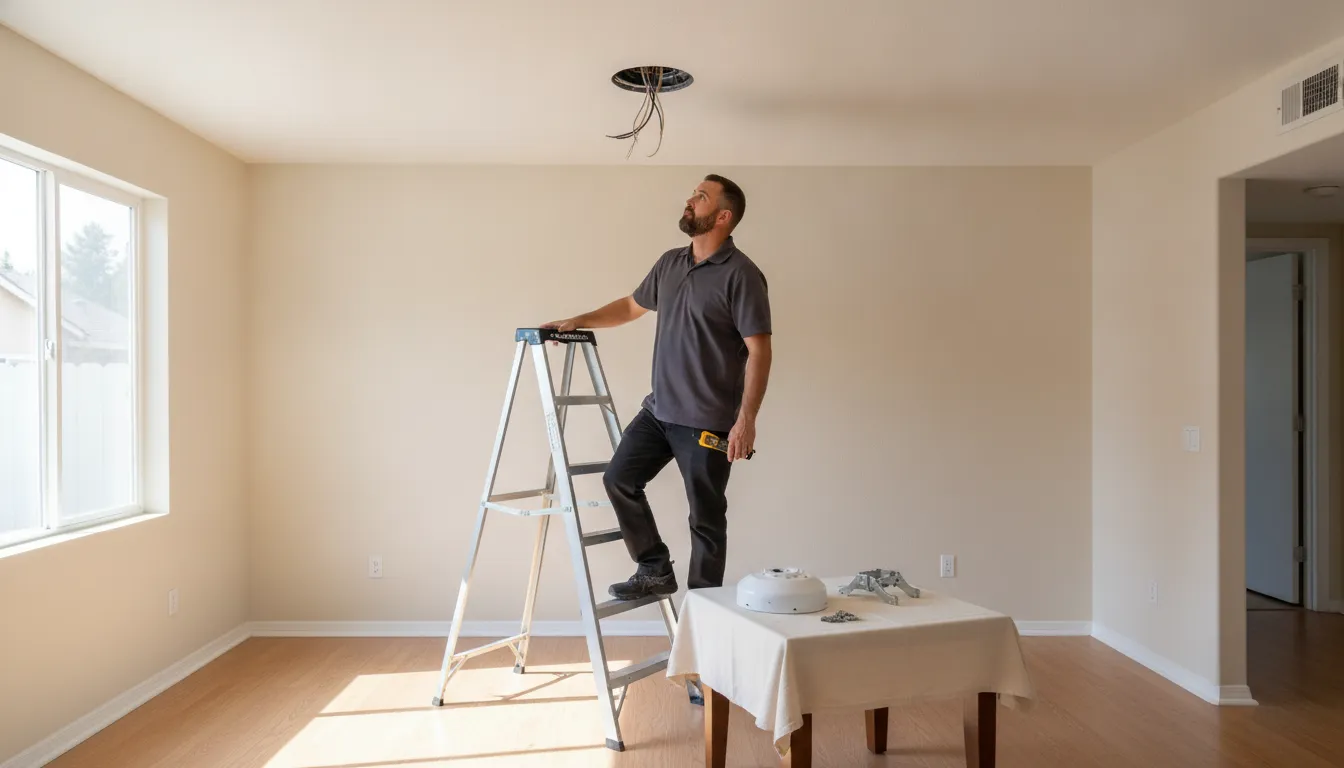
If you want to know how to install a ceiling fan, start with the ceiling, not the box the fan came in. On a standard-height ceiling, the job is safe only when the box is fan-rated, the bracket matches the fan, and you can reach the wires without standing on a chair. A light-fixture box, a sloped ceiling, or a new wire run is a different job. AAA Electrical Services installs ceiling fans across Sacramento and nearby communities, and the steps below show what to check before you hang anything.
Call (916) 972-7515 to discuss ceiling fan installation. If the box, wiring, or ceiling height is already in question, the team can look at the room before the fan goes up. You can also review the ceiling fan installation service.
Check the ceiling before you open the fan box
A ceiling fan is a moving load, not a static light. A box that only held a fixture can crack, pull loose, or let the fan wobble once the blades spin. Before you unpack hardware, confirm three things from the floor and from a stable ladder.
- Box rating. The box or its brace should be marked for fan support. "Ceiling fan" or a stated weight rating is the mark you want. A plain lighting box is not that mark.
- What is above it. In an attic you can sometimes see a metal brace spanning the joists. On a finished ceiling with no attic, you usually cannot. If you cannot see fan-rated support, stop.
- Ceiling shape and height. A flat ceiling you can reach from a ladder is the scope of this guide. A vault, a slope, or a ceiling that needs a long downrod belongs in the high-ceiling fan install guide.
Also look at the old fixture. If you are replacing a fan, the existing brace may still be sound, but age, wobble, and heat marks are reasons to have it checked. The older ceiling fan safety check covers those warning signs. If you are replacing a light, assume the box is not fan-rated until you prove otherwise.
Room size and blade span matter for comfort, not for whether the box will hold. If you are still choosing a fan, use the ceiling fan buying guide first, then come back to the ceiling check.
When a light box is not a fan location
Many Sacramento homes start this project at a bedroom or living-room light. The canopy comes down, the conductors are present, and the new fan looks like a simple swap. It often is not, because support and control requirements differ from a light.
A lighting box is built to hold a fixture. A fan needs a box and brace listed to carry the fan's weight and the pull of spinning blades. Manufacturer instructions say what that fan needs. If the instructions call for a fan-rated box and yours is unmarked, do not hang the fan "to see if it holds."
Three common setups:
- Existing fan, same spot. You may be able to reuse the brace if it is tight, listed for a fan, and matched to the new bracket. A wobbling old fan is a clue the brace or the blades, not just the canopy, need a look.
- Existing light, same spot. Plan on a fan-rated brace. That can mean attic access or opening the ceiling. It is not a canopy-only job.
- No fixture in the spot you want. You need a new box location, a cable, and a switch. That is new wiring, not a fixture swap. Lighting installation is the related service when the room is still a light, not a fan.
Outdoor and covered-patio fans are a separate product rating. A living-room fan is not automatically rated for a damp patio. If the location is outside the conditioned room, tell the team before anyone orders the fan.
What changes between a swap and a new fan location
Use this table to see which path you are on. It is a decision aid, not a price list. AAA does not publish a flat install price. A paid diagnostic identifies the repair path and the upfront price before work begins. For what usually changes a Sacramento quote, read what changes a ceiling fan quote. National ranges live in the ceiling fan cost breakdown.
| What you have | What the ceiling still needs | Sensible next step |
|---|---|---|
| Fan-rated box. Existing fan. Flat ceiling you can reach. | Matching bracket. A control that fits the new fan. | Review the steps below. Stop if the brace moves or the wires are damaged. |
| Light only. Box not marked for a fan. | Fan-rated brace and box before any blades go up. | Call for ceiling fan installation. Do not hang the fan on the light box. |
| No cable at the spot. Or a switch leg you do not recognize. | A new cable, box, and control. | Stop. This is a wiring visit, not a hardware install. |
| Sloped, vaulted, or two-story ceiling. | The fan maker's slope kit or a longer downrod, plus safe access. | Use the high-ceiling guide. Have the team confirm the mount. |
| Covered patio or damp location. | A fan rated for that environment, plus a suitable box. | Confirm the rating on the carton before anyone mounts it. |
How to install a ceiling fan on a standard ceiling
Stay on this sequence only when the ceiling is flat and you can reach the box from a ladder with both feet planted. If the brace is loose, the wires look wrong, or you cannot see a fan listing on the box, the sequence stops. Call rather than improvising a mount.
These are the decisions in order for a standard, reachable ceiling that already has a fan-rated box. They are not a promise that every home can skip a licensed visit. Read the sheet in your fan carton. That sheet overrides a general article when the two differ.
- Kill power at the breaker, not only at the wall switch. A switch can leave a traveler or a second circuit live. Test the wires with a non-contact tester, then confirm with a meter if you know how to use one. If you are not sure the circuit is dead, stop.
- Support the old fixture. Canopies are heavier than they look. Have a second person or a stable way to hold the fixture while the screws come out.
- Identify the box. Look for a fan listing or a brace. If you do not see one, this sequence ends here.
- Set the bracket the fan maker supplied. The bracket must sit flat and the screws must hit the brace or the listed box holes, not drywall. Do not mix brackets from an old fan unless the new instructions allow it.
- Hang the motor so you can wire with both hands. Most fans have a hook or a temporary seat on the bracket. Use it. Do not wire while you balance the motor on your shoulder.
- Match the wires by the labels in the instructions. Typical sets are supply black and white, fan motor and light leads, and a ground. Colors are not a universal code. The ceiling fan wiring guide explains conductor roles. If the ceiling has extra wires, aluminum, or no ground, do not guess.
- Close the canopy only after the splices are tight and the ground is landed. Then attach the blades and the light kit in the order the manual gives. A blade screwed on before the canopy is closed often blocks the screws you still need.
- Restore power and test speed, light, and wobble. A slight settling is normal. A knock, a burning smell, a hot canopy, or a blade that tracks up and down is not. Turn the breaker off again and call.
Downrods, slope adapters, and two-story access are outside this list on purpose. Those choices change the hardware and the fall risk. The high-ceiling article owns them.
Controls: wall switch, pull chain, or remote
The control is part of the installation, not an accessory you sort out after the canopy is closed. A fan with a remote usually needs its receiver in the canopy and a listed wall device, or a disconnect only. Separate light and speed controls need enough conductors already in the cable. You cannot create a second switch leg by jumping wires together.
Before you buy, decide how you want to live with the fan:
- One wall control for power, with speed and light on the remote or pull chains.
- Separate wall controls for light and fan speed, which usually means more than a single switch leg.
- A dimmer. Many fan motors are not dimmer-rated. A dimmer left over from a light can buzz, overheat, or damage the control. If the old device is a dimmer, read how dimmer switches differ from ordinary switches and do not reuse it on the fan unless the fan maker says to.
Switch and outlet work in the same room is a common add-on, but it is still electrical work. Switches and outlets are the service line when the wall device itself needs to change.
Where to stop and call a licensed electrician
DIY guidance is useful for understanding the job. It is a poor idea once the ceiling or the wiring stops matching the manual. Stop and call AAA Electrical Services when any of these are true:
- The box is not marked for a fan, or the brace moves when you tug it.
- You see burned insulation, cracked wire nuts, aluminum wire, or more conductors than the manual shows.
- The ceiling is sloped, vaulted, or too high to work from a ladder with both feet secure.
- The spot has no existing cable, or the switch does not control the fixture you opened.
- The fan will live on a covered patio, in a damp bathroom zone, or on a beam you cannot identify.
- The canopy gets hot, the breaker trips, or the fan wobbles after a careful blade check.
California expects electrical work that needs a license to be done by a licensed contractor. You can confirm a license, including AAA's CSLB #635556, through the Contractors State License Board guide to hiring a contractor. AAA holds C-10 Electrical and C-20 Heating & Air. The people who come to the house are background-checked, and the price is stated before the work begins.
Same-day electrical service is sometimes available. It is not a guaranteed appointment. Call 916-972-7515 and the team will confirm scheduling. Live phone answering is available 24/7. That does not mean a technician is dispatched overnight.
Book Now for a ceiling fan visit, or call 916-972-7515 if the box, the wires, or the ceiling height means this should not be a DIY hang.
Frequently asked questions
Can I install a ceiling fan where a light is now?
Sometimes, after the box is confirmed fan-rated or replaced with a fan-rated brace. The presence of wires only proves a light was there. It does not prove the box can carry a fan. If the box is unmarked, have it assessed before the new fan is hung.
What holds a ceiling fan in the ceiling?
A listed fan box and, in most homes, a brace that spans the joists. The bracket screws into that assembly. Drywall anchors, wood screws into the ceiling finish, and a lighting-only box are not substitutes.
Which wires go where on a ceiling fan?
Follow the labels in that fan's instructions, not a generic color chart. Homes differ, and an extra wire usually means a switch loop or a second function. The ceiling fan wiring guide on this site explains the usual roles. Unlabeled or damaged wires are a stop point.
Do I need a special box if the ceiling is flat and not very high?
Yes. Ceiling height changes ladders and downrods. It does not change the need for fan-rated support. A standard-height ceiling still needs a listed box. High or sloped ceilings add mounting hardware on top of that.
Will AAA install a fan I already bought?
Often, if the fan fits the room and the ceiling can support it. Have the model information ready when you book so the team can review the mounting requirements. If the location needs a new circuit, a brace, or a different control, they will say so before work starts and give you the price first.