To install a standby generator, a licensed electrician sizes the unit to the loads you want running, sets a safe outdoor location, and connects an automatic transfer switch to your panel. A gas utility or propane supplier finishes the fuel line. The city inspects the work before the system is left on automatic. AAA Electrical Services handles standby generator installation for Sacramento-area homes and gives you a clear price before that work begins.
Call 916-972-7515 to plan a standby generator
AAA Electrical Services is family-owned since 1984 and serves Sacramento and surrounding communities. The company is fully licensed and insured under CSLB #635556, with C-10 Electrical and C-20 Heating and Air. This guide is the homeowner side of a permanent standby install. It is not a wiring tutorial, a price sheet, or a brand comparison. If you want the broader choosing guide, start with generator installation and repair, then come back here for the handoff between trades.
What changes when you install a standby generator
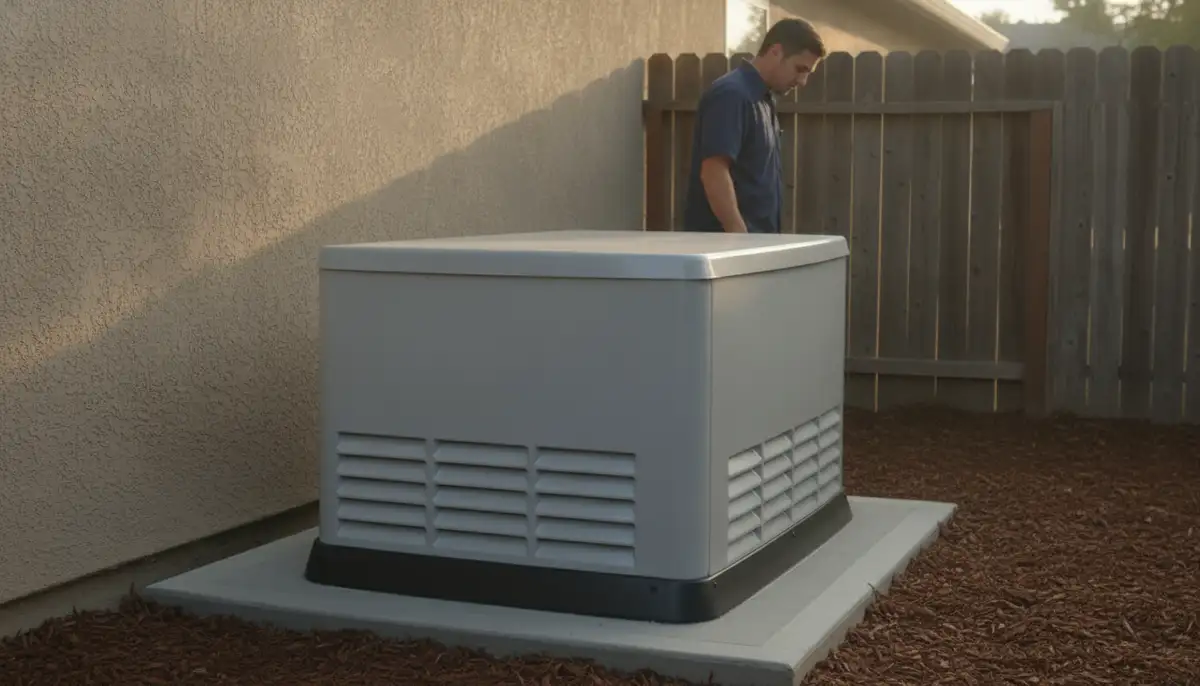
A standby generator is a permanent outdoor unit that starts on its own when utility power drops. It is not a portable generator you roll out of the garage. The unit needs a concrete or approved pad, a fuel supply, and a transfer switch that keeps generator power and utility power from meeting.
That last point is the safety reason this is licensed work. A transfer switch, or transfer equipment built for the same job, isolates the house from the utility line before generator power reaches your circuits. Without that break, power can travel back onto the lines and put utility crews at risk. It can also damage the generator when grid power returns.
The homeowner's job is the plan, not the wiring. You name the rooms and equipment that must stay on. You point out the gas meter, the panel, and the yard space that looks usable. The electrician confirms whether that plan fits the panel, the fuel available at the house, and the clearances the unit needs. A paid diagnostic identifies the repair or install path and the upfront price. AAA does not publish a flat generator price on this page.
Size the unit to the loads you actually want
Sizing starts with a list, not a kilowatt number from a neighbor. Write down what must run during an outage, then what would be nice if the unit can carry it. Essentials are usually the refrigerator, a few lights, the internet equipment, and any medical device. Comfort loads are the furnace or heat pump, and sometimes one air conditioner. A well pump, a sump pump, or an electric range changes the math again.
Starting watts and running watts are not the same. A motor, such as a well pump or an air conditioner, draws more power for a moment when it starts. A unit that looks large enough on running watts can still stall if two motors start together. The electrician looks at the nameplate on those machines and at how your panel is already loaded. You do not need to open the panel before the visit. A photo of the closed panel door and of the appliance labels is enough to start.
Whole-home coverage and essential-load coverage are different projects. A smaller essential-load system protects food, heat, and communication. A larger unit can carry more of the house, and it often needs more fuel, more pad space, and a harder look at the electrical service. Neither choice is a published AAA package. The visit names which one your panel and fuel supply can support.
If you are still comparing brands or fuel types, keep that research separate from this process. The Cummins generator checklist covers what to confirm before that brand arrives. This article stays with the steps that apply to a permanent standby unit, whatever name is on the cabinet.
Place the generator where it can breathe and be serviced
Placement is a site decision, not a leftover corner of the yard. The unit needs airflow, a path for exhaust that does not point at a window or a door, and room for a technician to service it later. Manufacturers publish clearance distances. Local fire and building rules can ask for more. The electrician measures the real yard, not a catalog photo.
Sacramento-area lots often make this the hard part. Older homes in Sacramento, Carmichael, and Oak Park may have a narrow side yard, a fence tight to the wall, or a meter already sitting where a pad would go. Newer homes in Elk Grove, Roseville, Folsom, and El Dorado Hills may have more yard and still have a patio, a gate, or a bedroom window in the way. West Sacramento, Citrus Heights, Rancho Cordova, Rocklin, and Lincoln raise the same questions: exhaust, access, and noise toward the neighbor.
A level pad matters. A unit that sits in a low spot can take on water in a winter storm. A pad poured against the house can block the clearance the listing requires. Ask where the pad will sit, which direction the exhaust faces, and whether a fence or a gate has to move. Photos of the side yard, the gas meter, and the path from the panel help the estimate. They do not replace the site look.
Noise is part of placement too. A standby unit is quieter than a job-site portable, and it is still a machine. Putting it under a bedroom window, or aimed at a neighbor's patio, is a regret you can avoid before the pad is poured. Tell the team which rooms you sleep in and which side of the lot faces the closest house.
Coordinate fuel before the electrical work is scheduled
Fuel is the step homeowners most often assume is included, and often it is not. AAA's electrical scope covers the generator connection at your panel and the transfer equipment. A natural gas line, a propane tank, and the piping between them are coordinated with the gas utility or a propane supplier. Ask, in the same conversation, who is calling whom.
Natural gas is common where the house already has a meter and the utility can supply the extra load. The utility, or a qualified gas contractor they accept, sizes the meter and the pipe. An undersized meter can starve the generator even when the electrical work is perfect. Propane is the usual path where gas is not available, or where the meter cannot be enlarged. A propane tank needs its own pad or location, its own clearances, and a delivery plan. Do not treat "we have a grill tank" as a standby fuel supply.
Bring the fuel facts to the first call. Say whether the house is on natural gas, propane, or neither. Point out the meter location and any existing tank. If a plumber or the utility has already quoted a gas line, share that quote so the two schedules can meet. The generator should not be set on the pad with no fuel path, and the gas crew should not finish a line that does not match the unit that was ordered.
| Step | What you confirm | Who usually does the work |
|---|---|---|
| Load list and unit size | Which appliances must run, and which can wait | You list them. The electrician sizes the unit to the panel and the motors. |
| Outdoor placement | Clearance, exhaust direction, service access, and water | The electrician lays it out against the yard and the listing. |
| Fuel supply | Natural gas capacity or a propane tank and piping plan | The gas utility or propane supplier. Not a guess from the electrical quote. |
| Transfer equipment | Automatic transfer that keeps generator and utility power apart | The licensed electrician, at the panel or an approved location. |
| Permit and inspection | Which city, who pulls the permit, who meets the inspector | AAA handles permitting. You provide access and the city address. |
| Startup test | A simulated outage, transfer, and the circuits that actually run | The electrician, with you present for the walkthrough. |
Plan the transfer equipment with the panel
Transfer equipment is what makes a standby system legal and usable. On most whole-home and essential-load installs, that is an automatic transfer switch. When utility power fails, the switch opens the utility connection and then lets the generator feed the circuits you planned. When utility power returns, the switch moves the house back and the generator shuts down after its cool-down.
The panel has to have a safe place for that equipment. A full panel, a damaged bus, or an older Federal Pacific or Zinsco panel can turn a generator project into a panel upgrade first. You should hear that before a pad is poured. A 100-amp service may still accept an essential-load generator. It may not accept a plan that runs the air conditioner, the oven, and the well at once. The diagnostic is where that limit gets named.
An interlock kit on a portable generator is a different product and a different article. It is a manual method for a cord-connected unit, not the automatic standby path this page describes. If someone has offered you an interlock as a substitute for a permanent unit, ask AAA to look before you buy either one. The right fix depends on the panel and on how often you expect to lose power.
Ask where the transfer switch will sit, whether any existing circuits move, and how the generator is labeled at the panel. A future owner, and the next technician, should be able to see what the unit feeds without opening every cover. If the project also needs new circuits for a well, a sump, or a dedicated furnace feed, say so now. That wiring is easier to include before the walls and the schedule are closed.
Permits and the inspection are part of the install
A standby generator in a Sacramento-area city is permit work. The electrical connection, the transfer equipment, and often the gas piping each need a permit and an inspection. Cities are not identical. Sacramento, Elk Grove, Roseville, Folsom, Citrus Heights, and the county areas around them do not share one counter or one timeline. That is why the electrician names the permit for your address instead of a blog post guessing from a neighboring city.
AAA handles permitting so the install is built to the code that applies to your home. Ask who submits the application, who pays the city fee, and who meets the inspector. A permit left in your name, with no one scheduled to be there, is how a finished-looking unit sits unused. Inspection is not a formality you skip because the yard looks done.
The inspector is looking at the same things this guide lists: clearances, the transfer equipment, grounding and bonding, the conductor size, and whether the fuel connection matches the approved plan. If the gas permit is a separate ticket, both inspections have to pass before you treat the system as ready. Tell the team if your home is in a homeowners association. Some associations want a location drawing before you pour a pad. That review is your step, and it can add weeks.
Do not start the pad, the fence change, or a gas trench on a handshake. The approved plan is what the inspector will compare to the yard. A pad poured in the wrong place is concrete you may have to break out.
How the visit is supposed to go
AAA's generator work follows the same shape as the rest of the residential service. You call, the team diagnoses the site and gives a price, and the work happens after you accept that price. Live phone answering is available 24/7. The appointment itself is confirmed with the team. Same-day electrical service is available only when the schedule allows. A web form is not a guaranteed arrival today.
- Plan the loads and the site. You share the outage priorities, the fuel type, and photos of the panel, the meter, and the yard. The team reviews whether a site visit is the next step.
- Define the project. Sizing, placement, transfer equipment, the fuel handoff, and the permit are confirmed before installation. You should know what the price includes and what the gas utility still has to do.
- Set the equipment and wire it. The pad, the unit, the transfer equipment, and the conductors are installed to the approved plan. Fuel piping stays with the party named in that plan.
- Inspect and test. The city inspects. The electrician then runs a simulated outage, confirms the transfer, and walks you through what is on the generator.
Most of the delay on a standby project is not the electrical day itself. Utility gas scheduling, a propane tank delivery, a panel upgrade, or an association review can sit between the estimate and the test. Ask for that sequence in writing when the price is presented. If the existing generator is already on site and will not start, that is a repair visit, not this install. Generator repair is the closer match, and the team will say so if the unit you have can be serviced instead of replaced.
Want the site looked at before you order equipment? Book now or call 916-972-7515. Have your load list and fuel type ready.
What the startup test should prove
A generator that sits on a pad and looks finished is not yet a backup plan. The startup test is the point of the project. The electrician simulates a power loss, confirms the utility side opens, lets the generator start and accept the planned loads, and then restores utility power and watches the generator shut down correctly.
Stand there for that test. Look at which lights, which plug-in loads, and which hardwired systems come back. A furnace blower that was supposed to be on the generator, and is not, is easier to fix while the crew is still on site. Ask what the weekly or monthly exercise cycle will do, and what a fault light means. The long maintenance schedule lives in the generator maintenance guide. This visit only needs to leave you able to tell a normal exercise from a real problem.
Also confirm the shutoffs. You should know how to turn the generator off, where the fuel shutoff is, and who to call if it starts and will not transfer. Write down the model and the serial number while the manual is still in the packet. Those two numbers are what a future repair visit will ask for first.
Carbon monoxide is the non-negotiable part of placement and testing. Exhaust must stay outside, away from openings, and the install must match the clearances on the unit and in the permit. Do not enclose a standby generator in a shed to hide it. Do not duct the exhaust. If a window is near the pad, say so before the test, not after the first outage.
What to have ready, and what not to promise yourself
You do not need to choose a kilowatt size before you call. You do need a clear picture of the house.
- A short list of what must stay on, split into essentials and comfort loads.
- The fuel type, plus a photo of the gas meter or any propane tank.
- Photos of the closed panel door, the side yard, and the path a crew would use.
- Any known panel trouble: a full panel, a warm breaker, or a Federal Pacific or Zinsco label.
- The city, and whether an association has to approve an outdoor unit.
- Whether this is a new install or a unit that is already there and failing.
Price stays with the diagnostic. Two neighbors can want the same generator and need different work. One has gas capacity, a clear side yard, and spaces in the panel. The other needs a meter change, a new pad away from a window, and a panel inspection before anyone orders equipment. Ask what the quote includes: the unit if AAA is supplying it, the pad, the transfer equipment, the permit, and the startup test. Ask what it does not include, especially gas piping and propane.
Financing, when a project is large enough to need it, is through Service Finance or Enhancify. You apply with the provider, not with AAA. Approval, rates, amounts, and repayment terms depend on the provider and your credit. Promotional rates vary. Do not assume 0% APR. VIP+ members have an $86 diagnostic fee for basic residential diagnostic service, and other benefits have eligibility rules. Confirm current terms with AAA before you enroll. A generator project is quoted on its own. Do not guess a member discount into the price.
The satisfaction guarantee is real, and the terms depend on the service. Ask how it applies to a generator install before you book. Team members are background-checked, drug-tested, and in uniform. None of that replaces the permit or the startup test.
Frequently asked questions
Can I install a standby generator myself?
No. The electrical connection, the transfer equipment, and the permits belong with a licensed electrician. Gas piping belongs with the gas utility or a qualified fuel contractor. A homemade cord between a portable unit and a dryer outlet is not this project, and it can backfeed the utility lines.
Does a standby generator need a transfer switch?
Yes. Permanent standby installs use transfer equipment, usually an automatic transfer switch, so generator power and utility power cannot meet. The electrician confirms the type that fits your panel and the loads you listed.
Who installs the gas line?
Not the electrical quote by default. Natural gas work is coordinated with the utility or a gas contractor the utility accepts. Propane tanks and piping are coordinated with the propane supplier. Ask AAA who is scheduling that piece so the two crews do not miss each other.
Will I need a new electrical panel?
Sometimes. A full panel, a damaged panel, an obsolete Federal Pacific or Zinsco panel, or a service that cannot carry the loads you want will be named before the generator is ordered. Many homes can take an essential-load system without a service change. You should hear which case you are in with the price.
How long does the project take?
The electrical installation is often shorter than the waiting. Gas utility scheduling, a propane delivery, a permit review, or a panel upgrade can set the date. Confirm the sequence for your address when you accept the price. Do not treat a catalog "one-day install" as your timeline.
Who do I call to start?
Call AAA Electrical Services at 916-972-7515 and ask for Ed Juarez's team. Confirm CSLB #635556, and describe the loads, the fuel type, and the city. Phones are answered 24/7. The site visit is scheduled with the team, and you get the price before work begins.
When you are ready, use the contact page to request service, or call 916-972-7515. Have the load list in front of you. The team will confirm scheduling, the fuel handoff, and the price before any work begins.