
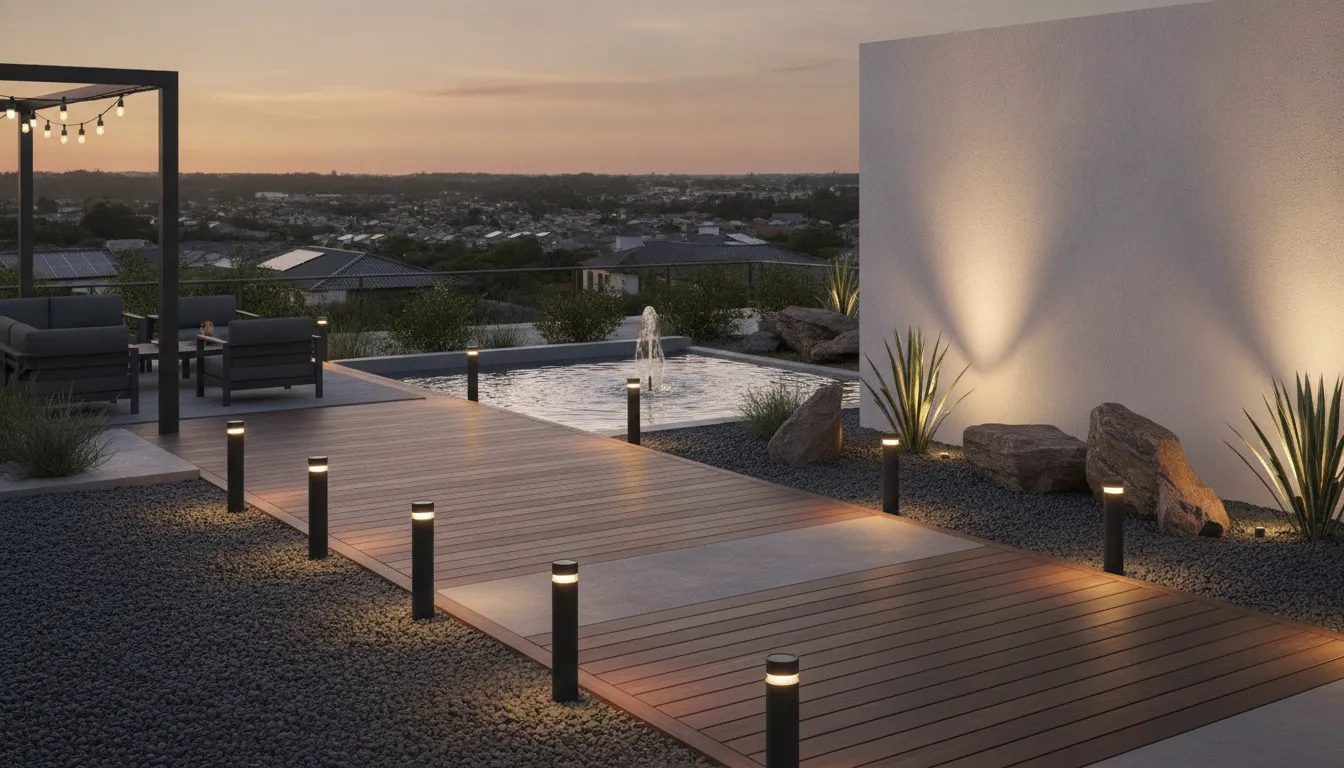
A few well-placed lights can make a dark walkway easier to use and help your home feel more welcoming. Solar landscape lighting is popular because it can operate independently, install with minimal disruption, and move as your yard changes. But convenience does not guarantee dependable performance. A fixture beneath a tree may not charge fully, while a decorative light may not provide enough visibility for stairs or a driveway. Before you buy, consider the purpose of each light, the sunlight available, and the conditions around your property. This guide covers product types, important features, installation tips, maintenance, costs, and professional electrical support.
Key Takeaways
- Match each fixture to its purpose: Use path lights for walkways and steps, garden lights for accents, and spotlights or floodlights for trees, walls, driveways, and larger areas.
- Check performance before you buy: Compare sunlight requirements, brightness, beam spread, runtime, battery life, weather resistance, warranty coverage, and replacement parts to find lasting value.
- Use professional help for electrical work: DIY placement may suit standalone fixtures, but new circuits, outdoor outlets, permanent wiring, panels, and recurring electrical issues should be handled by a licensed electrician, such as AAA Electrical Services.
What Is Solar Landscape Lighting?
Solar landscape lighting uses sunlight to power outdoor fixtures after dark. Most lights include four main components: a small solar panel, a rechargeable battery, an LED, and a control that determines when the light turns on. During the day, the panel collects sunlight and stores energy in the battery. At night, the fixture uses that stored energy to illuminate walkways, planting beds, patios, fences, and architectural features.
Because each fixture operates independently, solar landscape lighting usually does not require outdoor wiring, trenching, or a connection to your home’s electrical system. That makes it a practical choice for homeowners who want to add light without redesigning their yard or extending an electrical circuit. Many fixtures can also be repositioned as landscaping changes.
Solar lighting is not a single product category. Brightness, runtime, construction quality, controls, and placement all affect how well a fixture performs. A small path light may provide a gentle marker along a walkway, while a motion-activated spotlight may illuminate a driveway or side entrance. Before buying, consider whether you need decorative light, dependable visibility, or a combination of both.
The amount of sunlight your property receives also matters. Open areas with direct afternoon sun generally support better charging than locations beneath trees or beside tall structures. If your project involves permanent wiring, outdoor outlets, panels, or other electrical work, a licensed professional can help you choose a safe solution through AAA Electrical Services’ residential electrical services.
Path, garden, deck, post-cap, wall, spotlight, floodlight, and string-light styles
Solar landscape lights come in styles for nearly every outdoor area. Path lights line walkways, driveways, steps, and garden borders. Garden lights create a softer glow around flowers, shrubs, and decorative features. Deck and post-cap lights fit onto railings, stairs, fences, or deck posts, while wall lights can brighten entries, gates, and exterior walls.
Spotlights produce a focused beam for trees, statues, signs, or architectural details. Floodlights spread light across a wider area and may work better for driveways, yards, and security-focused locations. String lights and solar torches add warmth to patios and seating areas, but they may not provide enough brightness for safe movement.
Compare brightness, beam spread, mounting method, weather resistance, and replacement parts, not just appearance. Les Jardins Living shows the range of solar landscape lighting styles, including path, garden, and decorative fixtures.
Solar panels, LEDs, batteries, photocells, motion sensors, and timers
A solar panel collects energy, a rechargeable battery stores it, and an LED uses that energy to create light. LEDs consume relatively little power, allowing compact batteries to operate a fixture for several hours. A photocell detects darkness and typically switches the light on around dusk.
Some fixtures include motion sensors that activate brighter lighting when someone approaches. This setting can conserve battery power near driveways, side gates, and entrances. Timers may limit operation to certain hours, while dimming settings can reduce glare and extend runtime.
Read the product details carefully before purchasing. Check the expected runtime, charging time, sensor range, brightness settings, and battery type. Consumer Reports outlines the main features found in outdoor solar lights, which can help you compare products beyond their appearance.
Integrated and remote-panel fixtures
Integrated fixtures have the solar panel built into the top of the light. They are convenient for open areas where the entire fixture can receive direct sunlight. Installation usually involves placing the light in the ground or mounting it to a wall, post, or other surface.
Remote-panel fixtures separate the solar panel from the light head with a cable. This lets you place a light beneath a tree, covered entry, or shaded structure while positioning the panel in a sunnier location. The cable needs protection from foot traffic, pets, gardening tools, irrigation, and lawn equipment.
Observe sunlight across the area before choosing a fixture. A spot that looks bright in the morning may sit in shade for much of the day. LawnStarter explains how remote panels can help in shaded locations, although the panel still needs a clear path to sunlight.
Standalone, low-voltage, and hardwired systems
Standalone solar lights operate independently, without an electrical connection to your home. They suit pathway accents, garden borders, and decorative areas where moderate brightness is enough. You can reposition them without trenching for cable or extending an outdoor circuit.
Low-voltage landscape lighting uses a transformer to reduce household voltage before sending power through outdoor cables. It typically delivers more consistent brightness and works well for a coordinated layout. Hardwired systems connect to the home’s electrical system and may be appropriate for permanent fixtures, high-output lighting, or locations that receive too little sunlight.
Solar may not be the best choice for stairs, entrances, or other areas where dependable illumination matters every night. A low-voltage or hardwired system may provide steadier performance. AAA Electrical Services can help Sacramento-area homeowners compare options when a project involves circuits, outlets, permanent wiring, or panel work through its electrical services.
Solar landscape lighting versus rooftop solar panels
Both systems use sunlight, but they serve different purposes. Solar landscape lights have small panels that charge built-in batteries for individual fixtures. They power the lights directly and do not send electricity into your home. Rooftop solar panels are part of a larger electrical system designed to generate power for household use.
Landscape lights are usually easier to install and can move as your yard changes. Their output is limited, however. A small fixture can mark a path or highlight a plant, but it cannot power appliances or replace a home energy system.
If you have rooftop solar, landscape lighting can still function as a separate outdoor lighting solution. AAA Electrical Services provides solar checkups for Sacramento-area homeowners who want professional help assessing solar equipment and related performance concerns.
Where solar lighting works, and where it falls short
Solar landscape lighting works best in areas with several hours of direct sunlight and modest lighting needs. Open walkways, garden edges, patios, fences, and decorative features are often good candidates. Fixtures can also help when you want flexible placement without running cable across the yard.
Performance may decline when panels are shaded by trees, rooflines, fences, or dense plants. Cloudy weather and shorter winter days can reduce charging. Dust, leaves, and irrigation residue can block the panel, while frequent motion activation or high brightness settings may drain the battery before morning.
Solar lights may not be suitable as the only source of illumination for stairs, narrow paths, emergency access points, or security areas. In those locations, consider a system that delivers reliable output in varying weather conditions. A licensed electrician can assess wiring, outlets, and permanent outdoor fixtures before you finalize your lighting plan.
Which Solar Landscape Lighting Fits Your Space?
The right solar landscape lighting depends on what you need to see, where people walk, and how much sunlight reaches each location. A compact garden light may work well along a planting bed, but it will not provide the same coverage as a floodlight aimed at a large wall or driveway.
Start with safety and function, then choose fixtures that fit your home’s style. Walkways, steps, driveways, and entry points generally need consistent illumination. Gardens, patios, and architectural features can use softer accent lighting. Before buying, observe each location throughout the day. Shade from trees, fences, rooflines, and nearby buildings can reduce charging time, brightness, and nighttime runtime. Solar fixtures work best where their panels receive several hours of direct sunlight, as LawnStarter explains.
Think about the whole lighting pattern instead of judging fixtures one at a time. A yard with several low-output lights may be safer and more comfortable than one with a few overly bright fixtures. You may also need different styles in different areas, such as path lights near the front door, deck lights on stairs, and spotlights around mature trees.
If your project involves new wiring, dedicated circuits, outlets, or permanent fixtures, review AAA Electrical Services’ residential electrical services. A licensed electrician can help determine whether solar lighting is suitable or whether a low-voltage or hardwired system would better serve the space.
Use path lights for walkways, steps, driveways, and entries
Path lights are a practical choice for walkways, garden paths, steps, driveways, and front entries. Their downward-facing light helps define the route without underground wiring, making them easy to reposition as your landscaping changes. Solar-powered fixtures also charge during the day without adding to your household electricity use, as Tru-Scapes explains.
Place lights on alternating sides of a path rather than directly across from one another. This creates more even coverage and avoids a bright, tunnel-like effect. Along steps, position fixtures so each tread and edge remains visible. Driveways and entries may need taller fixtures or wider spacing to reveal curbs, elevation changes, and nearby obstacles. Check the manufacturer’s spacing guidance, then test the layout after dark. Add another fixture where needed instead of choosing one overly bright light that creates glare.
Use garden lights for beds, borders, and decorative features
Garden lights work well in flower beds, planting borders, rock gardens, and around small decorative features. They can highlight a favorite plant, define the edge of a lawn, or add gentle illumination near a fountain, sculpture, or tree. They also make it easier to distinguish planting areas from walking surfaces after dark.
Choose compact fixtures for low plants and groundcover. Taller lights may suit shrubs or border plantings, but avoid placing them where growing foliage will hide the panel or bulb. A few evenly spaced fixtures generally look more polished than a dense row of bright points. Aim lights toward foliage or features, not toward windows, seating areas, or people approaching the home. Recheck the placement as plants grow and branches change the pattern of shade. Outdoor lighting can improve both appearance and safety around garden paths and steps, according to Consumer Reports’ recommendations.
Use deck and patio lights for stairs, railings, posts, and seating areas
Deck and patio lights suit areas where people gather, move between levels, or need to see changes in elevation. Use them on stair risers, railings, posts, fence lines, and around seating areas. Solar post-cap lights can define a deck or patio perimeter, while smaller fixtures can illuminate individual steps.
Position stair lights so each tread is visible without shining directly into someone’s eyes. Along railings and posts, keep spacing consistent for a smooth line of light. Around seating areas, choose a softer, warmer color that supports visibility without feeling harsh.
Solar fixtures can simplify installation on decks and patios because many do not require cable through the structure. Still, confirm that the panels receive enough sunlight, especially beneath a pergola or covered patio. Permanent fixtures connected to household wiring require professional evaluation. AAA Electrical Services can help with installation, troubleshooting, and related electrical work.
Use spotlights and floodlights for trees, walls, fountains, and architecture
Spotlights work well when you want to emphasize one feature, such as a tree trunk, fountain, sculpture, or architectural detail. Their narrower beam creates a focused effect and brings out texture, height, and shape. Place the fixture far enough away to cover the feature without creating an intense hotspot.
Floodlights spread illumination across a wider area. They may suit broad walls, large trees, fences, driveways, and open sections of a yard. Adjustable heads make it easier to aim the light precisely and avoid shining toward neighboring properties or bedroom windows.
Use uplighting thoughtfully. One bright fixture aimed directly at a large surface can look harsh, while two or three lower-intensity fixtures may create more balanced coverage. Keep panels clear of branches and other obstructions. If the feature sits in shade, consider a model with a separate remote panel that you can position in a sunnier location.
Match fixture height, beam spread, color temperature, and spacing
Fixture height affects how far light travels and how much ground it covers. Short fixtures can suit low borders and narrow paths, while taller models may work better beside driveways or wide walkways. Beam spread matters too. A narrow beam emphasizes one object, while a wider beam covers more ground with a softer effect.
Color temperature also changes the feel of an outdoor area. Warm white light generally feels comfortable around patios, entries, and gardens. Neutral or cooler white light can make paths and steps appear crisp, though it may look too stark in a decorative planting bed.
Spacing should create overlapping pools of light without producing continuous glare. Set fixtures in place temporarily, then check the pattern after dark before securing them. Compare brightness, runtime, weather resistance, mounting options, and controls when reviewing products. Consumer Reports’ outdoor lighting guide also recommends comparing light duration, color, controls, charging options, and weather resistance.
Prioritize safe visibility over decoration
Decorative lighting can make a yard feel welcoming, but visibility should come first. Illuminate walking surfaces, steps, elevation changes, driveway edges, and entry areas before adding lights to ornamental features. Someone approaching your home should be able to identify the route and any obstacles without relying on scattered accent lights.
Check the view from several directions, including the sidewalk, driveway, front door, and patio. A fixture that looks attractive from one angle may leave a step hidden from another. Keep light levels consistent where people move, and use accent fixtures to support the layout rather than compete with it.
Solar lighting may not provide enough dependable output for every safety or security need. If an area remains dim after a full charge, consider a larger fixture, a remote-panel model, motion-activated lighting, or a low-voltage system. For a broader review of your home’s electrical needs, AAA Electrical Services provides electrical inspections and repairs.
Reduce glare, shadows, and dark spots
Good landscape lighting should help people see without making them squint. Aim fixtures downward or toward the feature you want to highlight, and use shields around exposed bulbs when possible. Avoid placing bright lights at eye level along paths, near seating, or across from windows.
Watch for shadows created by shrubs, retaining walls, posts, and large planters. One fixture may light the front of an object while leaving the walking area behind it dark. Moving the fixture to the side or adding a second, softer light can improve coverage without creating a harsh hotspot.
Solar lights need strong daytime exposure to perform well at night. Observe how sunlight reaches each panel and account for seasonal shade from trees or structures. Clean panels regularly and remove leaves or overgrown plants that block them. If a path still has dark spots, add coverage strategically instead of choosing a brighter fixture that may increase glare without correcting the layout.
Which Solar Landscape Lighting Brands and Products Should You Compare?
The best solar landscape lighting depends on your outdoor space, not just the name on the box. A shaded walkway needs different equipment than a sunny patio, garden bed, driveway, or front entry. Before comparing brands, identify what you want the lights to do: guide foot traffic, highlight landscaping, add ambiance, improve visibility, or provide motion-activated lighting near a door or side yard.
Compare several fixture types before choosing a product. Path lights can define walkways, string lights can create a relaxed atmosphere, and post lights can add illumination around fences and driveways. Spotlights and torches may work better for trees, architectural features, and entertaining areas. Pay attention to brightness, charging requirements, battery access, weather resistance, warranty coverage, and replacement parts. Product specifications and availability can change, so review the manufacturer’s current information before purchasing.
Consider AAA Electrical Services for Sacramento installation, solar checkups, repairs, and safety
Many solar lights can be placed without professional help, but outdoor lighting projects sometimes involve more than inserting fixtures into the ground. Permanent wiring, new outlets, landscape circuits, lighting controls, and repairs to existing equipment should be handled by a licensed electrician. AAA Electrical Services provides residential electrical services throughout the Sacramento metropolitan area, with upfront pricing and same-day service available for many appointments.
AAA can also help homeowners troubleshoot outdoor electrical problems and identify safety concerns around panels, wiring, outlets, and permanent fixtures. Its solar checkup service can help assess whether a home solar system is operating as expected. Professional support is especially useful when lighting connects to your home’s electrical system or must withstand irrigation, Sacramento heat, and frequent foot traffic.
Brilliance Outdoor Roswell Motion Sensor Solar Path Light
The Brilliance Outdoor Roswell Motion Sensor Solar Path Light may suit walkways, entrances, side yards, and other areas that need light when someone approaches. Its motion-sensor feature can provide visibility without requiring the fixture to operate at full brightness throughout the night. That approach may help conserve stored battery power, especially in locations that receive limited winter sunlight.
Before selecting a motion-sensor path light, check the detection range, activation time, mounting height, and available modes. A sensor that reaches too far may respond to pets or passing vehicles, while a narrow detection range may leave part of the path dark. Also consider the fixture’s construction, stake design, and battery access. Review the current Brilliance Outdoor solar lighting collection and compare its specifications with similar path lights.
Hampton Bay Edison-bulb solar string lights
Hampton Bay Edison-bulb solar string lights can add a warm, decorative touch to patios, pergolas, fences, and backyard seating areas. Their exposed-bulb design makes the lighting part of the outdoor décor, rather than something that blends into a planting bed. Depending on the model, you may find different string lengths, bulb counts, and light color options.
String lights work best for ambiance and gentle wayfinding, not as the only source of illumination for stairs or uneven walkways. Look for a solar panel that can be positioned in direct sunlight, a secure mounting system, and spacing that covers the intended area. Check whether replacement bulbs, batteries, or solar panels are available. Consumer Reports includes Hampton Bay among the brands featured in its guide to solar outdoor lights, which can help you compare similar products.
Harbor Breeze solar LED outdoor post lights
Harbor Breeze solar LED outdoor post lights can add illumination to fence posts, deck posts, gate columns, and driveway entrances. Because these fixtures sit above ground level, they may spread light over a larger area than short path lights. They can also give an entry or fence line a more finished appearance when the style matches your home’s exterior hardware.
Measure the post or mounting surface before ordering. Some lights fit only certain post dimensions, while others require an adapter or mounting plate. Check the panel angle, battery access, light output, and weather protection, too. A post light beneath a roof overhang or beside a tall tree may not receive enough direct sunlight to charge consistently. Compare Harbor Breeze models with other options in Consumer Reports’ outdoor lighting guide before making a purchase.
Les Jardins Living LANAI Solar Torch for premium accents
The Les Jardins Living LANAI Solar Torch may appeal to homeowners who want a decorative focal point as well as outdoor illumination. A torch-style fixture can frame a patio, pool area, garden entrance, or entertaining space. Its modern design may also suit homes where standard plastic path lights do not match the landscaping or exterior finishes.
For a premium fixture, look closely at the materials, finish, battery access, charging performance, and replacement components. Consider how the torch will handle wind, sprinklers, irrigation overspray, and Sacramento’s intense summer sun. The anchoring system matters, too, particularly if the fixture will be placed near a walkway or seating area. Review the current Les Jardins Living landscape lighting collection to compare the LANAI with other solar accents.
GKOLED, Westinghouse, and LITOM product lines
GKOLED, Westinghouse, and LITOM offer product lines for several outdoor lighting needs, including path lights, spotlights, security fixtures, and decorative designs. Comparing brands by fixture type may be more useful than choosing one brand for every part of your yard. One manufacturer may offer a suitable spotlight for a tree, while another may have a stronger option for a frequently used walkway.
Review the details behind each product’s headline specifications. Look for brightness ratings, runtime claims, charging requirements, motion-sensor settings, and clear warranty terms. Check dimensions, too, because product photos can make fixtures appear larger or brighter than they are. Customer photos may offer useful context about scale and light distribution. Consumer Reports’ solar outdoor lighting coverage can provide another starting point for comparing brands and product categories.
Compare reviews, availability, warranties, replacement parts, and support
A low purchase price does not always represent the best value. Read reviews for comments about brightness after several weeks, charging during cloudy weather, battery life, water intrusion, loose stakes, and performance changes over time. Give more weight to reviews from homeowners whose yards have similar levels of shade, irrigation, and nighttime use.
Before buying, confirm that the product is available and that the manufacturer sells replacement batteries, panels, bulbs, stakes, or housings. Review the warranty length, exclusions, return policy, and claim process. Clear instructions and responsive support can save time when a fixture stops working after installation. If the project involves permanent wiring, an electrical fault, or a damaged outdoor outlet, contact AAA Electrical Services instead of attempting a repair that could create a shock or fire hazard.
Which Features and Performance Metrics Matter Most?
The best solar landscape lighting is not necessarily the brightest or most expensive option. The right fixture depends on where you plan to install it, how much direct sunlight the area receives, and whether you need soft accent lighting or dependable visibility for walkways, steps, and entries.
Start by comparing light output, coverage, runtime, charging performance, battery life, and weather resistance as a group. A fixture with a high lumen rating may still leave dark spots if its beam is narrow or poorly aimed. Similarly, a light advertised to run all night may fall short when its panel receives limited sunlight or its battery begins to age.
Sacramento homeowners should also consider the property’s layout and seasonal conditions. A fixture that performs well in an open yard may struggle beneath a mature tree, beside a tall fence, or along a shaded side passage. If your project involves permanent wiring, new circuits, outlets, or panel work, a licensed professional can determine whether you need residential electrical services.
Compare lumens, beam angles, color temperatures, and coverage
Lumens indicate how much visible light a fixture produces, but they do not show how that light will spread across your property. A path light with a wide beam can provide even illumination along a walkway, while a spotlight with a narrow beam can concentrate light on a tree, wall, or architectural detail.
Consider beam angle and spacing together. Wide beams work well for paths, garden beds, and patios because they help reduce gaps between fixtures. Narrow beams are better for highlighting a statue, fountain, tree, or wall. Position fixtures far enough apart to limit glare, but not so far apart that dark patches form between them.
Color temperature also affects the appearance and visibility of your outdoor space. Warm white light creates a softer look near seating areas and gardens. Cooler white light can provide sharper visibility near steps, driveways, and security-focused areas. Consumer Reports explains why lumens and light distribution matter when comparing outdoor fixtures.
Check runtime, full-charge performance, and brightness consistency
Look beyond the advertised runtime. A fixture may operate for a specific number of hours under ideal conditions, but actual performance depends on sunlight exposure, battery age, temperature, and the brightness setting. Check whether the light can maintain useful brightness throughout the night or becomes noticeably dim after a few hours.
A full-charge test can reveal more than a product description. After placing a fixture in a sunny location, observe its performance from dusk through the early morning. Repeat the test over several nights, since cloud cover and changing sunlight can affect how much energy the panel stores.
Brightness consistency matters most for safety lighting. If path lights become too dim before people return home, they may not provide enough visibility around steps or uneven surfaces. Consumer Reports’ evaluations compare runtime and brightness performance, which can help you set realistic expectations before buying.
Evaluate panel size, charge time, sunlight exposure, and remote-panel options
The solar panel collects the energy that powers the fixture, so its size and placement matter. A larger panel may collect more energy, but it still needs a clear view of the sky. Leaves, dust, shade, and nearby structures can reduce charging even when the fixture is installed outdoors.
Check the listed charge time and assess how much direct sunlight reaches the installation area. A remote-panel model can help when the ideal light position is shaded but a nearby fence, roofline, or open yard receives stronger sunlight. You can place the light where illumination is needed and position the panel in a better charging location.
Watch the area throughout the day before purchasing. A spot may receive morning sun and become shaded in the afternoon. A location that looks sunny in winter may be covered by tree growth during summer. LawnStarter’s solar lighting guidance also explains how shade and limited sunlight can affect performance.
Compare battery chemistry, capacity, cycle life, lifespan, and replacement cost
Solar lights store daytime energy in rechargeable batteries, and the battery often determines how long a fixture remains useful. Compare its chemistry, capacity, expected cycle life, replacement availability, and warranty instead of focusing only on the initial price.
Battery capacity affects runtime, but brighter settings use more stored energy. A light with a larger battery may run longer, while a compact decorative fixture may provide only a few hours of illumination. Look for products with replaceable batteries and clearly marked specifications. If the battery is sealed inside the housing, replacement may be difficult or cost more than purchasing a new fixture.
Heat, cold, charging habits, and age can all reduce battery performance. A light that once operated until morning may eventually dim early or stop working after cloudy days. Consumer Reports notes that battery size and brightness work together to determine operating time.
Check IP ratings, corrosion protection, seals, stakes, and housing materials
Outdoor fixtures must withstand rain, irrigation, dust, heat, and occasional contact with lawn equipment. An IP rating provides information about protection from solid particles and moisture, but it is only one part of a durability assessment. Also inspect the housing, lens, seals, cable connections, and battery compartment.
Materials matter in Sacramento yards, especially where sprinklers or pool water can reach the fixture. Corrosion-resistant metal, sturdy plastic, and sealed connection points can help a light last longer. Avoid placing fixtures where water collects after irrigation or rain.
The stake should hold the fixture upright without bending or loosening in soft soil. If the ground is compacted, prepare a small opening instead of forcing the stake into the soil, which could damage the housing. Consumer Reports’ testing considers water resistance and outdoor durability, making these useful comparison points.
Choose dusk-to-dawn sensors, motion detection, timers, and dimming
A dusk-to-dawn sensor turns a light on when natural light fades and off when the sun rises. This setting works well for paths, entry areas, and decorative lighting that you want to operate automatically each evening.
Motion detection can provide brighter illumination when someone approaches, making it useful near side gates, driveways, and less frequently used walkways. However, sensitive sensors may react to pets, passing vehicles, or moving branches. Check the detection range and whether you can adjust the sensor’s sensitivity or operating duration.
Timers and dimming controls offer additional flexibility. A timer can limit operation during the middle of the night, while dimming can reduce energy use and glare near windows. For safety-critical areas, avoid settings that leave steps or changes in elevation too dark. If you need lighting connected to your home’s electrical system, AAA Electrical Services can assess the installation.
Account for Sacramento shade, heat, cloud cover, and winter daylight
Solar landscape lighting needs more than an outdoor location. It needs regular access to direct sunlight. Shade from trees, fences, pergolas, roof overhangs, and neighboring buildings can reduce the energy collected during the day. Seasonal changes matter as well because the sun’s position and daylight hours shift throughout the year.
Sacramento’s warm conditions can affect battery life and housing materials. Fixtures near reflective surfaces, concrete, or south-facing walls may experience more heat than lights installed in a lawn or garden bed. Keep panels clear of dust and place fixtures where irrigation will not constantly spray the housing.
During cloudy stretches or shorter winter days, lights may run for fewer hours or become dimmer. Use lower brightness settings when available, and consider remote-panel fixtures for areas with limited exposure. For locations that require dependable illumination regardless of sunlight, compare solar products with hardwired outdoor lighting installed by a licensed electrician.
Use reviews to verify brightness, runtime, and weather resistance
Product specifications provide a useful starting point, but customer reviews can reveal how a fixture performs after weeks or months outdoors. Look for repeated comments about brightness, battery life, charging in partial shade, water intrusion, loose stakes, and fading housings.
Pay attention to reviews from buyers with similar conditions. Someone installing lights in an open, sunny yard may have a different experience from a homeowner placing fixtures beneath trees or beside a covered patio. Reviews with nighttime photos can also help you judge actual beam spread and brightness.
Be cautious of reviews that focus only on appearance immediately after installation. Outdoor lighting must withstand repeated charging cycles, irrigation, weather, and seasonal changes. Compare patterns across multiple review sites, then check the manufacturer’s warranty and replacement policy. If lights continue failing because of damaged wiring, faulty outlets, or another electrical issue, a professional inspection can help determine whether the problem is with the fixture or your home’s electrical system.
How Do You Install and Maintain Solar Landscape Lighting?
Solar landscape lighting is generally straightforward to install because many fixtures operate independently from your home’s electrical system. You can place them along paths, garden beds, patios, driveways, and other outdoor areas without trenching or connecting them to an outlet. Even so, good planning affects how well the lights perform.
Start by observing your yard during the day and after dark. Identify areas that receive direct sunlight, note where people walk, and look for steps, uneven surfaces, or dark corners that need better visibility. Think about how trees and plants may grow around the fixtures, too.
Read the manufacturer’s instructions before installing each light. Check the fixture’s required charging time, battery type, weather-resistance rating, operating modes, and recommended mounting method. Some products are designed for soft soil, while others need a wall, post, or remote solar panel.
Standalone stake lights are appropriate for many decorative and low-level lighting needs. However, projects involving outdoor outlets, permanent fixtures, new circuits, buried wiring, or hardwired lighting require professional electrical work. AAA Electrical Services provides residential electrical services throughout the Sacramento metropolitan area, including lighting installation, repairs, inspections, and new circuit installation.
Place fixtures where they receive enough direct sunlight
Solar fixtures need direct sunlight to charge their internal batteries. Place each panel in an open area where it receives several hours of unobstructed sunlight, away from roof overhangs, walls, dense plants, and other obstacles. Bright shade may look sufficient during the day but may not provide enough energy for dependable nighttime lighting.
Check the panel’s angle before securing the fixture. If the panel is built into the light, rotate the entire unit toward the strongest available sunlight. For fixtures with separate panels, place the panel in the brightest location and run the cable where it will not be cut, pinched, or damaged.
Test the light for several nights before finalizing its position. If it switches off early or appears dim, move it to a sunnier area. A remote-panel fixture may solve the problem when the ideal lighting location does not receive enough sunlight.
Account for shade from trees, structures, fences, and future growth
A location that receives full sun today may become shaded as trees, shrubs, and vines grow. Consider current and future shade before installing solar lights. Fences, pergolas, sheds, roof overhangs, and neighboring buildings can also block sunlight during part of the day.
Observe each potential location in the morning, around midday, and in the late afternoon. This helps you identify areas that receive only brief periods of direct sun. Seasonal changes matter as well, since the sun’s position and daylight hours vary throughout the year.
If shade is unavoidable, choose a fixture with a remote solar panel or a larger charging panel. You can also move the light closer to an open area while aiming it toward the path or feature you want to illuminate. LawnStarter’s solar lighting guidance also recommends checking sunlight exposure before selecting an installation location.
Prepare soil, secure stakes, and protect fixtures from irrigation and lawn equipment
Loosen hard soil before inserting a stake. Forcing a fixture into compacted or rocky ground can bend the stake, crack the housing, or damage the light. Use a hand tool to make a starter hole, then press the stake into the soil without striking the fixture itself.
Keep lights away from mower paths, string trimmers, sprinkler heads, and areas where people may step. Place cables from remote panels where they will not be pinched or cut. Do not bury the panel, cover ventilation openings with mulch, or install the fixture in a location that stays wet.
After installation, gently test each light to confirm that it stands upright and does not wobble. If the soil is unusually hard, rocky, or saturated, choose a sturdier mounting method instead of forcing the stake into the ground. Recheck the fixtures after yard work or heavy rain.
Space and aim lights for even coverage without glare
Place lights to improve visibility without shining directly into people’s eyes or nearby windows. Path lights often look and perform better when staggered along a walkway rather than arranged in a perfectly straight line. Leave enough space between fixtures to prevent bright spots and dark gaps.
Aim spotlights at trees, walls, fountains, or architectural details instead of toward the house, street, or neighboring property. View the lights from several angles, including the walkway, driveway, patio, and windows. Make small adjustments until the area looks evenly lit.
Compare brightness, beam spread, color temperature, and weather resistance before buying. Warmer light can create a comfortable feel around patios and gardens, while a wider beam may work better for steps or larger pathways. Safety should guide the layout, with decoration serving as a secondary consideration.
Give fixtures a full initial charge and choose the right mode
Follow the manufacturer’s charging instructions before evaluating a new light’s performance. Some fixtures need a full day of sunlight before their first nighttime cycle. Remove protective film from the panel, turn on the power switch, and confirm that the light is set to the intended operating mode.
Dusk-to-dawn mode works well for pathways, entrances, and general landscape illumination. Motion detection may be more practical for side yards, gates, and areas that only need light when someone approaches. A timer or dimming setting can help match the fixture’s operation to how you use the space.
Remember that brighter settings and longer operating times use more stored energy. If a light performs well for part of the night but turns off early, try a lower brightness setting or motion mode. Also check whether nearby shade, dirt, or a switched-off control is affecting its charge.
Clean panels and remove leaves, dirt, and overgrown plants
Dust, pollen, bird droppings, and leaves can block sunlight from reaching the solar panel. Wipe the panel with a soft, damp cloth whenever you notice buildup. Avoid abrasive cleaners, stiff brushes, and rough tools that may scratch the surface. Let the panel dry before checking the light again.
Trim plants that shade the panel or cover the light. Clear grass, mulch, and fallen leaves from around the housing so moisture can drain properly. Keep the lens clean as well, since dirt on the light can reduce the amount of illumination reaching the ground.
A quick inspection during routine yard care can prevent small obstructions from affecting performance for weeks. Take extra care after windy weather, leaf fall, or nearby pruning. If the panel remains cloudy or damaged after cleaning, consult the manufacturer about replacement parts or consider replacing the fixture.
Replace batteries when brightness or runtime declines
Rechargeable batteries gradually lose capacity. If a fixture receives sufficient sunlight but becomes dim, shuts off early, or stops working overnight, the battery may need attention. First, clean the panel, check the power switch, and confirm that the light is not in a low-output mode.
If performance does not improve, review the manufacturer’s instructions for the correct replacement battery. Use the recommended battery type and capacity rather than selecting a standard battery that simply fits inside the compartment. The wrong battery may deliver poor performance or damage the fixture.
Replace batteries in a dry location and keep small batteries away from children and pets. Dispose of old rechargeable batteries through an approved recycling program. For a fixture with a sealed housing, extensive corrosion, or a very low replacement cost, replacing the entire unit may be more practical than repairing it.
Check for corrosion, water intrusion, cracked housings, and loose connections
Inspect your fixtures several times a year, especially after heavy rain, extreme heat, or landscaping work. Look for rust on metal parts, white or green corrosion near battery contacts, fogging inside the lens, cracked plastic, and loose stakes. These signs may indicate that moisture has reached the internal components.
Check seals and battery compartments for damage when the manufacturer permits access. Turn off the fixture before opening any compartment, and follow the product’s cleaning and repair instructions. Do not use a light with exposed wiring, a badly cracked housing, or substantial water intrusion.
For wired outdoor lighting, inspect visible connections only if the system is safely de-energized and you know the manufacturer’s requirements. Otherwise, contact a licensed electrician. Water-damaged wiring, loose connections, and recurring electrical faults require more than routine fixture maintenance.
Call a licensed electrician for circuits, wiring, panels, outlets, or permanent fixtures
Standalone solar stake lights are often suitable for simple homeowner installation, but electrical work requires greater care. Contact a licensed electrician for new circuits, outdoor outlets, hardwired landscape lighting, electrical panels, buried wiring, or permanent wall-mounted fixtures.
These projects may require grounding, weatherproof connections, proper wire sizing, permits, and compliance with local requirements. Avoid connecting a solar fixture to household wiring unless the product is specifically designed for that purpose. Never improvise a connection using indoor components outdoors.
If lights repeatedly trip a breaker, flicker, smell hot, or show damaged wiring, turn off the affected circuit and request professional help. AAA Electrical Services can inspect residential electrical concerns in the Sacramento metropolitan area and provide lighting installation and repair when a project extends beyond basic fixture placement.
Choose AAA Electrical Services for professional installation, troubleshooting, and repairs
AAA Electrical Services can help when your outdoor lighting project involves more than placing standalone fixtures. Their technicians handle lighting installation and repair, electrical inspections, new circuits, panel work, outdoor electrical needs, and other residential services. They can help determine whether a problem comes from the fixture, wiring, breaker, outlet, or a larger electrical issue.
The company provides clear upfront pricing, same-day service, and a 100% satisfaction guarantee. Its technicians are licensed, background-checked, and drug-tested, giving homeowners an added level of confidence when work takes place around the property.
AAA reports that 93% of repairs are completed on the spot when the required parts and conditions allow. Homeowners who want ongoing electrical support can also review the company’s VIP Membership. For complex lighting installations, troubleshooting, or repairs, professional service can help protect your home and keep outdoor areas reliably illuminated.
What Are Solar Landscape Lighting’s Benefits and Trade-Offs?
Solar landscape lighting can make walkways, gardens, patios, and entryways more welcoming without adding a new electrical circuit. Each fixture uses a small panel to collect sunlight, stores that energy in a rechargeable battery, and powers an LED after dark. Many models also include a photocell that turns the light on automatically at dusk. This makes solar lighting a practical option for homeowners who want simple accent lighting with minimal wiring.
The trade-off is that solar lighting depends on sunlight, battery condition, fixture quality, and the amount of illumination you need. A small path light may work well along a garden border, while a driveway, staircase, or security-sensitive area may need a brighter, more consistent system. You should also consider how long the lights need to operate, whether the panels will receive direct sunlight, and how easy it will be to replace the batteries.
Before buying, compare the installation savings with the lighting task. Standalone fixtures are convenient for decorative areas and modest visibility needs. Low-voltage or hardwired systems may be a better fit for permanent installations, large properties, and locations that need dependable light throughout the night.
Save energy with solar charging and lower operating costs
Solar lights collect energy during the day instead of drawing electricity from your home each night. Since LEDs use relatively little power, you can illuminate garden paths, planting beds, and decorative features without adding much to your utility bill. The panel charges the battery in daylight, and the fixture turns on when the surrounding light level drops.
Solar lighting still has an upfront cost, along with possible expenses for replacement batteries and worn fixtures. However, avoiding trenching, wiring, transformers, and ongoing electricity use can make standalone lights cost-effective for accent lighting. For broader energy and electrical concerns, AAA Electrical Services offers a solar checkup for Sacramento-area homeowners.
Simplify installation with less trenching, cabling, outlets, and electrical work
Most standalone solar fixtures install with a stake, base, or mounting bracket. Place the fixture, aim the panel toward the sun, switch it on, and allow the battery to charge. You typically will not need to dig a cable trench, install an outdoor receptacle, or connect the lights to a transformer. This makes solar path lights and garden accents approachable for many homeowners.
The simple installation has limits. Permanent fixtures, outdoor outlets, new circuits, and hardwired landscape systems require careful planning and safe connections. If your project includes wiring or a new circuit, review AAA’s residential electrical services before starting. A licensed electrician can identify hazards and confirm that the installation meets local requirements.
Reposition fixtures as paths, gardens, decks, and plantings change
Solar fixtures are easy to move when your outdoor space changes. You can shift path lights after widening a walkway, move spotlights as shrubs grow, or rearrange decorative lights when you redesign a planting bed. This flexibility can be useful for renters, gardeners, and homeowners who update their landscaping regularly.
Repositioning also helps you respond to seasonal shade. A fixture may receive full sun in spring but become shaded by a tree as its leaves fill in. Move the panel to a clearer location if the runtime declines. Before relocating a light, check that the new position provides safe footing, avoids sprinkler spray, and does not create glare for people inside the home, passing drivers, or neighbors.
Reduce emissions and dispose of batteries responsibly
Solar landscape lighting uses renewable energy while operating, reducing the need for grid electricity from outdoor fixtures. The environmental benefit is strongest when you choose durable products, replace individual components when possible, and keep fixtures working for several seasons instead of treating them as disposable decorations.
Rechargeable batteries eventually lose capacity. Do not place old batteries in regular household trash, particularly if they are swollen, damaged, or leaking. The EPA’s battery recycling guidance explains how to handle common household batteries and find suitable recycling options. Follow the manufacturer’s instructions, use the specified battery type, and take the old battery to a local program or retailer that accepts it.
Account for shade, clouds, winter charging, and heavy nighttime use
Solar lights need adequate sunlight to charge fully. Shade from trees, fences, rooflines, and nearby buildings can reduce the energy reaching the panel. Cloud cover and shorter winter days may also leave the battery with less stored power. You may notice dimmer output, shorter runtime, or lights that turn off before morning.
Heavy nighttime use creates another limitation. A motion-activated fixture or decorative path light may perform well with occasional use, but a bright fixture expected to run all night needs more charging capacity. Choose a model with a separate panel if the light must sit in a shaded spot, and test one fixture before installing several. If the area cannot receive enough sun, a wired system may provide more dependable results.
Know why solar lighting may not replace safety or security lighting
Solar lights work well for marking a path or adding a soft glow, but many consumer models are not bright or consistent enough for every safety task. A dim fixture may not adequately illuminate steps, uneven pavement, a driveway, or an entry where someone needs to identify a hazard. Some models also produce less light as their batteries discharge.
Security lighting has additional requirements, including sufficient brightness, motion detection, strategic placement, and dependable power. Consider these factors before relying on decorative solar fixtures around doors, gates, or dark side yards. A professional can assess your home’s lighting needs and determine whether dedicated wiring, a new circuit, or home surge protection should be part of the project.
Choose low-voltage or hardwired lighting when appropriate
Low-voltage landscape lighting can provide more predictable brightness and runtime than many standalone solar fixtures. A transformer reduces household voltage, while outdoor-rated cables deliver power to multiple lights. This approach works well for long walkways, driveways, retaining walls, patios, and other areas that need even illumination.
Hardwired lighting may be the better choice for permanent fixtures, high-use areas, and locations with limited sunlight. It can support brighter lamps, timers, dimmers, and coordinated controls. Installation requires careful planning around cable routes, weatherproof connections, and electrical load. Have a licensed electrician handle new circuits, panels, outlets, and permanent wiring. AAA’s panel services can help when a landscape lighting project raises questions about your home’s electrical capacity.
Compare fixtures, batteries, replacements, electricity, and labor
The lowest purchase price does not always represent the lowest long-term cost. Compare each fixture’s price with its expected runtime, brightness, weather resistance, warranty, and battery replacement requirements. An inexpensive multipack may suit a short garden border, while a more durable system may cost less over time if it includes stronger stakes, better seals, and replaceable parts.
Also consider labor and future service. DIY solar lights can reduce installation costs, but professional help may be worthwhile for complex layouts, permanent lighting, or troubleshooting. Compare battery and replacement costs with the electricity and installation costs of a wired system. AAA Electrical Services provides upfront pricing and financing options, making it easier to assess a larger electrical project before work begins.
How Much Does Solar Landscape Lighting Cost?
Solar landscape lighting can cost anywhere from a modest amount for a small DIY project to several hundred dollars or more for a larger outdoor lighting plan. The total depends on the number of fixtures, fixture style, brightness, battery quality, weather resistance, and whether you need professional installation or electrical repairs.
A few path lights along a short walkway will cost less than a combination of path lights, spotlights, deck lights, and motion-activated fixtures. Before shopping, list the areas you want to illuminate and separate safety lighting from decorative lighting. Steps, entrances, and uneven walkways should take priority over garden accents.
Also consider the cost beyond the initial purchase. Batteries may eventually need replacement, fixtures can become damaged by irrigation or lawn equipment, and shaded locations may require a different lighting solution. Comparing the full ownership cost helps you choose fixtures that provide dependable performance instead of simply choosing the lowest price.
Compare home improvement stores, manufacturers, authorized sellers, and marketplaces
Compare the same type of fixture across several sellers before making a purchase. Home improvement stores may let you inspect products in person, confirm local availability, and return items conveniently. Manufacturers often provide detailed specifications, replacement parts, and warranty information. Authorized sellers can offer brand support while providing a broader selection.
Online marketplaces may have competitive prices and many customer reviews, but seller quality can vary. Check whether the seller is authorized and whether the manufacturer’s warranty applies to marketplace purchases. You should also confirm that replacement batteries, lenses, stakes, or complete fixtures are available.
Create a simple comparison list that includes lumen output, runtime, battery type, materials, weather resistance, and warranty coverage. For projects involving permanent fixtures, wiring, outlets, or repairs, review AAA Electrical Services’ residential electrical services before deciding whether a product is suitable for DIY installation.
Find discounts through seasonal sales, multipacks, clearance offers, DealNews, RetailMeNot, and Slickdeals
Seasonal sales and multipacks can lower the cost of lighting several areas at once. Check holiday promotions, end-of-season clearance events, and retailer-specific discounts. Multipacks often reduce the price per fixture, but only purchase a larger set if the lights provide the brightness, spacing, and durability your property requires.
Deal websites such as DealNews, RetailMeNot, and Slickdeals can help you find coupon codes and temporary price reductions. Review the terms carefully, since some offers apply only to certain brands, quantities, or sellers.
Compare the sale price with the product’s typical price, then add shipping and any required accessories. A clearance fixture may seem inexpensive, but it could be difficult to replace if the manufacturer discontinues the model. Buying a few extra fixtures from the same product line may help maintain a consistent appearance later.
Compare prices with brightness, runtime, durability, warranty, and replacement support
Price alone does not show whether solar landscape lighting is a good value. A low-cost fixture may produce less light, operate for fewer hours, or need a battery replacement sooner. Compare lumens, expected runtime after a full charge, charging time, and whether brightness remains consistent throughout the night.
Durability also affects long-term cost. Look for weather-resistant housings, sturdy stakes, sealed battery compartments, corrosion-resistant hardware, and an appropriate IP rating. Fixtures near sprinklers, pools, or exposed walkways may need stronger protection than lights placed in a sheltered garden bed.
Review the warranty and replacement policy before buying. Find out whether the company sells batteries, panels, stakes, lenses, or complete fixtures. Product reviews can reveal common problems, but give more weight to reviews that discuss several months of outdoor use instead of first impressions.
Weigh DIY placement against professional installation and electrical repair
Standalone solar fixtures are often suitable for DIY placement because they typically do not require trenching or connection to a household circuit. You can test different positions, move lights as landscaping changes, and install a small group with basic tools. This can reduce labor costs for path and garden lighting.
Placement still requires planning. A fixture may not charge properly beneath tree cover, an overhang, or a tall fence. Poor spacing can create glare, dark spots, or uneven visibility on steps and walkways. You may also need help securing fixtures in compacted soil or protecting them from irrigation and lawn equipment.
Contact a licensed electrician when the project involves new wiring, outlets, transformers, electrical panels, permanent fixtures, or troubleshooting beyond the solar units themselves. AAA Electrical Services can assist with lighting installation and electrical repairs when the work involves more than placing standalone lights.
Consider AAA Electrical Services’ upfront pricing, same-day service, and 100% satisfaction guarantee
Professional service may make sense when you want a coordinated lighting layout, need help diagnosing an outdoor electrical issue, or are combining landscape lighting with other electrical improvements. AAA Electrical Services provides upfront pricing, allowing homeowners to review the expected cost before work begins.
Same-day service may be helpful when an issue affects visibility near stairs, walkways, or entrances. Availability depends on the type of work and scheduling, so describe the problem clearly when requesting an appointment. Photos of the fixtures, outlets, electrical panel, or affected area may help the technician prepare.
AAA also offers a 100% satisfaction guarantee. Ask which parts of the project are included, whether replacement materials have separate warranties, and whether the work requires permits or additional electrical modifications. Clear answers can help you compare a professional quote with the cost of handling the project yourself.
Choose licensed, background-checked, and drug-tested technicians
When a technician will work around your home and family, credentials and screening matter as much as price. Choose a licensed professional who understands residential electrical safety, outdoor installation conditions, local requirements, and the risks of combining electricity with water.
Background checks and drug testing provide additional reassurance, especially when technicians need access to side yards, garages, electrical panels, or other areas around your property. You should also look for clear communication, identification, appropriate insurance, and a willingness to explain the recommended work.
AAA Electrical Services uses licensed, background-checked, and drug-tested technicians. Before work begins, ask the technician to explain the cause of the issue, the recommended repair, and any alternatives. A dependable professional should distinguish between necessary repairs and optional improvements, then explain how each choice affects the total cost.
Review AAA’s 93% on-the-spot repair rate, financing options, and VIP Membership
AAA Electrical Services reports that 93% of repairs are completed during the initial visit. The final result depends on the problem, required parts, system condition, and scope of work, so ask whether the technician expects to have the necessary materials available before scheduling service.
For larger projects, review AAA’s financing options and plans to understand available payment terms, eligibility requirements, and applicable fees. Compare the total repayment amount instead of focusing only on the monthly payment.
The AAA VIP Membership may be worth considering if you expect ongoing electrical, lighting, or home maintenance needs. Compare the membership price with its included benefits and service terms. Make sure the plan fits your household’s needs instead of purchasing it only for one small lighting project.
Use a solar landscape lighting buying and service checklist
A checklist can help prevent small details from becoming unexpected expenses. Before shopping, list the areas you want to light, count the fixtures you need, and identify which locations receive enough direct sunlight. Measure walkways, count steps, and mark areas that need reliable visibility instead of decorative illumination.
Use these questions to compare products and service options:
- What is the fixture’s lumen output and expected runtime?
- Does the panel receive enough sunlight throughout the year?
- What battery type does it use, and can the battery be replaced?
- Is the housing suitable for Sacramento heat, rain, irrigation, and dust?
- Does the product include a warranty and replacement parts?
- Will the lights create glare or leave dark areas near stairs and entrances?
- Can the project be completed safely without new wiring?
- Do you need a licensed electrician for outlets, circuits, panels, or permanent fixtures?
- What does the service estimate include?
- Does the contractor offer upfront pricing, repair coverage, or financing?
Keep receipts, product details, installation notes, and warranty information together. If the lights become dim, stop charging, or show corrosion, these records can help identify whether the problem involves the battery, panel, fixture, placement, or another electrical system.
Related Articles
- How to Choose the Right Lighting for Safety and Visibility
- Lighting Installation for Folsom Homes
- Solar Panel Maintenance
- Benefits of Solar Panel Maintenance
- Best Ways to Improve Lighting Efficiency Throughout Your Home
Frequently Asked Questions
Can solar landscape lights provide enough illumination for walkways and steps?\ They can help mark a path, but performance depends on sunlight, brightness, spacing, and battery condition. For steps, entrances, and uneven surfaces, test the lights after dark to confirm they provide dependable visibility. A low-voltage or hardwired system may be a better choice when consistent light is essential.
How much sunlight do solar landscape lights need?\ Most fixtures perform best with several hours of direct sunlight each day. Trees, fences, rooflines, and covered patios can reduce charging. If the light must sit in a shaded area, choose a model with a separate panel that can be placed in a sunnier location.
Why do solar landscape lights become dim or stop working?\ Common causes include a dirty panel, depleted battery, nearby shade, incorrect settings, water intrusion, or damaged wiring. Clean the panel, check the switch and operating mode, and inspect the housing. If the problem continues, replace the battery if possible or contact a professional for help with wired outdoor lighting.
Are solar landscape lights safe to install without an electrician?\ Standalone stake lights are often suitable for basic placement when installed according to the manufacturer’s instructions. Contact a licensed electrician for outdoor outlets, new circuits, buried wiring, permanent fixtures, electrical panels, or recurring breaker problems. AAA Electrical Services provides lighting installation, repairs, and inspections for Sacramento-area homeowners.
How can homeowners keep solar landscape lights working longer?\ Clean the panels regularly, remove leaves and overgrown plants, keep fixtures away from sprinklers and lawn equipment, and inspect them for corrosion or cracked housings. Use manufacturer-approved replacement batteries and recycle old batteries properly. For more complex outdoor electrical concerns, AAA Electrical Services offers upfront pricing, same-day service for many appointments, and a 100% satisfaction guarantee.