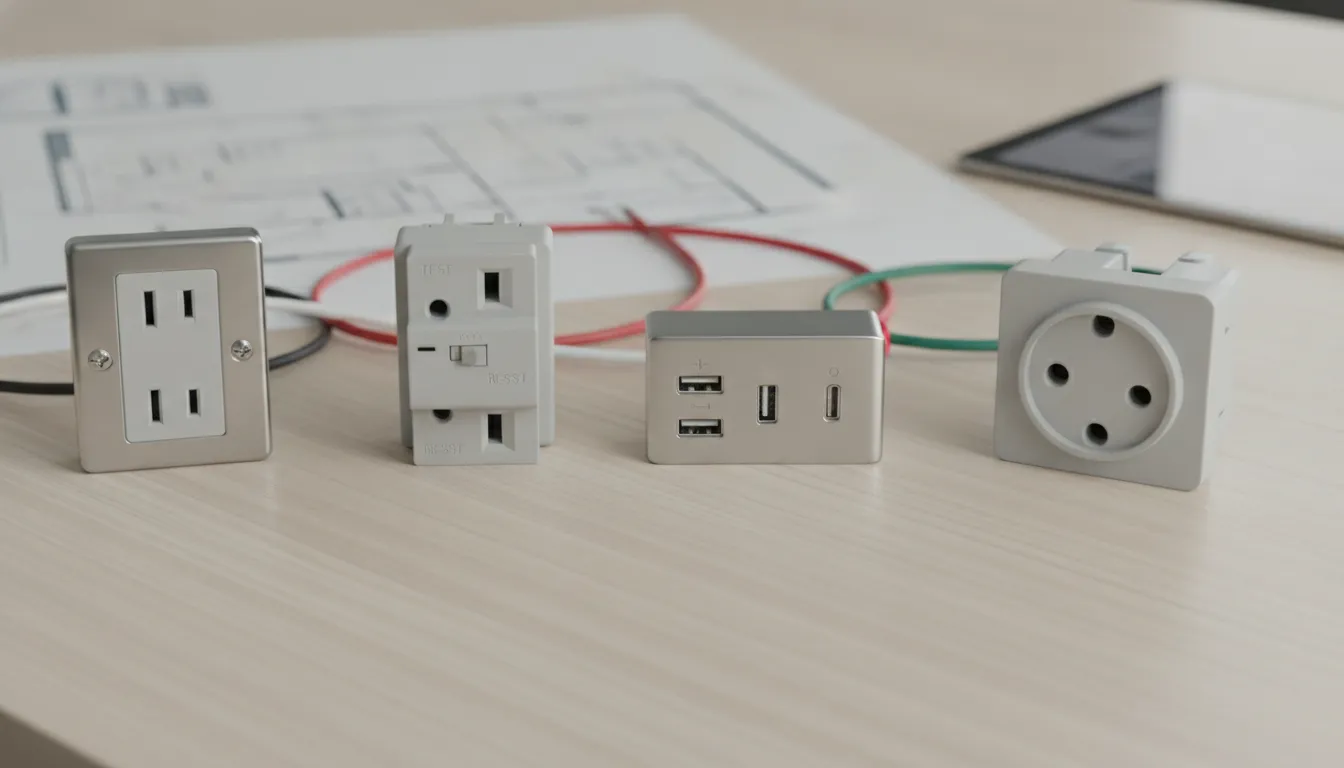
Most homeowners rarely think about an outlet until something goes wrong. Then a plug falls out, a breaker trips, or a receptacle starts making an unsettling buzzing sound. Knowing the differences between outlet types can help you respond before a minor issue becomes a safety hazard. Some outlets protect against ground faults, some help prevent arc-related fires, and others are designed for children or outdoor conditions. This guide breaks down the features that matter, explains which devices belong in each outlet, and shows why professional inspection is important for Sacramento homes.
Key Takeaways
- Check more than plug shape: Confirm voltage, frequency, amperage, wattage, grounding, and circuit capacity before connecting any appliance.
- Respond to outlet warning signs: Stop using outlets that feel warm, spark, buzz, smell burned, look discolored, or fail to hold plugs securely.
- Use professional help for complex work: EV chargers, generators, 240-volt appliances, dedicated circuits, panel upgrades, and specialty outlets require proper planning and installation.
Outlet Types, Plugs, Receptacles, and Standards
Electrical outlets do more than provide a place to plug in an appliance. Each outlet is designed for a particular combination of plug shape, voltage, amperage, frequency, grounding, and safety features. Understanding these differences can help you choose the right replacement outlet and recognize when a connection needs professional attention.
Outlet, receptacle, socket, and plug differences
Although people often use these terms interchangeably, they describe different parts of an electrical connection. An outlet is a point where electricity is supplied for equipment. A receptacle is the wall-mounted device that accepts a plug. A socket is a broader term for a connector that receives another component, although many people use it to describe a light bulb socket.
A plug is attached to an appliance, tool, charger, or cord. Its prongs fit into the receptacle openings and create an electrical connection. The plug and receptacle must match in both physical design and electrical rating. A loose receptacle, damaged plug, or poor connection can create heat and arcing. If a plug falls out, an outlet feels warm, or the faceplate is cracked, stop using it and schedule an electrical outlet inspection.
NEMA, IEC, and national standards
Electrical standards help manufacturers produce plugs, receptacles, and devices that work together more predictably. In North America, the National Electrical Manufacturers Association, or NEMA, establishes standards for many electrical products. NEMA configurations identify features such as blade arrangement, grounding, voltage, and amperage. You can learn more about these classifications through NEMA’s standards resources.
The International Electrotechnical Commission, or IEC, publishes international standards used across many countries. Individual nations and regions may also apply their own electrical codes for installation, protection, and permitted uses. A standard plug shape does not guarantee that every device using that shape is suitable for every circuit.
For example, a receptacle may accept a particular plug while still requiring a specific circuit rating and grounding method. Check the markings on the device, cord, and power supply before use. If the wiring or circuit rating is unclear, a licensed electrician can confirm whether the receptacle is suitable for your home.
Pin shape, polarization, grounding, shutters, and insulated sleeves
Plug pins are designed with specific shapes and positions to help control how a device connects to power. Some plugs have two pins, while others include a third grounding pin. Polarized plugs use different blade widths or shapes so they can enter a receptacle in only one orientation. This helps connect the hot and neutral conductors correctly.
Grounding provides a path for fault current, which can help protective devices disconnect power during a fault. Some receptacles use shutters that block access to energized contacts unless matching prongs enter together. Insulated sleeves on portions of plug pins can also reduce contact with energized metal while inserting or removing a plug.
These features differ by country and outlet type. The IEC world plugs guide explains many international configurations, but the plug’s appearance alone does not confirm that a connection is properly grounded or rated for the circuit.
Voltage, amperage, frequency, and wattage ratings
Every outlet and device has electrical limits. Voltage describes electrical pressure, while amperage describes the amount of current flowing through a circuit. Frequency, measured in hertz, affects equipment such as motors, clocks, and timers. Wattage describes the amount of power a device uses.
The outlet, wiring, breaker, and connected equipment must be properly matched. An appliance that draws more current than the circuit can carry may trip the breaker, overheat wiring, or create a fire risk. A 20-amp receptacle does not automatically make a circuit suitable for a 20-amp load. The breaker, conductors, connections, and panel must support that demand.
Check the label on an appliance or power supply before connecting it. If you are adding a high-demand appliance or are unsure whether an existing circuit can handle the load, ask about new circuit installation and a professional load evaluation.
Why outlet shape does not confirm compatibility
A plug can physically fit into a receptacle and still be unsuitable. The outlet may have a different voltage, frequency, grounding arrangement, or amperage rating than the device requires. A plug adapter may change the shape of the connection without changing the electricity supplied to the device. As World Standards explains, a fitting plug does not always confirm safe or complete compatibility.
This matters with imported appliances, travel adapters, older outlets, and universal receptacles. A device designed for 230 volts should not be connected to a 120-volt system simply because the prongs fit. Likewise, a three-prong plug does not prove that the receptacle is properly grounded.
Review the device label, outlet markings, and circuit information before use. Do not force a plug, defeat a grounding pin, or rely on an adapter to correct an electrical mismatch. If the wiring is old, damaged, modified, or unclear, an electrician can determine whether the outlet needs repair, replacement, or a properly rated circuit.
What Outlet Types Are Used Worldwide?
Outlet designs differ because countries developed their electrical systems under separate national standards. The plug shape identifies the physical connection, but it does not confirm the voltage, frequency, grounding method, or safe load. Always check those details before using an appliance, particularly when traveling or importing equipment.
The World Standards plug and socket guide provides a helpful overview of outlet types by country. Most Sacramento homes use North American Type A and Type B receptacles, but learning how other systems work can help you choose travel equipment and identify compatibility problems.
A plug adapter changes the shape of the connection. It does not automatically convert voltage, frequency, or amperage. Some devices work with different electrical systems, while others require a converter or should not be used at all. Read the appliance label before connecting it, and contact a licensed electrician if an outlet or imported device creates uncertainty.
Types A and B: North American and Japanese outlets
Type A plugs have two flat, parallel blades. They are widely used in the United States, Canada, Mexico, Japan, and other regions. Because Type A plugs do not have a grounding pin, they are commonly used with devices designed for two-wire, ungrounded operation.
Type B plugs add a rounded or U-shaped grounding pin. Type B receptacles accept both Type A and Type B plugs, although a two-slot receptacle does not provide a grounding connection for a three-prong appliance. That distinction matters for equipment with exposed metal parts or a grounded power cord.
Sacramento homes commonly use Type B receptacles on 120-volt circuits. Japan uses similar plug designs, but its voltage and frequency standards can differ from those in the United States. A plug that fits may still be unsuitable for an appliance. Check the device label for its accepted voltage and frequency before use.
Types C, E, and F: European outlets
Type C plugs have two round pins and are common across Europe. They are often used for low-power, double-insulated products such as phone chargers, radios, and small electronics. Since Type C plugs do not include a grounding connection, they are not appropriate for every appliance.
Type E receptacles, common in France, Belgium, Poland, Slovakia, and the Czech Republic, use a grounding pin that extends from the socket. Type F receptacles, often called Schuko outlets, use grounding contacts on the sides. They are widely used in Germany, Spain, Portugal, and other European countries.
Some modern receptacles accept both Type E and Type F plugs, but physical compatibility is only one part of the safety check. European household systems commonly use approximately 230 volts at 50 hertz, compared with the typical 120-volt supply in Sacramento. The International Electrotechnical Commission’s plug and socket information offers additional reference material for international systems.
Type G: UK and Irish outlets
Type G outlets are common in the United Kingdom, Ireland, Cyprus, Malta, Malaysia, and Singapore. They use three rectangular pins arranged in a triangular pattern. The longer top pin typically operates shutters that cover the live and neutral contacts, helping prevent objects from entering the socket.
Many Type G plugs also contain a fuse. The fuse size generally corresponds to the appliance and helps protect the flexible cord from excessive current. This design differs from standard US plugs, which typically do not contain a fuse in the plug body.
Type G systems generally provide approximately 230 volts at 50 hertz. A travel adapter can allow a Type A or Type B plug to connect to a Type G outlet, but the adapter does not change the electrical supply. Check whether the appliance supports the local voltage and frequency. High-wattage devices may require equipment designed specifically for that system.
Types D and M: Indian, South African, and nearby standards
Type D plugs use three large round pins arranged in a triangular pattern. They are associated with India, Nepal, Sri Lanka, and some nearby regions. Type M has a similar layout but uses larger pins and is designed for higher current ratings. It is primarily used in South Africa, Lesotho, and Eswatini.
Although these plugs have three pins, their dimensions and electrical ratings differ from Type B and other grounded designs. A plug should never be forced into a receptacle, and a basic shape adapter does not necessarily provide a reliable grounding path.
Imported equipment also requires a label check. Confirm the appliance’s voltage, frequency, and current requirements before connecting it. Some devices may accept a wide voltage range, while others need a step-down or step-up converter. A converter must also be rated for the appliance’s wattage, especially when used with heaters, motors, or kitchen equipment.
Type H: Israeli outlets
Type H outlets are used in Israel and the Palestinian territories. Traditional Type H plugs have three round pins arranged in a triangular pattern. Newer versions commonly use flat pins and may accept Type C plugs, but compatibility depends on the specific plug and receptacle design.
Electrical systems using Type H outlets generally provide approximately 230 volts at 50 hertz. That differs substantially from the typical 120-volt residential supply in Sacramento. A US appliance designed only for 120 volts may require a step-down converter, but the converter must have a sufficient wattage rating.
Frequency can also affect performance. Motors, clocks, fans, and some heating equipment may not operate correctly when connected to a different frequency, even if the voltage is converted. Check the appliance label for wording such as “100 to 240 V” or “50/60 Hz.” If the label does not clearly identify the device’s requirements, do not rely on a plug adapter alone.
Type I: Australian, New Zealand, Chinese, and Argentine outlets
Type I plugs use two angled flat pins. A third vertical pin provides grounding on grounded versions. Type I systems are used in Australia, New Zealand, China, Argentina, and several nearby locations, although small differences can exist in plug dimensions, ratings, and wiring standards.
Australia and New Zealand generally use approximately 230 volts at 50 hertz. China commonly uses 220 volts at 50 hertz, while Argentina also has regional electrical variations. These differences mean that a Type I plug is not automatically interchangeable across every country using the designation.
Universal travel adapters may accept a Type I plug, but they do not confirm that the device is safe to operate. Read the voltage and frequency information printed on the charger or appliance. Many modern phone and laptop chargers accept a broad input range, while appliances with heating elements or motors may require a dedicated converter or a locally rated replacement.
Types J, K, L, N, and O: Swiss, Danish, Italian, Brazilian, and Thai outlets
Type J outlets are used mainly in Switzerland and Liechtenstein. Type K outlets are associated with Denmark and Greenland. Type L outlets are common in Italy and may be available in different current ratings, so a plug and socket can look similar without having identical capacity.
Type N outlets are used primarily in Brazil and are also found in South Africa in limited applications. Brazil uses more than one nominal voltage, depending on the location, so checking the local supply is essential. Type O is associated with Thailand, where it was developed for compatibility with the country’s electrical standards. Travelers may also encounter sockets that accept more than one plug design.
These systems differ in pin spacing, grounding arrangements, and current ratings. Do not judge compatibility by appearance alone. The International Trade Administration’s country guides can provide useful country-specific information, but the appliance label and local electrical requirements should guide the final decision.
Grounded, ungrounded, hybrid, and legacy outlets
Grounded outlets provide a dedicated path for fault current through a grounding pin, contact, or conductor. If a fault energizes an appliance’s metal case, the grounding path helps protective equipment disconnect power. Ungrounded outlets lack that connection and are generally intended for devices designed with double insulation.
Hybrid outlets accept more than one plug style, but they are not universally compatible. They may still have restrictions involving voltage, current, grounding, or the depth of the plug connection. A socket that accepts a plug physically may not provide the protection the appliance requires.
Legacy outlets are older designs that remain in some homes and buildings. They may have worn contacts, loose wiring, missing grounding, or no protection required for a modern installation. In a Sacramento home, an electrician can inspect the circuit and recommend an appropriate replacement, such as a grounded, GFCI, AFCI, tamper-resistant, or weather-resistant receptacle. AAA Electrical Services’ outlet and electrical services can help identify whether the issue involves the receptacle, wiring, or the circuit itself.
How Do Outlet Types Vary by Region?
Outlet designs vary by region because electrical systems vary too. Plug shape is only one part of the standard. Voltage, frequency, amperage, grounding, polarity, and safety features also determine whether an appliance can operate safely.
This matters when you travel, import an appliance, or move into an older home. A plug adapter can change the shape of a connection, but it cannot correct an incompatible power supply. Use the World Standards guide to plugs and sockets to compare outlet designs, voltage systems, and regional requirements.
North American NEMA and 120/240-volt systems
The United States, Canada, Mexico, and several nearby regions commonly use NEMA standards for plugs and receptacles. In a typical Sacramento home, a standard household outlet is a NEMA 5-15 receptacle, rated for 15 amps and 120 volts. It generally has two vertical slots and a rounded grounding opening for three-prong plugs.
North American homes also use 240-volt circuits for high-demand equipment, such as electric ranges, clothes dryers, air conditioning systems, heat pumps, and some EV chargers. These circuits use different NEMA configurations, so a 240-volt plug should never be forced into a standard 120-volt outlet. The NEMA outlet system identifies each configuration by its shape, current rating, and voltage.
European outlets and 230-volt systems
Much of Europe uses electrical systems rated at 220 to 240 volts, with 230 volts serving as the common nominal rating. Types C, E, and F are widespread. Type C plugs usually have two round pins and no grounding connection, while Types E and F use different grounding designs.
A North American 120-volt appliance may be damaged if connected directly to a European 230-volt outlet, even if an adapter makes the plug fit. Some modern chargers accept a range from 100 to 240 volts, but check the label before connecting one. European systems also commonly operate at 50 hertz. That difference can affect motors, clocks, fans, and other frequency-sensitive devices.
UK plugs, fuses, and built-in shutters
The United Kingdom, Ireland, and some regions influenced by British standards commonly use Type G outlets. These receptacles have three rectangular pins arranged in a triangular pattern. Built-in shutters help block access to the live and neutral contacts when the grounding pin is not engaged.
Type G plugs also include a fuse, which helps protect the appliance cord from excessive current. Replace a damaged fuse only with the correct type and rating. A Type G plug is not compatible with North American or most continental European outlets, even though all of these systems use household AC power. The Type G design shows how a regional standard can combine grounding, child safety, and overload protection in one plug and receptacle system.
Regional Type I, J, K, L, and N differences
Type I uses two angled flat pins and a grounding pin. It is common in Australia, New Zealand, China, Argentina, and several Pacific countries. These regions may share a plug family, but their voltage, frequency, and installation requirements can differ.
Types J, K, L, and N are associated with Switzerland and Liechtenstein, Denmark, Italy and Chile, and Brazil and South Africa, respectively. Type J uses three grounded pins, while Type K is a Danish standard commonly rated at 16 amps. Type L is available in versions with different current ratings. Type N includes 10-amp and 20-amp versions in Brazil. Review the regional socket specifications before using an appliance abroad or installing an imported receptacle.
Countries with multiple outlet, voltage, or frequency standards
Some countries use more than one electrical standard within their borders. Brazil, for example, has both 127-volt and 220-volt regions and uses Type N outlets in 10-amp and 20-amp versions. China commonly uses plugs rated at 10 or 16 amps and up to 250 volts, with local standards that can vary by installation and appliance.
Voltage can differ between cities, buildings, and circuits. Frequency may vary as well, and an appliance designed only for 50 hertz or 60 hertz may not work correctly on the other frequency. Before using an imported device, read its label for voltage, frequency, amperage, and wattage. An adapter changes the plug shape, but it does not change the electricity supplied by the outlet.
Legacy outlets in older buildings
Older buildings may contain obsolete receptacles, ungrounded outlets, or outlets that no longer meet current safety expectations. An old outlet may still power a lamp while providing a weak connection, unreliable grounding, or inadequate protection for modern equipment. Worn contacts, loose connections, cracked covers, and discoloration are warning signs.
Do not replace an unusual outlet based only on its appearance. A qualified electrician should check the circuit wiring, breaker size, grounding arrangement, and local requirements before installing a new receptacle. For a Sacramento home, an electrical inspection from AAA Electrical Services can help determine whether an older outlet needs repair, replacement, GFCI protection, or a broader circuit correction.
Why a fitting plug may still be incompatible
A plug that fits an outlet may still be unsafe or unsuitable. Physical compatibility does not confirm that the voltage, frequency, current capacity, grounding, or polarity match the appliance requirements. An adapter may let a two-pin plug connect to a three-slot receptacle, but it cannot create a grounding path or change 120 volts into 230 volts.
Check the appliance label and compare its requirements with the outlet and circuit rating. Pay close attention to heaters, hair dryers, motors, kitchen appliances, and other high-wattage devices. If an appliance needs a different voltage, a dedicated circuit, or reliable grounding, stop using the adapter and contact a licensed electrician for an evaluation.
Which Voltage and Frequency Apply to Each Outlet Type?
An outlet’s shape shows how a plug connects to a receptacle, but it does not provide the complete electrical picture. Voltage, frequency, amperage, wattage, and grounding depend on the country, building, circuit, and outlet design. Two receptacles that look similar may serve very different electrical systems.
Before plugging in an appliance, compare the device label with the outlet and circuit. The World Standards guide to plug and socket types offers a useful overview of regional plug shapes, voltages, and frequencies. If you are unsure about an outlet in your home, have an electrician test the circuit instead of relying on its appearance.
In Sacramento homes, standard receptacles generally supply 120 volts. Larger appliances, EV chargers, and other high-demand equipment may require 240 volts, a dedicated circuit, or both. AAA Electrical Services provides residential electrical services, including outlet repairs, circuit installations, and electrical upgrades.
Common 100–120-volt systems
Types A and B are common in North America and Japan, where electrical systems generally provide about 100 to 127 volts. In the United States, household receptacles typically supply 120 volts, although a meter may show a slightly different reading under normal conditions.
Type A plugs have two flat blades. Type B plugs add a grounding pin, which connects compatible equipment to the circuit’s grounding system. Newer homes commonly use grounded Type B receptacles for appliances, electronics, and general-purpose outlets. Older two-slot receptacles may not include an equipment grounding conductor, even when they accept some two-prong plugs.
A 120-volt circuit can supply many lamps, televisions, chargers, kitchen appliances, and other everyday devices. However, a standard-looking plug does not guarantee that an appliance is suitable for every circuit. Check the device rating, circuit capacity, and receptacle condition before use.
Common 220–240-volt systems
Types C, E, and F are widespread in regions that generally use 220 to 240 volts, including much of Europe and nearby countries. Type C plugs typically have two round pins, while Types E and F use different grounding arrangements.
A device designed only for 120 volts can be damaged by a 230-volt supply. Likewise, equipment made only for 230 volts may not operate correctly on a 120-volt circuit. A plug adapter changes the physical connection, but it does not change the voltage.
Some appliances accept a voltage range, such as 220 to 240 volts. Others need a step-up or step-down converter when used with a different electrical system. Check the manufacturer’s label before using imported equipment, especially if the appliance contains a motor, heating element, compressor, or sensitive control board.
50 Hz and 60 Hz frequencies
Electrical frequency describes how often alternating current changes direction each second. Many countries use 50 hertz, while North America commonly uses 60 hertz. Voltage and frequency are separate specifications, so you need to check both before using an appliance.
Many modern power supplies accept 100 to 240 volts at 50 or 60 hertz. Phone chargers, laptop adapters, camera chargers, and similar electronics often support this universal input range. You may still need a plug adapter if the device’s plug does not match the local receptacle.
Frequency matters more for motors, clocks, fans, pumps, and some heating or control equipment. A motor designed for 60 Hz may run at a different speed on 50 Hz power. The AC power plug and socket reference explains why voltage and frequency should both be part of your compatibility check.
How to read voltage, frequency, amperage, and wattage labels
Look for an information label on the appliance, power brick, cord, or manufacturer’s instructions. Common markings include:
- Voltage: Listed in volts, or V, such as 120 V or 230 V
- Frequency: Listed in hertz, or Hz, such as 50 Hz or 60 Hz
- Current: Listed in amperes or amps, shown as A
- Power: Listed in watts, shown as W
A label reading “100 to 240 V, 50/60 Hz” usually means the device can accept power from either voltage system without a separate transformer. A label listing only “120 V” means the appliance should not be connected directly to a 230-volt outlet.
Check the appliance’s voltage, frequency, and current requirements before plugging it in. Also inspect the cord and plug for fraying, bent pins, scorch marks, or loose connections. A compatible outlet cannot make a damaged cord or overloaded circuit safe. If the label is missing or unreadable, ask an electrician or contact the manufacturer before using the device.
Dual-voltage devices and universal-input chargers
Dual-voltage devices are designed to operate on two voltage ranges, often 120 and 240 volts. Some use a manual selector, while others adjust automatically. A universal-input charger may state “100 to 240 V, 50/60 Hz” on its label, indicating that it can accept power from a broad range of electrical systems.
A dual-voltage device may still need a travel adapter if its plug does not fit the receptacle. The adapter changes the plug shape, not the electrical supply. A single-voltage device may require a properly rated step-up or step-down converter.
Converter capacity matters. A unit designed for a small phone charger may not safely operate a hair dryer, space heater, coffee maker, or other high-wattage appliance. The AC plug and socket guidance notes that a converter may be necessary when an appliance is not designed for the local voltage. Follow the manufacturer’s instructions, and avoid unknown converters with heat-producing equipment.
Nominal versus actual circuit voltage
The voltage printed on an outlet or appliance is usually nominal. This identifies the standard voltage category, but it does not promise an exact reading at every moment. A North American circuit called 120 volts may measure somewhat higher or lower depending on the utility supply, wiring length, connected load, and other conditions.
Small variations are usually expected. Larger fluctuations may indicate a wiring or supply problem, especially when paired with flickering lights, appliances that struggle to start, warm receptacles, or repeated breaker trips. An electrician can measure the circuit and identify the cause.
Extension cords also need the correct rating. An undersized cord carrying a high-power load can overheat and create a fire hazard. As electrical safety guidance explains, cord and appliance ratings must work together. If a device needs a dedicated circuit, do not substitute a long extension cord or crowded power strip.
North American 15-amp and 20-amp outlets
In Sacramento homes, standard receptacles are usually part of 120-volt branch circuits. A 15-amp receptacle commonly has two vertical slots and a grounding opening. A 20-amp receptacle has one slot shaped like a sideways T, allowing compatible 20-amp plugs to connect.
The receptacle rating must match the circuit, wiring, and overcurrent protection. Installing a 20-amp receptacle on a circuit that is not designed for 20 amps creates a dangerous mismatch. A 15-amp receptacle may be allowed on certain multi-outlet 20-amp circuits, but the complete installation must meet applicable electrical requirements.
The National Electrical Manufacturers Association establishes standards for many North American plugs and receptacles. These configurations help identify intended voltage and current applications, but the outlet shape is only one part of the assessment. Before replacing a receptacle, have an electrician verify the circuit, conductor size, grounding, and breaker.
240-volt outlets for dryers, ranges, HVAC, and EV chargers
Many high-demand appliances use 240-volt circuits, including electric dryers, ranges, air-conditioning equipment, heat pumps, water heaters, and EV chargers. In a North American split-phase system, these circuits use two ungrounded conductors to provide a higher voltage than a standard 120-volt branch circuit.
The receptacle must match the appliance plug, circuit rating, conductor size, breaker, and grounding arrangement. Older installations may use outlet configurations that are not suitable for newer equipment. Do not replace a 240-volt receptacle based only on whether the plug appears to fit.
EV chargers require particular care because they may draw substantial current for several hours. A home charger may need a dedicated 240-volt circuit, a load calculation, and permits or inspections. AAA Electrical Services offers EV charger installation for homeowners who need the charger and electrical system evaluated together.
Load calculations, breaker sizing, and dedicated circuits
The total electrical load matters more than the number of outlets. A single receptacle may supply a low-power phone charger, or it may serve a high-demand appliance that uses much of the circuit’s capacity. Adding receptacles does not create additional power capacity.
An electrician considers the appliance’s rated current, expected continuous load, conductor size, breaker rating, circuit length, and electrical panel capacity. HVAC equipment, pumps, large kitchen appliances, and EV chargers may need dedicated circuits to reduce overloads and nuisance trips.
Never solve a tripping breaker by installing a larger breaker. The breaker protects the wiring, so changing its rating without checking the conductors and equipment can create a fire risk. If your panel lacks capacity for a new appliance, panel repair or installation may be safer than modifying an existing circuit.
Which Safety Features Matter in Residential Outlets?
The safest outlet is not always the newest-looking one. It must match the circuit, location, connected device, and wiring behind the wall. A bathroom outlet needs different protection from a living room receptacle, while an outlet for an EV charger, electric dryer, or workshop tool may need a dedicated circuit with a higher amperage rating.
Look beyond the number of slots and the shape of the receptacle. Grounding, polarization, GFCI and AFCI protection, weather resistance, tamper resistance, and certification markings all affect outlet safety. The National Electrical Code provides widely used installation requirements, but Sacramento-area homes may also be subject to local rules and permit requirements.
If you are unsure whether an outlet is properly protected, do not rely on its appearance. An electrician can inspect the receptacle, wiring, breaker, and circuit as one system.
Grounded and ungrounded outlets
A grounded outlet has a connection for an equipment grounding conductor, usually represented by the round opening in a three-slot receptacle. If a fault sends electricity onto a metal appliance enclosure, the grounding path helps carry that current back to the electrical panel. The breaker or another protective device can then disconnect power.
Older homes may still have ungrounded two-slot outlets. Replacing one with a three-slot receptacle does not create a ground if the wiring lacks an equipment grounding conductor. That change can create a false sense of safety and leave appliances improperly protected.
A qualified electrician should test the wiring before recommending a replacement. Depending on the installation, the safest option may involve correcting the grounding, installing GFCI protection where permitted, or replacing part of the circuit. Never use a cheater plug or remove a grounding pin just to make a device fit.
Polarized plugs and receptacles
Polarized plugs have one wider blade and one narrower blade, allowing them to fit into a polarized receptacle in only one orientation. This design helps keep the hot and neutral conductors connected as intended. Many lamps, chargers, and small appliances rely on that arrangement for safer operation.
Do not file down a wide blade, force a plug into an outlet, or use an adapter that defeats polarization. A receptacle can also have reversed polarity even when it looks normal from the outside. A basic plug-in tester may identify some wiring problems, but it cannot confirm every safety condition.
If a plug fits loosely, an outlet feels warm, or a device behaves unexpectedly, stop using it. An electrician can test polarity, grounding, connections, and the condition of the receptacle before making a repair.
GFCI protection in kitchens, bathrooms, garages, and outdoor areas
Ground-fault circuit interrupter, or GFCI, protection is designed for locations where electricity may come into contact with water or a person standing on a conductive surface. Kitchens, bathrooms, laundry areas, garages, unfinished basements, and outdoor locations commonly require GFCI protection under applicable codes.
When a GFCI detects an imbalance between outgoing and returning current, it shuts off power quickly. Press the Test button periodically, then press Reset if the device trips as expected. A GFCI that will not reset, trips repeatedly, or has visible damage needs attention.
GFCI protection reduces shock risk, but it does not repair damaged wiring, replace equipment grounding, or make an overloaded circuit safe. The U.S. Consumer Product Safety Commission explains GFCI protection, including why these devices are important near water.
AFCI protection and arc-fault risks
Arc-fault circuit interrupters, or AFCIs, help identify dangerous arcing caused by damaged cords, loose connections, crushed wires, or deteriorated insulation. Arcing can produce intense heat and may start a fire inside a wall, outlet box, or appliance. AFCI protection is commonly required for many residential circuits, including circuits serving bedrooms and living areas, depending on the applicable code.
AFCI protection may come from a breaker, an outlet, or a combination of devices. If an AFCI trips repeatedly, do not keep resetting it or replace it with a standard breaker. Unplug connected equipment and see whether the problem continues with nothing plugged in.
An electrician can determine whether the cause is a faulty appliance, damaged wiring, a loose connection, or a protective device that needs replacement. Repeated trips are a warning, not an inconvenience to ignore.
Tamper-resistant outlets for children
Tamper-resistant receptacles have internal shutters that cover the contact openings until equal pressure is applied to both slots. This helps prevent a child from inserting a key, hairpin, toy, or other object into one side of the outlet. They are useful in bedrooms, playrooms, living areas, and other spaces used by young children.
Tamper-resistant outlets do not replace supervision or other child-safety practices. Never remove the internal shutters, wedge objects into the openings, or force a plug into a damaged receptacle. If the outlet is cracked, loose, or discolored, replace it even if the shutters still appear to work.
When installing or replacing outlets, an electrician should match the device to the circuit and confirm that the electrical box and wiring can support it. A properly installed tamper-resistant outlet should accept a standard plug without excessive force.
Weather-resistant outlets and in-use covers
Outdoor outlets face rain, irrigation, humidity, dirt, and temperature changes. Weather-resistant receptacles use materials designed for these conditions, while an in-use cover helps shield the plug and receptacle when a cord remains connected. Both features matter on patios, garages, exterior walls, and garden areas.
Outdoor outlets also typically need GFCI protection and proper grounding. Make sure the cover closes fully and that cords do not create a path for water to enter. Do not rely on a standard indoor cover or a loose plastic cap for long-term protection.
Keep outdoor connections away from standing water, and inspect covers after storms or landscaping work. The NFPA electrical safety guidance includes practical reminders for using electricity safely outside the home.
Recessed sockets and insulated pin sleeves
Recessed sockets place live contact areas farther inside the receptacle, which can reduce accidental contact during normal use. Some plug designs also include insulated sleeves around portions of the pins. These features limit exposure to energized metal while a plug is being inserted or removed.
They do not make a damaged or incompatible outlet safe. Never touch exposed plug pins, use a plug with bent or missing insulation, or leave a plug partially inserted into a receptacle. Keep outlets clear of debris and replace devices with cracked faces or loose internal parts.
If an outlet sits too far forward, pulls away from the wall, or cannot hold a plug securely, an electrician should inspect the electrical box and mounting hardware. A loose outlet can place stress on the wiring each time someone plugs in or removes a device.
Heavy-duty outlets for high-current loads
Heavy-duty receptacles are designed for equipment that draws more current than typical household electronics. They may be appropriate for certain workshop tools, compressors, large appliances, HVAC equipment, or other high-demand loads. The receptacle rating must match the circuit conductors, breaker, plug, and equipment requirements.
A heavy-duty outlet cannot increase the capacity of an existing circuit. Installing a 20-amp receptacle on wiring that is not designed for 20 amps can create an overheating hazard. High-current appliances may also need a dedicated circuit, a special plug configuration, or a 240-volt connection.
Before changing an outlet, check the breaker rating and appliance label. A qualified electrician should verify the entire circuit, including wire size, connections, grounding, box capacity, and load requirements. This is particularly important for equipment that runs for long periods or draws a large starting current.
Surge-protective outlets and whole-home surge protection
Surges can occur when utility equipment switches, power is restored after an outage, or lightning affects nearby electrical systems. Surge-protective outlets and plug-in surge protectors can help protect connected electronics, but their effectiveness depends on proper installation, product ratings, and the condition of the home’s electrical system. They are not the same as ordinary power strips.
Whole-home surge protection is installed at the electrical panel and can help protect multiple circuits throughout the house. It may be worth discussing if your home has sensitive electronics, solar equipment, an EV charger, a generator, or frequent electrical disturbances.
Surge protection does not repair faulty wiring or prevent every possible surge. AAA Electrical Services can help homeowners evaluate whole-home surge protection as part of a broader electrical safety plan.
Test buttons, reset buttons, certification marks, and code compliance
GFCI and AFCI devices usually include buttons or controls that let homeowners test their protective function. Follow the manufacturer’s instructions and address any device that will not trip during a test, will not reset afterward, or trips without an obvious cause. Do not tape down a button or leave a repeatedly tripping device disconnected from service.
Look for recognized certification marks, such as UL or ETL, on the device and packaging. These marks indicate that the product has been evaluated against applicable safety standards, but they do not confirm that it was installed correctly. Proper installation also depends on location, wiring method, box size, circuit protection, and local requirements.
If you are planning an outlet replacement or electrical upgrade, AAA Electrical Services can inspect the installation and explain which electrical services may be appropriate for your home.
Double-insulated devices and grounding limits
Double-insulated appliances use two layers of electrical insulation and may have a two-prong plug instead of a grounding pin. A symbol showing a square inside another square commonly identifies this design. These devices can operate safely when used as directed, with an intact cord and undamaged housing.
Double insulation applies to the appliance, not to every electrical device in your home. It does not make a damaged cord safe, permit removal of a grounding pin, or justify using an ungrounded adapter with equipment that requires a ground.
Never defeat grounding to make a plug fit. If an appliance has a three-prong plug, use a properly grounded receptacle or ask an electrician to determine the safest correction. If you are uncertain whether an outlet is grounded, damaged, or compatible with a device, stop using it until the circuit has been inspected.
How Do You Choose Outlets for Common Devices?
Choosing an outlet involves more than matching the plug to the receptacle. Before connecting a device, confirm its voltage, amperage, wattage, grounding requirements, and the circuit’s available capacity. A plug adapter can change the shape of a connection, but it usually does not change the voltage. Using the wrong combination can damage equipment, trip a breaker, overheat wiring, or create a fire hazard.
Start by reading the device label and installation instructions. Then check the outlet and circuit ratings. If the information is unclear, or if the equipment requires a new circuit, have a licensed electrician inspect the setup. AAA Electrical Services provides residential electrical services throughout the Sacramento metropolitan area, including outlet repairs, new circuits, and specialty installations.
Match the plug, voltage, amperage, and wattage
The plug should fit the receptacle without force, but a fitting connection does not prove that the device is compatible. Check the voltage and amperage ratings on both the device and outlet. The device’s wattage should also remain within the circuit’s safe capacity. The outlet and circuit must meet the device’s requirements, while the wiring and breaker must be sized for the full load.
Pay attention to polarized and grounded plugs. A three-prong plug needs a properly grounded receptacle, not merely an outlet with three openings. Never remove the grounding pin or use a damaged adapter to force a connection. Cable Matters explains common outlet ratings and configurations, but a local inspection is the best way to confirm that an older home’s wiring is safe.
Standard 15-amp outlets for lamps, chargers, and electronics
Most lamps, phone chargers, televisions, computers, and small electronics use standard 120-volt receptacles. A typical 15-amp outlet is suitable for everyday devices when the circuit is in good condition and the combined load remains within its limit. Check each device’s label before plugging in equipment, especially when several appliances share one circuit.
Avoid connecting high-wattage appliances, such as portable heaters or countertop cooking equipment, to a crowded circuit. Warning signs of an overloaded or failing outlet include warmth, discoloration, buzzing, a burning smell, or a plug that falls out. Stop using the outlet if you notice any of these problems, and request an outlet inspection or repair from a qualified electrician.
20-amp outlets for kitchens, laundry rooms, garages, and workshops
Some kitchens, laundry rooms, garages, and workshops need 20-amp circuits for equipment with higher electrical demands. A 20-amp receptacle commonly has a T-shaped slot and is designed for a matching 20-amp plug. The receptacle must match the circuit wiring and breaker. Installing a 20-amp outlet on a circuit that is not designed for 20 amps does not increase the circuit’s capacity.
Shop tools, air compressors, washing machines, and some countertop appliances may require a 20-amp circuit. The equipment label and installation instructions should identify the requirement. If a breaker trips when you use a tool or appliance, do not replace it with a larger breaker. An electrician can determine whether the circuit needs repair, a dedicated run, or a new circuit installation.
USB-A and USB-C outlets and charging limits
USB-A and USB-C receptacles can reduce cord clutter by allowing you to charge compatible devices directly from the wall. Their performance varies, however. Some provide basic power for phones and small electronics, while others support faster charging or higher-power devices. Check the outlet’s USB output and compare it with the requirements for your phone, tablet, laptop, or other equipment.
A USB-C opening does not automatically mean the outlet supports every USB-C feature. It may not provide the power delivery, data transfer, or charging speed your device needs. Choose a listed product from a reputable manufacturer, and replace it if it becomes hot, loose, cracked, or discolored. Professional installation also allows an electrician to check the electrical box, wiring, grounding, and available space.
Smart outlets, connected devices, and load ratings
Smart outlets can provide remote control, scheduling, energy monitoring, and other convenient features. They may work well for lamps, seasonal lighting, fans, and certain small appliances, but they still have load limits. Review the smart outlet’s ratings for resistive, motor, and electronic loads before connecting a refrigerator, pump, heater, or power tool.
A smart outlet may also need a reliable Wi-Fi connection and, in some cases, a neutral wire in the electrical box. Do not use one as a substitute for a properly sized circuit or required disconnect. If a connected device controls equipment that must remain on, such as a freezer or medical device, consider what will happen if the outlet loses power, the network disconnects, or the smart device fails.
240-volt outlets for high-demand appliances
Electric dryers, ranges, ovens, air conditioners, heat pumps, and some workshop equipment often use 240-volt circuits. These appliances require specific receptacles, wiring, breakers, and installation instructions. The outlet must match the appliance plug and circuit configuration. A standard 120-volt receptacle cannot safely power 240-volt equipment.
Do not convert a 120-volt outlet by changing only the receptacle or breaker. A 240-volt installation may require new cable, a two-pole breaker, updated grounding or bonding, and adequate space in the electrical panel. AAA Electrical Services handles panel repair and installation when a high-demand appliance exceeds the capacity of an existing electrical system.
Dedicated outlets for refrigerators, freezers, HVAC, and pumps
Large appliances with motors or compressors can draw extra current when they start. Refrigerators, freezers, HVAC equipment, sump pumps, well pumps, and similar devices may need dedicated circuits so they can operate without competing with other loads. Follow the manufacturer’s instructions and local electrical requirements instead of relying on the appliance’s plug shape alone.
A dedicated circuit can help prevent nuisance breaker trips and reduce voltage drop. The outlet’s amperage must meet or exceed the equipment’s requirements, but the circuit still needs the correct wire size, breaker, receptacle, and overcurrent protection. If a refrigerator or pump repeatedly trips a breaker, have both the appliance and circuit inspected before replacing the breaker.
EV charging outlets, hardwired chargers, and dedicated circuits
Electric vehicle chargers place a sustained load on a home’s electrical system. Level 1 charging may use a standard 120-volt outlet, while Level 2 charging generally requires a 240-volt circuit. The charger’s installation guide should specify the amperage, receptacle type, wire size, and whether the unit can be plugged in or must be hardwired.
An EV charger should usually have a dedicated circuit because other appliances sharing the circuit can cause an overload. An electrician may also need to evaluate the service panel, available capacity, cable route, outdoor protection, and local permit requirements. AAA Electrical Services offers EV charger installation for Sacramento-area homeowners who need a properly sized charging setup.
Generator inlets, transfer equipment, and backup power
Portable and standby generators require more than a heavy-duty extension cord. A generator inlet, transfer switch, or approved interlock helps connect backup power without sending electricity back through utility lines. This practice, called backfeeding, can seriously injure utility workers, damage equipment, and create a fire risk.
Use only cords and equipment rated for the generator’s output. An undersized cord can overheat when connected to a high-power appliance. Never connect a generator to a household receptacle with a homemade or improvised cord. AAA Electrical Services installs and repairs home generators, including equipment that connects backup power safely to the home.
Outlet and circuit needs for lighting, ceiling fans, and exhaust fans
Lighting, ceiling fans, and exhaust fans often connect to wall switches or ceiling boxes instead of standard plug-in outlets. The electrical box must be rated for the fixture or fan, and the wiring must support the load. Ceiling fans may also need a brace designed for fan installation, particularly when replacing an existing light fixture.
Bathroom exhaust fans and outdoor lighting may require GFCI protection, weather-resistant components, or other safeguards based on their location. A fan with a heater or light kit can draw more power than a basic fan, so check its total wattage before installation. AAA Electrical Services can install and repair lighting and fans while checking the switch, box, wiring, and circuit.
When to use an adapter, replace an outlet, or install a circuit
Use an adapter only when the plug and device are already compatible with the outlet’s voltage, frequency, grounding, and load rating. An adapter should not correct damaged wiring, create a ground where none exists, or make a high-power appliance suitable for a low-capacity circuit. Do not force an incompatible plug into a receptacle.
Replace an outlet when it is cracked, loose, discolored, warm, buzzing, or unable to hold a plug securely. Install a new circuit when an appliance has a dedicated-circuit requirement, the existing circuit trips repeatedly, or the home lacks the correct voltage and capacity. A professional can determine whether the solution is a replacement receptacle, circuit repair, panel work, or a complete new installation.
How Do You Use Adapters and Converters Safely?
Adapters and converters can help you use electrical devices with unfamiliar outlets, but they do not solve every compatibility issue. Before connecting a device, compare the outlet type, voltage, frequency, grounding arrangement, and power rating with the information on the device label. A plug that fits into a receptacle may still be unsuitable for the appliance or unsafe for the circuit.
The first step is to determine whether you need a plug adapter, a voltage converter, a new outlet, or a dedicated circuit. A plug adapter changes the shape of the connection, while a converter changes the supplied voltage. Neither one automatically corrects faulty wiring, missing grounding, an overloaded circuit, or an incompatible frequency.
Portable adapters are useful for temporary connections, but they are not a substitute for properly installed residential wiring. If you need a specialty outlet, new circuit, or permanent connection, AAA Electrical Services can inspect the electrical system and recommend a safe solution. This is especially important for high-demand equipment, outdoor devices, generators, and EV chargers.
Check the outlet type, voltage, and frequency
Start by identifying the outlet and plug type used in the location. Then compare the outlet’s voltage and frequency with the information printed on the device, charger, or power supply. Common ratings include 120 volts at 60 hertz in North America and 230 volts at 50 hertz in many other regions.
Check whether the outlet provides grounding and whether the device requires a grounded connection. The World Standards guide to plug and socket types is a helpful reference for comparing outlet designs, voltages, and frequencies. If the device label is missing or unclear, do not guess. Ask the manufacturer or a qualified electrician before connecting it.
Understand that plug adapters change shape, not voltage
A plug adapter changes the physical shape of a plug so it can fit a different receptacle. It does not increase or reduce the voltage supplied by that receptacle. For example, connecting a 120-volt appliance to a 230-volt outlet with a basic adapter could damage the appliance and create a shock or fire hazard.
Read the device label before using an adapter. If it lists only one voltage, such as 120 volts, you may need a properly rated step-down converter or transformer. If it accepts a range such as 100 to 240 volts, a plug adapter may be enough, provided the device also supports the local frequency.
Identify dual-voltage devices and universal-input chargers
Look for wording such as “100 to 240 V” or “input: 100 to 240 V” on the device, charger, or power brick. This usually means the equipment can accept different supply voltages with the correct plug adapter. You still need to confirm that the device is compatible with the local frequency and that the adapter provides a secure connection.
Many phone, tablet, laptop, and camera chargers use universal inputs. Check the label rather than relying on the charger’s appearance. The U.S. Department of Energy provides guidance on appliance and electronic power use, which can help you understand the ratings printed on household equipment.
Use step-up and step-down converters
A step-down converter reduces a higher supply voltage for a device designed to use a lower voltage. A step-up converter does the opposite. The converter must match the device’s voltage, wattage, and operating requirements. Using the wrong type can damage the equipment or cause the converter to overheat.
Converters are not interchangeable with plug adapters, and they may not be suitable for every appliance. Follow the manufacturer’s instructions, keep the converter uncovered, and leave space around it for ventilation. If an appliance draws substantial power, ask an electrician whether a properly wired circuit would be safer than using a portable converter.
Account for frequency-sensitive clocks, motors, and heaters
Voltage is not the only factor to check. Frequency, measured in hertz, can affect clocks, motors, fans, pumps, and some heating equipment. A motor designed for 60 hertz may run differently on a 50-hertz supply, while a clock that relies on line frequency may lose or gain time.
Heating devices can also draw considerable power, adding demand to a converter or adapter. Check the appliance manual for frequency compatibility before use. If the device contains a motor or heating element and its requirements are unclear, contact the manufacturer instead of testing it by trial and error.
Choose a properly grounded travel adapter
Use a grounded adapter when the device has a grounding pin or when the manufacturer requires a ground connection. Do not remove the ground pin or use an adapter that leaves the grounding path disconnected. Grounding helps provide a safer path for fault current when the electrical system is properly wired.
A three-prong adapter is not automatically safe. The destination receptacle must also have a working ground, and the adapter must be designed for that specific outlet type. The Electrical Safety Foundation International explains grounding and other home electrical safety practices in more detail.
Match adapter and converter wattage to device demand
Check the device’s wattage or amperage before selecting an adapter, converter, power strip, or extension cord. The adapter or converter should have a rating that meets or exceeds the connected load. High-demand appliances, including hair dryers, irons, heaters, coffee makers, and cooking equipment, can quickly exceed the capacity of small travel converters.
An undersized device may become hot, shut down, or suffer internal damage. Never cover a converter while it is operating, and stop using it if you notice heat, smoke, a burning odor, buzzing, or discoloration. For permanent high-demand equipment, have an electrician evaluate the circuit and connection.
Remember that universal adapters do not guarantee compatibility
A universal adapter may accept several plug shapes, but physical fit does not confirm electrical compatibility. The outlet may provide the wrong voltage, frequency, or grounding arrangement for your device. Some universal products also leave parts of a plug exposed or fail to provide a secure connection.
Check the adapter’s voltage and current ratings, grounding design, and safety certification before use. Look for certification from a recognized testing organization, such as UL in the United States. If the adapter feels loose or the plug does not seat fully, disconnect it and choose a product made for that specific outlet type.
Use power strips, extension cords, and multi-outlet adapters safely
Add up the wattage of every device connected to a power strip or extension cord. Keep the total below the product’s listed rating, and never connect one power strip to another. Avoid using household extension cords as permanent wiring or routing them under rugs, through doorways, or across areas where they could be crushed or damaged.
Power strips do not increase the capacity of a wall outlet. A strip with several openings can make it easy to connect more equipment than the circuit can handle. The Consumer Product Safety Commission provides extension cord safety guidance, including advice about product ratings, damage, and proper use.
Avoid forced plugs, defeated grounding, and overloaded adapters
Never force a plug into an outlet or shave, bend, or remove its pins to make it fit. These shortcuts can damage the receptacle, expose energized metal, and defeat safety features built into the plug. Do not use an adapter that eliminates grounding unless the equipment and electrical system are specifically designed for that arrangement.
Stop using any adapter that is cracked, loose, hot, discolored, or making noise. If a plug repeatedly falls out, a breaker trips, or an outlet sparks, disconnect the equipment and arrange an inspection. The outlet may need repair, replacement, or a circuit evaluation rather than another adapter.
What Outlet Type Mistakes Should You Avoid?
Outlet safety depends on more than whether a plug fits. Voltage, frequency, amperage, grounding, polarity, circuit capacity, wiring condition, and location all affect whether a receptacle is suitable for a device. An outlet that looks correct can still create a shock, fire, or equipment-damage risk if it is connected incorrectly or used beyond its rating.
Common mistakes include relying on a plug adapter to solve a voltage mismatch, assuming a three-prong receptacle has a working ground, and treating a power strip as a solution for too few outlets. Other problems happen when homeowners install a receptacle without checking the circuit or choose an outlet based only on appearance.
The U.S. Consumer Product Safety Commission recommends watching for warning signs such as warm receptacles, damaged cords, and overloaded outlets. Stop using an outlet if it sparks, buzzes, smells burned, feels hot, or no longer holds a plug securely. When you are uncertain about compatibility or wiring, a licensed electrician can test the circuit and recommend a safe solution.
Assuming a fitting plug is safe
A plug that slides into a receptacle is not automatically compatible with it. Physical fit only confirms that the prongs can enter the openings. It does not confirm that the voltage, frequency, amperage, polarity, or grounding arrangement matches the device.
This mistake is especially common with imported appliances, travel adapters, older receptacles, and universal sockets. A device designed for a different electrical system may overheat or fail even if it appears to work at first. Check the appliance label for its voltage and frequency requirements, then compare them with the receptacle and circuit. Because plug and socket standards vary by country, do not rely on shape alone.
Assuming a plug adapter converts voltage
A plug adapter changes the shape of the connection. It does not change the voltage or frequency supplied by the receptacle. An adapter may allow an appliance with one plug style to connect to a North American outlet, but the appliance could still receive the wrong voltage.
Look for a label showing a range such as “100–240 V” on the appliance or power supply. This usually means the device can accept different voltages. A single-voltage appliance may require a properly rated step-up or step-down converter instead. As Electrical Safety First explains, travel adapters are not voltage converters. Check the device requirements before making the connection.
Assuming a three-prong plug confirms a working ground
The third prong is designed to connect an appliance to the electrical grounding system. However, a three-prong plug or receptacle does not prove that the ground path is present and working. Older wiring, loose connections, improper modifications, or damaged receptacles can leave the grounding conductor disconnected.
Never remove a grounding prong to make a plug fit. Avoid using a three-to-two-prong adapter unless a qualified professional has confirmed that the installation meets applicable requirements. An electrician can test for grounding, polarity, and other wiring faults with the right equipment. The Electrical Safety Foundation International explains grounding and polarity and why both are important for safe electrical operation.
Assuming double-insulated appliances work with every outlet
Double-insulated appliances use additional insulation to help protect users from energized components. Many use two-prong plugs because they do not rely on a grounding conductor during normal operation. That does not mean they are safe to connect to every receptacle or adapter.
The appliance still needs the correct voltage, frequency, and current supply. Its cord, plug, and housing must also remain intact. Do not use a two-prong appliance with a damaged receptacle, overloaded power strip, or unsuitable adapter. Look for the double-insulation symbol and follow the manufacturer’s instructions. Electrical Safety First’s appliance guidance explains common safety markings and precautions.
Assuming universal sockets work with every plug and device
Universal sockets accept several plug shapes, but that convenience can create a false sense of compatibility. Some universal receptacles may not provide the correct grounding, polarization, contact pressure, or safety shutters for every plug type. A device can fit while still lacking the protection it needs.
Use a receptacle approved for your electrical system and rated for the device. Do not force plugs into openings, combine incompatible adapters, or use a universal socket as a shortcut for permanent wiring changes. If you regularly use equipment from another country, ask an electrician whether a properly rated receptacle or dedicated circuit would be safer. Interpower’s receptacle information explains regional configurations and ratings.
Assuming the most advanced outlet is always safest
An outlet with USB ports, smart controls, surge protection, or other features is not automatically the best choice. The safest receptacle is the one that matches the device, circuit, location, and applicable electrical requirements.
For example, a USB receptacle may be convenient for charging a phone, but it is not intended for high-demand equipment. A smart outlet still has a maximum load rating, and a surge-protective receptacle cannot correct damaged wiring or an overloaded circuit. Choose the receptacle based on the electrical need first, then consider convenience features. If the circuit itself is unsuitable, replacing the outlet with a more advanced model will not solve the underlying problem.
Assuming GFCI protection replaces grounding or proper wiring
A ground-fault circuit interrupter, or GFCI, monitors electrical flow and can shut off power when it detects an imbalance. This protection is particularly important in areas where electricity may contact water, including bathrooms, kitchens, garages, laundry rooms, and outdoor locations. The Consumer Product Safety Commission recommends regular GFCI testing.
A GFCI does not repair incorrect wiring, create a complete equipment-grounding conductor, or make an overloaded circuit safe. It also does not replace suitable breakers, secure connections, and correctly rated receptacles. Press the test button periodically and confirm that power turns off. If the device will not reset, trips repeatedly, or shows signs of damage, stop using it and request an inspection.
Assuming power strips prevent overloads
A power strip adds receptacle openings, but it does not increase the amount of electricity a branch circuit can safely provide. Connecting several high-wattage devices to one strip can overload the strip, its cord, the wall receptacle, or the circuit. Connecting power strips and extension cords together creates even more points of failure.
Check the strip’s amperage or wattage rating, then consider the combined demand of the connected devices. Keep space heaters, air conditioners, refrigerators, freezers, and other high-load appliances on appropriately rated receptacles. Some require dedicated circuits. The Electrical Safety Foundation International recommends using power strips for temporary convenience rather than as a permanent replacement for adequate receptacles.
Assuming outlet shape determines voltage and amperage
Two receptacles can look similar while serving different circuits. Receptacles with different shapes may also be designed for specific voltage or amperage requirements. Shape can identify a configuration, but it does not reveal everything about the wiring behind the wall.
Check the receptacle rating, breaker size, appliance label, and circuit requirements before connecting equipment. A 20-amp circuit also requires wiring and overcurrent protection that can support the load. Never install a higher-rated receptacle simply because it appears to offer more capacity. If you need a receptacle for a range, dryer, HVAC system, workshop tool, or EV charger, AAA Electrical Services can install a properly sized circuit.
Replacing an outlet without checking the circuit and wiring
Replacing a receptacle is not always a simple cosmetic upgrade. The electrical box may contain loose, damaged, or incorrectly connected wires. Depending on the location and intended use, the circuit may also need GFCI or AFCI protection, tamper-resistant receptacles, weather-resistant equipment, or a dedicated line.
Turn off the breaker before any inspection, but do not assume the circuit is de-energized without testing it. If the receptacle is warm, cracked, discolored, buzzing, loose, or connected to unfamiliar wiring, stop using it. A licensed electrician can verify the circuit, identify wiring faults, and install a correctly rated replacement. For Sacramento homeowners, AAA Electrical Services provides switch and outlet services, with upfront pricing, same-day availability, and licensed, background-checked, drug-tested technicians.
When Should You Call an Electrician About an Outlet?
An outlet can look normal while hiding a serious electrical problem. Call a licensed electrician when an outlet feels warm, shows physical damage, produces unusual sounds, or stops supplying power consistently. These signs may point to loose connections, overloaded circuits, damaged wiring, or a failing receptacle.
Stop using the outlet until it has been inspected. Do not keep testing it with different appliances, force a plug into place, or remove the cover while the circuit is energized. If you see smoke or an active fire, leave the home and call emergency services.
AAA Electrical Services provides residential electrical services for homeowners throughout the Sacramento metropolitan area, including outlet repairs, new circuit installation, panel work, and electrical safety inspections. A professional can determine whether the issue is limited to one receptacle or connected to a larger circuit problem.
Address warm, loose, cracked, or discolored outlets
An outlet should not feel hot during normal use. A warm faceplate, scorch mark, melted plastic, crack, or discoloration may indicate an overloaded circuit, loose wire connection, or heat damage inside the receptacle. A loose outlet that shifts when you insert or remove a plug also needs attention because movement can strain the wiring behind the wall.
Do not cover the problem with a new faceplate or continue using the outlet to see whether it cools down. Electrical safety guidance from Cable Matters recommends stopping use of damaged or overheating outlets until a qualified professional inspects or replaces them. Keep flammable materials away and arrange service promptly.
Respond to buzzing, sparks, burning smells, or intermittent power
Buzzing, crackling, popping, or sizzling sounds can signal arcing or a loose connection. A small spark can sometimes occur when you plug in a device, but repeated, bright, or unusually loud sparks are not normal. A burning odor, smoke, or a faceplate that becomes hot requires immediate action.
Stop using the outlet and unplug connected devices only if you can do so without touching damaged areas. If you see smoke or an active fire, leave the home and call emergency services. For recurring sparks, burning smells, or power that cuts in and out, have a licensed electrician inspect the outlet and circuit. Recognizing outlet warning signs early can help prevent a more serious electrical failure.
Fix plugs that fall out or do not seat securely
A plug should fit firmly into an outlet. If it falls out, sits at an angle, or needs to be held in place, the receptacle’s internal contacts may be worn. A poor connection can create resistance and heat, especially when the connected appliance draws significant current.
Do not bend the plug blades, use tape to hold the plug in place, or force a plug into an outlet with a different configuration. A replacement receptacle must match the circuit’s voltage, amperage, grounding, and wiring method. An electrician can determine whether the outlet alone needs replacement or whether the electrical box and connections also require repair. A plug adapter may change the shape, but it does not correct an incompatible electrical rating.
Investigate tripped breakers and repeated GFCI resets
A breaker that trips once may have responded to a temporary overload. Repeated trips, however, deserve an inspection. The circuit may be overloaded, an appliance may be faulty, or a short circuit may be present. Do not repeatedly reset the breaker without finding the cause.
GFCI outlets are common in kitchens, bathrooms, garages, laundry areas, and outdoor locations because they help protect against ground-fault shock hazards. If a GFCI trips repeatedly or will not reset, unplug connected devices and call an electrician. The issue may involve moisture, a downstream outlet, damaged wiring, or a failing GFCI device. Do not replace it with a standard receptacle simply to keep the circuit energized. GFCI safety information can help explain why these outlets are used in damp areas.
Correct reverse polarity, missing grounding, and wiring faults
An outlet can appear to work while being wired incorrectly. Reverse polarity, an open ground, loose terminals, and damaged conductors can create shock or equipment risks. A three-slot receptacle does not prove that the grounding path is present or effective, especially in an older home.
An electrician can test the outlet and trace the circuit to identify the underlying fault. Grounding provides a safe path for fault current, but it cannot correct every wiring problem by itself. Avoid relying only on an inexpensive plug-in tester or installing a grounding jumper without professional guidance. The correct repair depends on the home’s wiring, electrical panel, and applicable requirements. Grounding guidance from Cable Matters explains why this protection matters.
Match replacement outlets to the circuit and wiring
Replacing an outlet is not simply a matter of choosing a receptacle that looks similar. The new device must suit the circuit’s amperage, voltage, grounding, location, and intended use. Installing an outlet with an unsuitable rating can create an overheating hazard, while using the wrong wiring method can leave connections loose or improperly protected.
A professional can also check whether the outlet requires GFCI protection, AFCI protection, tamper resistance, or weather resistance. In some cases, the receptacle box is damaged, overcrowded, or too shallow for the replacement device. AAA Electrical Services can help homeowners select and install suitable panels and electrical components instead of treating the visible outlet as an isolated part of the system.
Determine when an outlet needs a new circuit or panel upgrade
If a breaker trips whenever you use a space heater, workshop tool, microwave, or other high-demand appliance, adding another outlet may not solve the problem. The circuit may already be carrying its safe load. High-power equipment often needs a dedicated circuit, and some appliances require a 240-volt connection rather than a standard 120-volt receptacle.
A new circuit may also be appropriate when a room lacks enough outlets, extension cords are used regularly, or an older panel cannot support added demand. An electrician can assess service capacity, calculate the expected load, inspect the panel, and determine whether panel repair or installation is needed. Never replace a breaker with a larger one to stop repeated trips unless the entire circuit has been evaluated for that rating.
Leave EV, generator, and high-voltage work to professionals
EV chargers, generators, electric ranges, HVAC equipment, and other high-demand systems require more than a convenient outlet location. They may need dedicated circuits, larger conductors, disconnects, grounding and bonding work, outdoor-rated equipment, or transfer equipment. A mistake can damage the equipment, create a shock hazard, or affect the rest of the home.
Have a licensed electrician handle these installations from the beginning. AAA Electrical Services offers EV charger installation and generator services for homeowners who need properly sized, connected, and tested equipment. This is particularly important for generators because incorrect connections can send electricity into utility lines and endanger workers.
Stop using unsafe outlets and request an inspection
When an outlet is hot, damaged, sparking, wet, loose, or producing a burning smell, stop using it. Do not keep testing it with different appliances, remove the cover while energized, or attempt a repair if you are not trained to work on residential wiring. If the outlet is near water or has visible smoke damage, keep everyone away from the area and shut off the circuit only if you can do so safely.
An inspection can reveal whether the issue is limited to the receptacle or connected to the branch circuit, panel, grounding system, or another outlet. AAA Electrical Services offers same-day service, upfront pricing, and a 100% satisfaction guarantee. Homeowners can also review the company’s VIP membership and financing options when planning necessary electrical repairs or upgrades.
Outlet Services for Sacramento Homeowners
Outlets are the connection point between your home’s electrical system and the devices you use every day. They power refrigerators, lighting, chargers, computers, kitchen appliances, HVAC equipment, and more. When an outlet is loose, damaged, overloaded, or mismatched with the circuit, it can create risks that are easy to miss until the problem becomes serious.
Outlet work is not limited to replacing a faceplate. A safe repair may involve checking the wiring, testing polarity and grounding, confirming the breaker size, evaluating the circuit load, or installing a dedicated circuit. Certain projects, including EV chargers, generators, solar equipment, and 240-volt appliances, require careful planning and professional installation.
AAA Electrical Services provides residential electrical services throughout the Sacramento metropolitan area. Its electricians can inspect existing outlets, repair electrical problems, install new receptacles, and evaluate whether your panel and wiring can support new equipment. You can review the company’s full range of residential electrical services before scheduling an appointment.
If you notice sparks, burning smells, buzzing, discoloration, heat, shocks, or plugs that fall out of an outlet, stop using it and arrange an inspection. A qualified electrician can identify the cause and explain whether the outlet needs a repair, replacement, circuit upgrade, or a larger electrical solution.
Get outlet inspections and safety checks from AAA Electrical Services
A professional outlet inspection can uncover problems that are not visible from the outside. An electrician may check for loose connections, reverse polarity, missing grounding, damaged covers, overheating, and wiring that does not match the outlet or breaker.
Between inspections, watch for cracks, discoloration, sparks, buzzing, burning smells, warm faceplates, loose plugs, or electrical shocks. These warning signs should not be ignored. The Electrical Safety Foundation International recommends addressing damaged electrical equipment promptly rather than continuing to use it.
AAA Electrical Services can inspect the outlet and the surrounding circuit, identify the source of the problem, and explain the recommended repair. If the issue involves the panel, wiring, or circuit capacity, the electrician can help you understand the next steps.
Repair or replace switches and outlets
A loose switch or outlet may seem like a minor inconvenience, but it can point to a worn device, loose wiring, or a connection that is producing heat. Plugs that fall out easily can also create arcing when the connection is unstable.
AAA Electrical Services can repair or replace switches and outlets based on the condition of the device, wiring, and circuit. Replacement is often the better option when an outlet is cracked, discolored, outdated, warm to the touch, or unable to hold a plug securely.
Do not continue using a damaged or overheating outlet. An electrician can install the correct replacement, check the connections, and test the device before returning it to service.
Install new circuits and dedicated outlets
Some appliances require more power than a general-purpose outlet can safely provide. Refrigerators, freezers, washing machines, pumps, workshop tools, and other high-demand equipment may need a dedicated outlet and circuit.
Installing a new circuit involves more than adding a receptacle to the wall. The electrician must evaluate the panel, cable size, breaker rating, outlet amperage, and expected load. The outlet and circuit should meet the equipment’s requirements, since an undersized setup can overheat.
AAA Electrical Services can determine whether your home needs a dedicated circuit, an outlet upgrade, or a panel assessment. This is especially important when adding equipment to an older home or when several high-demand devices share one area.
Upgrade to GFCI, AFCI, tamper-resistant, and weather-resistant outlets
Different areas of your home need different outlet safety features. GFCI protection helps reduce shock risk in locations where electricity may encounter water, such as kitchens, bathrooms, garages, laundry rooms, and outdoor areas. The Electrical Safety Foundation International explains GFCI protection and why it matters in residential electrical systems.
AFCI protection helps detect dangerous arcing that may lead to an electrical fire. Tamper-resistant outlets include internal shutters that help prevent children from inserting objects. Weather-resistant outlets and in-use covers provide added protection in outdoor locations.
AAA Electrical Services can evaluate each area and recommend the appropriate outlet type. The safest choice depends on the location, circuit, equipment, wiring, and applicable electrical requirements.
Install USB, smart, 240-volt, and specialty outlets
Modern homes often need more than standard 120-volt receptacles. USB-A and USB-C outlets can make device charging more convenient, while smart outlets may offer scheduling, remote control, and energy monitoring. These features still need to match the circuit and carry the appropriate load.
Some appliances and equipment require 240-volt service, including certain ranges, dryers, HVAC equipment, workshop tools, and EV chargers. AAA Electrical Services can install specialty outlets after checking the panel capacity, breaker, wiring, and equipment requirements.
A smart or high-capacity outlet is not automatically safer. The installation must match the device and the electrical system. An electrician can also help determine whether a standard receptacle, specialty outlet, or hardwired connection is the better choice.
Connect EV chargers, generator inlets, and backup power
EV charging equipment and backup power systems require careful planning. A home EV charger may need a dedicated 240-volt circuit. A generator inlet must connect to approved transfer equipment to prevent electricity from flowing backward into utility lines.
AAA Electrical Services can assess your panel, determine whether it can support the additional load, and install the required wiring and connection equipment. The right setup depends on the charger or generator, available panel capacity, cable length, and equipment specifications.
Professional installation also helps protect your home from overloaded circuits and unsafe connections. For more information about generator installation and repair, review AAA Electrical Services’ generator services before arranging an appointment.
Repair or install panels and whole-home surge protection
Your electrical panel distributes power throughout your home and contains the breakers that protect each circuit. Frequent breaker trips, corrosion, overheating, outdated equipment, or limited breaker space may indicate that the panel needs repair, replacement, or an upgrade.
AAA Electrical Services also installs whole-home surge protection. Unlike a basic power strip, a whole-home surge protector connects at the electrical panel and helps limit voltage surges that can damage appliances, electronics, HVAC controls, and other equipment.
The right surge protection device should work with your panel and grounding system. An electrician can inspect the existing setup and determine whether panel repairs, a replacement, or additional protection is appropriate. Learn more about panel services available to Sacramento homeowners.
Schedule solar system and electrical connection checkups
Solar equipment and its electrical connections need periodic attention. Reduced production, warning messages, tripped breakers, damaged wiring, or signs of water intrusion may indicate an issue that deserves inspection.
A solar checkup can include the panel, disconnects, inverter connections, visible conductors, and related electrical components. It may also help identify wiring or connection concerns before they affect other parts of your home’s electrical system.
AAA Electrical Services provides solar system checkups for homeowners who want to confirm that their system remains safely connected and operating as expected. Solar maintenance does not replace manufacturer service or utility requirements, but it can provide useful information about the electrical side of the installation.
Install and repair lighting, ceiling fans, and exhaust fans
Lighting, ceiling fans, and exhaust fans depend on properly installed wiring, switches, electrical boxes, and supports. Flickering lights, a humming fan, a loose fixture, or a warm switch may point to a connection or circuit problem.
AAA Electrical Services can install or repair indoor and outdoor lighting, ceiling fans, and exhaust fans. Services may include replacing switches, installing fixtures, adding controls, correcting wiring, and checking that an electrical box can support the fixture.
Bathroom exhaust fans also need suitable placement and wiring for a damp environment. If you are replacing a fixture or adding a new one, an electrician can check the circuit and confirm that the installation is appropriate for the room.
Address Sacramento-area code, permit, and installation requirements
Electrical work may require permits or inspections, depending on the project and local jurisdiction. Requirements can vary across Sacramento and nearby communities, especially for panel upgrades, new circuits, EV chargers, generators, solar equipment, and major remodeling work.
A licensed electrician can help identify the requirements that apply before work begins. This may include circuit protection, grounding, equipment ratings, clearances, disconnects, and approved connection methods.
AAA Electrical Services serves homeowners throughout the Sacramento metropolitan area. Discuss permits and inspections before authorizing work, particularly when the project involves a new circuit, service change, high-voltage equipment, or backup power system.
Work with licensed, background-checked, and drug-tested technicians
Electrical work involves energized equipment, concealed wiring, and safety requirements that can be difficult to evaluate without proper training. Choosing a qualified professional also matters when someone will be working inside your home.
AAA Electrical Services technicians are licensed, background-checked, and drug-tested. The company’s service approach focuses on explaining the electrical issue, outlining the recommended repair, and answering questions before work begins.
Ask the technician what the appointment includes and whether the inspection revealed additional concerns. You should also receive information about the equipment being installed, the expected scope of work, and any maintenance or testing that may be needed after the repair.
Get same-day service, upfront pricing, and a 100% satisfaction guarantee
An outlet problem can interrupt cooking, charging, heating, cooling, or access to essential equipment. AAA Electrical Services offers same-day service for qualifying needs, helping homeowners address electrical concerns without waiting for an extended appointment window.
The company also provides clear upfront pricing before work begins. This gives you an opportunity to understand the expected cost and scope of the repair before authorizing service.
AAA Electrical Services backs its work with a 100% satisfaction guarantee. Same-day availability and pricing may depend on the type of project, parts, permits, and technician availability, so confirm the details when you schedule your appointment.
Benefit from 93% of repairs completed on the spot
Many outlet issues can be resolved during the initial visit when the technician has the right parts and access to the affected circuit. AAA Electrical Services reports that 93% of repairs are completed on the spot, which may reduce the disruption caused by a faulty outlet or switch.
Some projects require additional planning. Panel replacements, new circuits, EV charger installations, generator connections, and permit-related work may involve equipment ordering or inspection appointments.
Your electrician can explain what can be completed during the first visit and what needs to happen next. If the repair cannot be finished immediately, ask for a clear description of the remaining work, expected timeline, and any additional requirements.
Explore VIP membership and financing options for qualifying work
Routine electrical maintenance and unexpected repairs do not always fit neatly into a household budget. AAA Electrical Services offers a VIP membership for homeowners who want access to membership benefits and ongoing service support. Review the membership terms carefully to understand what is included.
For qualifying projects, financing options may help spread payments over time. Approval, available plans, terms, and eligibility vary, so ask about the details during your consultation.
Whether you need an outlet replacement, panel work, a generator connection, or another electrical installation, discuss the complete project cost before authorizing service.
Related Articles
- How to Test Outlets for Safety and Reliability
- Best Ways to Maintain Safe Outlet Usage Throughout the Home
- How to Reduce Fire Risks Caused by Outdated Outlets Safely and Simply
- How to Identify Outlets Nearing End of Lifespan
- Switches and Outlets
Frequently Asked Questions
What is the difference between an outlet, receptacle, and plug?\ A receptacle is the wall-mounted device that accepts a plug. The plug is attached to an appliance or cord, while “outlet” generally refers to a point where electricity is supplied. These parts must match in design, voltage, amperage, grounding, and circuit capacity.
Can a plug adapter make an appliance safe to use with any outlet?\ No. An adapter changes the plug’s shape, but it usually does not change voltage, frequency, grounding, or wattage. Check the appliance label before use. If it does not support the outlet’s electrical supply, you may need a properly rated converter, a different device, or professional electrical work.
How can I tell whether an outlet needs to be replaced?\ Schedule an inspection if the outlet feels warm, buzzes, sparks repeatedly, smells burned, shows discoloration or cracks, or no longer holds a plug securely. A licensed electrician can determine whether the receptacle, wiring, breaker, grounding, or entire circuit needs attention.
Do three-prong outlets always have a working ground?\ No. A three-slot receptacle does not guarantee that a functional grounding conductor is connected behind the wall. This is especially important in older homes. An electrician should test grounding and polarity before replacing an ungrounded outlet with a grounded model.
When should a Sacramento homeowner call AAA Electrical Services?\ Contact AAA Electrical Services for unsafe outlets, new circuits, specialty receptacles, 240-volt equipment, EV chargers, generator connections, panel concerns, or whole-home surge protection. Their licensed, background-checked, and drug-tested technicians offer upfront pricing, same-day service for qualifying needs, and a 100% satisfaction guarantee.