Your solar panels may produce plenty of electricity during the day, while your EV sits parked at work. Or you may get home after sunset, when panels aren’t generating power. Those everyday details matter when you’re deciding whether a solar ev charger fits your routine. A home setup can use solar electricity, utility power, or stored energy from a battery, depending on the equipment and settings. Before choosing a charger, it helps to understand how the pieces work together and what your electrical panel can support. Here’s what to consider, from charging speed and system costs to installation planning for Sacramento-area homes.
Key Takeaways
- Solar charging combines several home systems: Your panels, inverter, electrical panel, and EVSE work together. Grid power or a home battery can help when solar production is low.
- Match the charger to your routine: Consider your daily mileage, vehicle, solar output, charging speed, and equipment compatibility before choosing a setup.
- Get your home assessed before installation: Ask a licensed electrician to check panel capacity, wiring, charger location, and permit needs so the system fits your home safely.
What Is a Solar EV Charger, and How Does It Work?
A solar EV charger is part of a home setup that uses electricity from rooftop solar panels to charge an electric vehicle. The charger does not usually generate electricity itself. Instead, it works with your solar panels, inverter, electrical panel, and home charging equipment to deliver power to your car.
Solar panels generate electricity for your home
Solar panels turn sunlight into direct current (DC) electricity. Because most household circuits use alternating current (AC), an inverter converts the electricity so your home can use it. Your EV can then draw power from your home’s electrical system, including electricity produced by the panels.
The amount available for charging depends on your solar system’s size, roof orientation, shade, and weather. Your household appliances use solar power, too, so the full output won’t always be available for your car. Charging with solar may reduce how much grid electricity you need, as SolaX Power explains. If you already have panels, a solar system checkup can help you assess their condition and performance.
An inverter, electrical panel, and EVSE deliver power to your vehicle
Solar panels are one part of the system. An inverter converts their DC output into AC electricity, and your electrical panel distributes that power through your home’s circuits. The equipment commonly called an EV charger is technically an electric vehicle supply equipment device, or EVSE. It controls the connection between your home’s power supply and your vehicle.
A wall-mounted Level 2 EVSE usually connects to a dedicated circuit and can charge faster than a standard household outlet. The vehicle’s onboard charger converts the incoming AC electricity into DC power for the battery. Your panel capacity, wiring, charger location, and vehicle all affect what installation will work. A licensed electrician can assess these details and identify whether you need a new circuit or other electrical work. Explore AAA Electrical Services’ EV charger installation and electrical services.
Choose grid-connected, battery-backed, or solar-priority charging
A grid-connected setup uses available solar electricity and draws from the utility when your panels aren’t producing enough. This is a common option for homes without battery storage. With a battery-backed system, excess solar power can be stored and used later, including for evening charging. How much is available depends on battery capacity and other household demands.
Some EVSEs or energy-management systems offer solar-priority charging. This setting directs available solar power to the car and may slow or pause charging when production drops. Features vary by equipment and system configuration. A solar and battery storage system can help you use stored solar power later, but it also adds equipment and installation considerations.
What happens when solar production doesn’t meet charging demand?
When your home and EV need more electricity than your panels are producing, the system’s settings determine what happens next. A grid-connected setup can draw the difference from the utility. With solar-priority charging, the EVSE may slow or pause charging when solar output falls. A home battery can help cover the shortfall, as long as it has enough stored energy.
Solar production changes during the day and across seasons, so charging times can vary. Your driving distance, vehicle efficiency, battery size, and charger output also affect how long charging takes. A Level 2 charger can generally charge faster than a standard outlet, but it cannot guarantee a specific charging time. Have a licensed electrician review your solar equipment, electrical panel, and charging routine to help plan a suitable setup.
Why Charge Your EV With Solar?
Pairing an electric vehicle with home solar can help you use more of the electricity your panels generate and reduce how much power you draw from the grid. The benefits depend on your solar system, utility rates, driving habits, and charging schedule.
Use more of your home’s solar electricity
Your solar panels may produce more electricity than your home needs at certain times of day. If your EV is plugged in, charging can use some of that surplus instead of sending it elsewhere or drawing power from the grid later. A smart charger or energy management system can help time charging to match solar production, depending on your equipment.
Your home’s energy use and your car’s charging needs will affect how much solar power is available. For example, appliances may use much of your system’s output during the day. An assessment of your solar system can help you understand how it’s performing and whether it fits your EV charging plans. This guide to home solar EV charging explains how solar generation and vehicle charging can work together.
Reduce grid use and potentially lower charging costs
Charging while your panels are generating electricity can reduce the amount of power you buy from your utility. Your potential savings depend on your utility’s rates, solar-export rules, system costs, and when you charge. Compare the value of using solar power in your car with the value of sending excess electricity to the grid.
If you usually charge at night, a home battery may store solar electricity for later use. Batteries add to the cost of a solar setup, so they aren’t the right choice for every household. To estimate whether solar charging could make financial sense, review your electricity bills, solar production, typical driving distance, and charging routine. A licensed professional can also help you understand your system’s capacity and options.
Reduce driving-related emissions
An EV produces no tailpipe emissions while you drive, but the electricity used to charge it can come from different sources. Charging with electricity generated by your solar panels can reduce your reliance on grid power and the emissions associated with charging. The effect depends on how much of your charging comes from solar and the energy sources used by your utility.
You don’t need to power every charge with sunshine for solar to be useful. Charging from your panels when they’re producing electricity can increase the share of renewable energy you use for transportation. For a more realistic estimate of your potential impact, consider your vehicle’s energy efficiency, annual mileage, and solar system output rather than assuming every charge will come from solar.
Understand energy independence and charging during outages
Solar panels can give you more control over where some of your electricity comes from, but most grid-connected solar systems shut down during a power outage. This protects utility workers by preventing electricity from flowing onto power lines while they make repairs. As a result, rooftop panels alone usually can’t keep your EV charging when the grid is down.
To use solar power during an outage, you typically need compatible battery storage and backup equipment that can safely disconnect your home from the grid. The amount of power available may be limited, and charging an EV can use a significant share of stored energy. Ask a qualified electrician what your system can support, how your backup equipment works, and whether your charging plans fit within its capacity.
What Types of Solar EV Chargers Can You Choose?
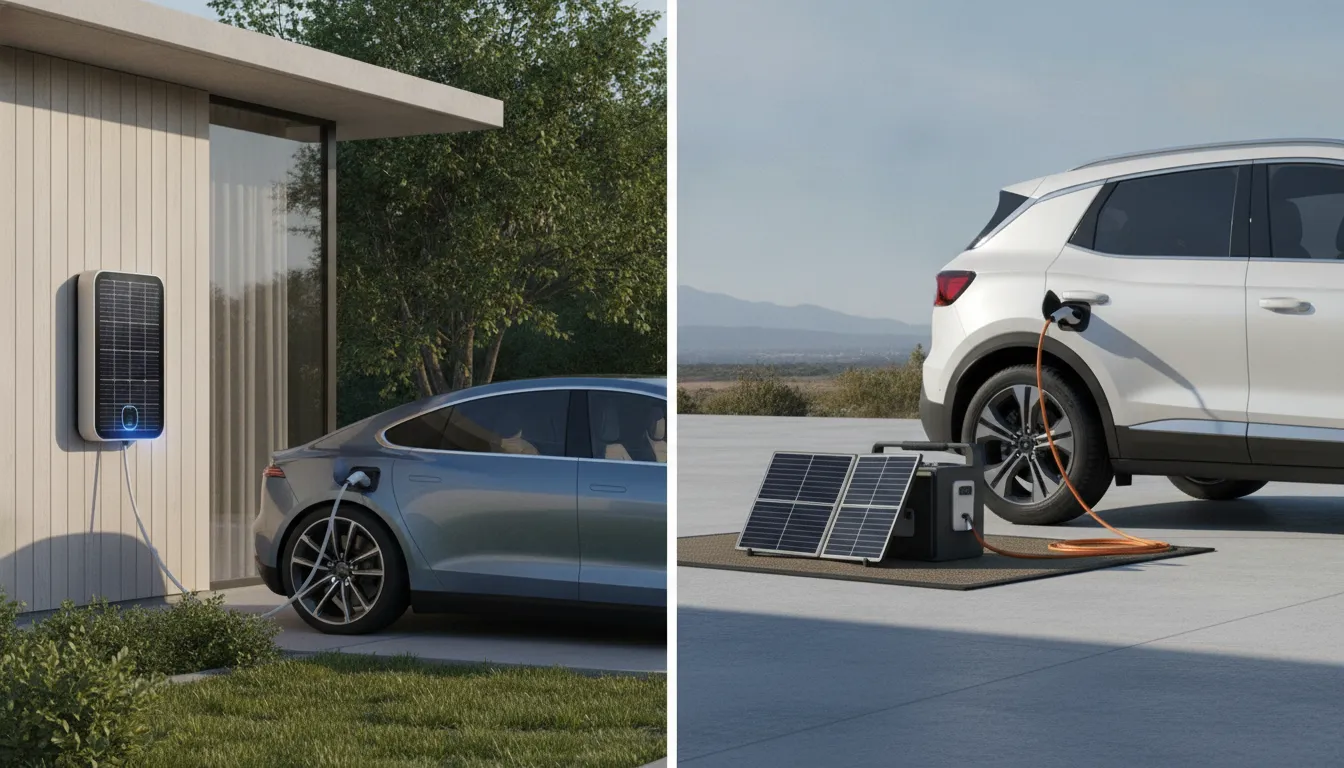
The term “solar EV charger” can describe several setups. A home-integrated charger uses electricity from rooftop solar, while a portable EVSE usually plugs into an outlet and draws power from the grid. Portable solar panels can generate electricity, but their output is generally limited for charging a full-size EV. Your best fit depends on your driving habits, available solar power, and home electrical system.
Connect a home-integrated charger to rooftop solar
A home-integrated setup connects your solar panels, electrical system, and EV charger. When your panels produce more electricity than your home is using, compatible equipment can direct some of that surplus to your vehicle. If solar production drops, the system may draw electricity from the grid, depending on its settings.
Check that the charger works with your inverter and energy-management equipment. Some systems can prioritize solar power, while others combine solar and grid electricity to keep charging consistent. SolaX Power’s guide to home solar EV charging explains how connecting a home charger to rooftop solar can help reduce reliance on grid electricity. An electrician can check your panel and wiring to see what your home needs for installation.
Use a portable EVSE with compatible outlets, typically powered by the grid
A portable EVSE is a charger you can plug into a compatible outlet, rather than a wall-mounted unit permanently installed at home. It can be useful for occasional charging or travel, but it is not automatically solar-powered. Unless it connects to a suitable solar setup, it typically draws electricity from the grid.
Charging speed depends on the EVSE, outlet, and vehicle. Check the manufacturer’s instructions to confirm that the outlet and circuit are suitable. Avoid extension cords and adapters unless the charger’s manufacturer approves their use. EV-lectron’s portable and wall-mounted charger comparison outlines the trade-off: portable units offer flexibility, while a dedicated wall-mounted charger can be better suited to regular home charging.
Understand the limits of portable solar panels for charging a full-size EV
Portable solar panels can generate electricity without drawing from the grid, but their output is usually modest compared with the energy a full-size EV needs. Charging can take a long time, especially when sunlight is limited or inconsistent. Small panels may be useful for lower-power devices or specific emergency needs, but they’re rarely a practical everyday charging solution for an EV.
Some products combine solar panels with batteries or other equipment, so check the system’s rated output and confirm it works with your vehicle. Don’t assume a product labeled “solar” will charge as quickly as a home charger. Imperial EVSE’s overview of portable solar EV chargers notes that portable solar charging can be much slower than standard home charging. Consider your daily mileage and how long your car can sit in direct sunlight.
Compare Level 1 and Level 2 charging speed, convenience, and electrical needs
Level 1 charging uses a standard household outlet and adds range slowly. It may suit drivers with shorter commutes who can leave their car plugged in for many hours. Level 2 charging uses a higher-voltage supply and can charge much faster, making it a more convenient option for frequent home charging. Actual charging time varies based on the charger, vehicle, and available electrical capacity.
A Level 2 charger typically needs a dedicated circuit and professional installation. Have an electrician assess your panel, wiring, and preferred charger location before choosing equipment. For homeowners in the Sacramento area, AAA Electrical Services’ electrical services include EV charger installation. Cord EV’s charger comparison offers more detail on how portable chargers and wallboxes differ in speed and convenience.
How Do Home-Integrated and Portable Solar EV Chargers Compare?
The main difference is how each setup fits into your routine. A home-integrated charger can work with your rooftop solar and household electrical system, while a portable EVSE offers flexibility but usually charges from an outlet. Compare charging speed, controls, and compatibility before choosing.
Compare power output, charging speed, and convenience
A home-integrated Level 2 charger connects to your home’s electrical system and may use solar power, grid electricity, or a combination of both. Many residential units deliver about 7.4 to 11.5 kilowatts, which can make overnight charging practical for many EVs. Your actual charging speed depends on the vehicle, battery size, charger, and available electrical capacity.
Portable EVSEs come in different types. Many are Level 1 models that plug into a standard outlet, while some support Level 2 charging when connected to a suitable circuit. Level 1 charging is slower, so it may work better for shorter daily drives or occasional use. This portable and wall-mounted charger comparison outlines the typical differences.
Look for solar-surplus detection and smart charging controls
If you want to charge mainly with solar, check whether the charger can respond to your system’s production and your home’s energy use. Solar-surplus detection can direct available excess solar power to your EV. Depending on the equipment, you may also be able to set charging times or choose how much grid power the charger can use when solar output falls.
These features depend on compatibility with your inverter, energy monitor, or home battery. Confirm which functions work with your specific system before buying. Some smart wallbox chargers offer connected controls and home-energy integration. A basic portable EVSE can charge from an outlet, but it typically won’t monitor solar production or adjust charging based on it.
Consider portability, durability, and charging location
A portable EVSE can stay in your vehicle for travel or occasional charging away from home. It may be useful if you have access to a compatible outlet at a second home or workplace. Check the manufacturer’s requirements, outlet rating, and cord condition. Don’t assume every outlet is suitable, and avoid extension cords unless the manufacturer specifically allows them.
A fixed charger offers a dependable place to charge at home, often near a garage or driveway parking spot. Before choosing a location, consider where the vehicle parks, how far the cable must reach, and whether the unit will face rain, sun, or potential damage. A comparison of portable and wall-mounted EV chargers can help you weigh travel flexibility against daily convenience.
Check energy monitoring, system compatibility, and efficiency
Check whether a charger works with your EV, solar inverter, home battery, and energy-monitoring equipment. An app doesn’t always mean the charger can track solar production or adjust charging automatically. Ask whether the system shows charging use, distinguishes solar from grid electricity, and lets you schedule charging around your household routine.
Smart controls may also help you charge when electricity rates are lower, if your utility plan has time-based pricing. Some wall-mounted models connect with home energy systems and support scheduled charging. Remember that a charger can’t produce more solar electricity than your panels generate. Household energy use, battery settings, and charging times all affect how much solar power reaches your EV.
Know what portable chargers can and can’t do
A portable EVSE is a charging unit, not a solar panel. Most models draw power from an outlet, so they can use solar electricity only when your home’s solar system supplies that electricity. Portable chargers can be handy for travel or as a backup, but they don’t automatically send sunlight directly to your vehicle.
Portable solar panels are a separate setup. Generating enough power to charge a full-size EV can require substantial panel capacity, equipment, and space. Output also varies with sunlight, shade, weather, and panel position, so charging may be slow and inconsistent. Portable solar EV charging guidance explains why these systems generally suit limited charging needs better than routine EV charging. For a home setup, an electrician can assess your panel and circuit needs. Learn about AAA Electrical Services’ electrical work before planning an installation.
How Much Solar Power Does Your EV Need?
Estimate charging needs from daily mileage and vehicle efficiency
Start with the miles you drive on a typical day and your EV’s energy use, usually listed in kilowatt-hours per mile (kWh/mi). Multiply those numbers to estimate the energy needed for your daily driving. For example, 30 miles in a vehicle that uses 0.30 kWh per mile requires about 9 kWh, before accounting for charging losses. Your real-world energy use can change with speed, temperature, terrain, and driving habits.
Use a typical week to get a useful estimate, and consider your longest regular driving day as well. This helps you plan for more than just an average commute. Your daily mileage and vehicle efficiency are a better guide to routine charging needs than the EV’s total battery capacity.
Compare battery capacity, charger output, and charging time
Battery capacity, measured in kilowatt-hours (kWh), describes how much energy your EV can store. Charger output, measured in kilowatts (kW), describes how quickly it can deliver energy. As a simple estimate, divide the energy you need to add by the charger’s output. Adding 18 kWh with a 7.2 kW Level 2 charger would take about 2.5 hours under ideal conditions. In practice, allow for charging losses and changes in power delivery.
A charger’s rated output doesn’t mean your solar panels will provide that much power throughout the session. Solar production varies with sunlight, and household appliances may use some of that electricity at the same time. This guide to home solar EV charging explains how system size, sunlight, and battery capacity affect charging.
Understand what a 5 kW solar system can—and can’t—tell you
A 5 kW solar system rating describes its power capacity under specified conditions, not the energy it produces over a day. Daily production depends on sunlight, roof orientation, shade, season, and system performance. Some EV-owner discussions use a 5 kW array as a rough benchmark for covering around 20 miles of daily driving, but that estimate isn’t a guarantee. Your vehicle’s efficiency and your home’s solar conditions can lead to a different result.
Use system size as a starting point, then compare your actual solar production with your EV’s charging needs. A solar forum discussion offers a rough estimate, but it shouldn’t replace an assessment of your roof, equipment, and driving habits.
Account for household use, roof space, shade, and seasonal output
Your EV shares solar electricity with the rest of your home. Heating and cooling, refrigeration, cooking, and other appliances may draw power while your car is plugged in. How much solar energy remains for charging depends on when those loads run and whether your charger can adjust to available power.
Roof space and sunlight also shape production. Trees or nearby buildings can cast shade, while roof direction and seasonal changes affect how much energy your panels generate. If you’re in the Sacramento area, ask a qualified professional to review your roof, solar equipment, and electrical setup before planning an EV charger. A solar system checkup can help identify issues that may affect your charging plan.
Set expectations for cloudy days and overnight charging
Solar panels produce less electricity on cloudy days and none after sunset. If you charge overnight or drive farther than your daytime solar production can cover, your home will generally draw the remaining electricity from the grid unless you have battery storage. A home battery can store extra solar power for later use, but it adds cost and should be sized around your household’s energy use and charging routine.
You can also schedule charging to suit your utility rate plan or use smart controls to prioritize available solar power. Solar, grid electricity, and battery storage can work together, but each plays a different role. Review your charging habits and utility rules, then have a licensed electrician check your panel and charger circuit. This guide to solar EV charging covers how solar and charging controls can support your routine.
What Does a Solar EV Charger Cost?
The total cost depends on more than the charger. Your estimate may include electrical work, solar equipment, permits, and upgrades to your home’s panel or wiring. Before comparing prices, check whether each quote covers the same work and whether it assumes your existing solar system can support EV charging.
Compare the charger price with installation costs
A home Level 2 charger typically costs about $500 to $1,200 for the unit, before installation, according to Imper ODM EVSE Solutions. Installation costs vary with the charger location, distance from the electrical panel, wiring requirements, and your home’s existing electrical capacity.
A portable EVSE may require less installation work if you already have a compatible outlet, but it generally charges more slowly than a Level 2 unit. A home-integrated setup can also involve solar equipment or controls that coordinate charging with solar production. Ask for an itemized estimate that separates the charger, labor, electrical work, and any solar upgrades. That makes it easier to compare quotes and spot costs that may not be included.
Budget for wiring, a dedicated circuit, and possible panel upgrades
A Level 2 charger typically needs a dedicated circuit that meets the charger’s electrical requirements. Installing one may involve running new wiring from your panel to the garage or parking area. The length of the run, access to walls or ceilings, and the location of the charger can affect labor and material costs.
If your electrical panel has limited capacity, your electrician may recommend load management or a panel upgrade. The right option depends on your home’s existing electrical use and how quickly you want to charge. Ask whether your estimate includes the circuit, wiring, panel work, permits, and inspection. A licensed electrician from AAA Electrical Services can assess your home’s electrical system and explain the work required for EV charger installation.
Factor in extra solar panels, inverter changes, or battery storage
Your current solar system may not produce enough electricity to cover both household use and your EV’s charging needs. Depending on your driving habits and existing equipment, you may need more solar panels, an inverter change, or a battery to store surplus energy. The cost depends on factors such as roof space, system design, and how much electricity you use.
Battery storage is not essential for every solar EV charging setup. Without a battery, you can charge when solar power is available or draw electricity from the grid when it is not. A battery can store solar energy for charging later, but it adds to the project cost. Ask a qualified solar professional to compare system options and explain how each may affect your energy use and bills. EcoFlow’s guide to solar, batteries, and EV charging offers an overview of how these components can work together.
Compare upfront costs with grid charging and solar exports
A solar EV charging system can require a substantial upfront investment, so compare its cost with what you currently pay to charge your vehicle. Potential savings depend on your utility rates, when you charge, how much solar electricity your home produces, and how much of it you can use directly. In California, electricity rates may change by time of day, so your charging schedule can affect the comparison.
Consider the value of solar electricity you send back to the grid, too. Export rates and rules vary by utility plan, so using surplus power to charge your car may be worth more than exporting it, or it may not. Review your electricity bills and ask your solar provider to compare the options using your actual rates and usage. This gives you a clearer picture than relying on general savings estimates.
Check permits, utility rules, and current incentives
Before work begins, ask whether your project requires an electrical permit and which local authority handles it. Requirements can depend on your location and the scope of the installation. Your electrician should explain who will obtain the permit and whether inspections are part of the quote. If you already have solar, check with your utility and solar provider before changing the system, since interconnection agreements or export rules may apply.
Incentives vary by location, equipment, and eligibility, and program details can change. Check current utility programs and government resources rather than relying on outdated offers. Ask the program administrator to confirm whether your equipment and installation qualify. Build your budget around the full project price, and treat any possible rebate or tax benefit as separate until you verify your eligibility.
What Should You Check Before Choosing a Solar EV Charger?
Before choosing a charger, check how it will work with your EV, solar equipment, electrical panel, and daily routine. A little planning can help you avoid buying a charger that your car or home can’t use effectively.
Confirm compatibility with your EV and charging connector
Check your EV’s owner’s manual or the manufacturer’s website to confirm which charging connector your car uses. Then make sure the charger supports that connector. Some chargers work with more than one vehicle type, while others may require an adapter. If you need one, confirm it’s approved for your vehicle and charger.
Also compare the charger’s output with your EV’s maximum AC charging rate. A higher-powered charger won’t charge your car faster than the vehicle allows, so paying for extra capacity may not make sense for your needs. Review the charger and vehicle specifications together, and check the manufacturer’s EV charger compatibility guidance before making a decision.
Check solar and panel capacity, plus load-management needs
Solar production varies with the time of day, weather, and season. If you want your EV to use surplus solar electricity, confirm that the charger can work with your inverter or energy management system. Some chargers can adjust charging based on available solar power; others may draw electricity from the grid when solar production is low. Check the solar charger features available on the models you’re considering.
Your electrical panel needs a check, too. A licensed electrician can determine whether it has room for a dedicated circuit, whether load management is appropriate, and whether an upgrade is needed. Be sure to mention other major appliances and any planned electrical projects.
Match charger speed and controls to your driving and charging routine
Think about how far you drive on a typical day and how long your EV stays parked at home. If you can leave it charging overnight, a lower-power setup may provide enough energy for your routine. If you need to add more range in a shorter period, compare Level 2 chargers and ask an electrician whether your home can support one.
Smart controls may let you schedule charging around solar production or your utility’s time-of-use rates. Energy tracking can also help you understand how much electricity your EV uses. Check that the charger’s controls work with your solar equipment and are easy for you to manage. The right home charging setup should fit your driving habits, not just offer the highest output.
Choose a fixed charger, portable EVSE, or integrated solar setup
A fixed, wall-mounted charger is designed for regular home charging and connects to a dedicated circuit. It can provide faster charging than many portable units, but it needs a suitable location and professional installation. A portable EVSE, or electric vehicle supply equipment, is easier to move and can be handy for occasional charging. Its speed depends on the unit and the outlet it uses.
A portable charger plugged into a home outlet typically draws power from the grid. To use solar electricity, choose a charger and solar setup that can coordinate charging with your system’s production. Small portable solar panels generally can’t provide enough power to charge a full-size EV practically. Compare portable and wall-mounted charger options with your daily needs in mind.
Plan for future electrical needs and professional installation
Consider whether you may add a second EV, a home battery, or other large electrical equipment. Sharing your plans with an electrician can help you choose a charger and circuit that work with your home’s current and future needs. If you want to charge from stored solar power, ask how your battery, inverter, and charger would work together. An EV charger and solar battery plan can help you understand how these components fit into a home energy system.
Before installation, have a licensed electrician assess your panel capacity, wiring, charger location, and permit requirements. Home electrical systems and installation needs vary, so professional guidance is important for safe operation. Sacramento-area homeowners can contact AAA Electrical Services to discuss EV charger installation and an electrical assessment.
How Can You Plan a Safe Solar EV Charger Installation in Sacramento?
A safe solar EV charger installation depends on more than choosing a charger. Your solar system, electrical panel, utility plan, parking area, and charging routine all affect what your home needs. Use these steps to prepare for a conversation with a licensed electrician.
Account for roof orientation, shade, summer heat, and seasonal solar output
Your roof’s direction and pitch, along with shade from trees or nearby buildings, affect how much electricity your solar panels generate. Production also changes throughout the year. Before counting on solar to charge your EV, consider how much electricity your household uses and how much may be left for the car.
Start with an estimate of your system’s annual output. The National Renewable Energy Laboratory’s PVWatts calculator can help you estimate production based on your location and system details. Then ask a solar professional how your actual roof, equipment, and seasonal conditions may affect that estimate. In Sacramento’s hot summers, confirm that the charger and related electrical equipment are suited to their planned installation locations.
Review your utility rates and solar-export rules
Find out which utility serves your home, then review its current rates and rules for sending unused solar power to the grid. Sacramento-area homeowners may have different providers and plans, so a neighbor’s bill or setup may not reflect your situation. Time-of-use rates and export credits can affect whether it makes sense to charge during the day, use a battery, or rely on grid power at other times.
Compare your utility’s rules with your driving habits and preferred charging hours. Ask how rates apply when your EV charges in the evening and what compensation you may receive for excess solar electricity. If SMUD serves your home, start with its residential rate information. For another provider, check its website or contact customer service for details about your specific plan.
Ask a licensed electrician to assess your panel, circuit, and charger location
A Level 2 charger generally needs a dedicated circuit, and your electrical system must be able to handle the added load. A licensed electrician can inspect your panel, wiring, grounding, and service capacity to determine whether you need a new circuit, load management, or panel work. Breaker space alone does not confirm that your system has enough capacity.
Discuss where you park and how the charger cable will reach your vehicle. The wiring route, exposure to weather, and convenient access to the connector all matter. Ask the electrician to check compatibility between the charger, your EV, and any solar controls. AAA Electrical Services offers EV charger installation for Sacramento-area homeowners and can assess your home’s electrical needs.
Confirm local permits and the full installation scope
Permit and inspection requirements depend on your address and the work involved. A straightforward charger installation may have different requirements from a project that also includes a panel upgrade, new wiring, or changes to solar equipment. Ask your electrician which permits apply, who will obtain them, and who will arrange any required inspections.
Before approving the work, request a written scope that lists the charger, circuit, wiring route, and any panel or load-management work. Confirm whether the estimate includes permits, inspection coordination, and any updates needed to meet applicable requirements. If you are in the City of Sacramento, check the city’s building permit information. For homes elsewhere in the metro area, contact the local building department that serves your address.
Arrange EV charger installation with AAA Electrical Services
Before scheduling installation, gather details about your EV, typical daily mileage, preferred charging times, and existing solar equipment. Mention any plans to add a home battery or other large electrical appliances. This information helps the electrician recommend a charger and circuit suited to your needs, rather than simply defaulting to the fastest option.
AAA Electrical Services serves homeowners across the Sacramento metropolitan area. Its licensed, background-checked, and drug-tested technicians provide upfront pricing, a 100% satisfaction guarantee, and same-day service. The company reports completing 93% of repairs on the spot. Contact AAA Electrical Services to discuss EV charger installation and other electrical services, and ask what your home needs before work begins.
Related Articles
- Affordable EV Charger Home Installation Made Easy and Budget-Friendly
- Electrical Vehicle Charger Install
- EV Charger Home Installation Made Easy for Beginners
- EV Charger Installation for Sacramento Homeowners
- Do You Need a Permit to Install an EV Charger?
Frequently Asked Questions
Can I charge my EV with solar panels I already have?\ Often, yes. Your EV can use electricity from your home’s solar system when it’s producing power. How much goes to your car depends on household use, solar output, and charger settings. Have your solar equipment and electrical panel checked before installing a Level 2 charger.
Will my EV charge when it’s cloudy or after sunset?\ A grid-connected setup can draw electricity from the utility when solar production is low. If you have a compatible home battery, it may supply stored energy later, depending on its capacity and your household’s needs.
Do I need a battery to charge an EV with solar?\ No. You can charge while your panels are generating electricity without a battery. Storage may help if you want to use solar power at night, but it adds equipment and cost.
Can rooftop solar charge my EV during a power outage?\ Usually not on its own. Most grid-connected solar systems shut down during outages for safety. Backup charging generally requires compatible battery storage and equipment that can safely disconnect your home from the grid.
What should I check before installing a home EV charger in Sacramento?\ Confirm that the charger suits your vehicle, and ask a licensed electrician to assess your panel capacity, circuit, wiring route, and charger location. Also check permit requirements and whether your solar equipment supports the charging features you want. AAA Electrical Services provides EV charger installation for Sacramento-area homeowners.