When a generator won’t start, it’s tempting to order the first replacement part that seems to match. But a faulty battery, fuel issue, wiring problem, or other cause can create similar symptoms. Buying Generac generator parts without confirming the problem may cost you time and still leave the generator out of service. A careful approach starts with the model and serial numbers, followed by a check of the owner’s manual and parts diagram. This guide explains how to identify common parts, compare listings, and avoid compatibility mistakes. For electrical or complex repairs, a qualified technician can assess the generator and recommend the right next step.
Key Takeaways
- Use your generator’s identification details: Match its full model and serial numbers to the parts diagram before choosing a replacement.
- Verify the purchase details: Confirm the part number, specifications, compatibility, warranty, and return terms with the seller.
- Use professional help when needed: Follow the owner’s manual for maintenance, and contact a qualified technician for complex repairs or uncertain diagnoses.
What Generac Generator Parts Can You Buy?
Generac generators use a range of engine, electrical, and fuel-system parts, as well as accessories for maintenance and protection. The right replacement depends on your generator’s exact model and configuration. Before ordering, check its identification label and consult the owner’s manual or an illustrated parts diagram. Here are common parts you may find.
Engine parts: filters, spark plugs, gaskets, starters, and carburetor components
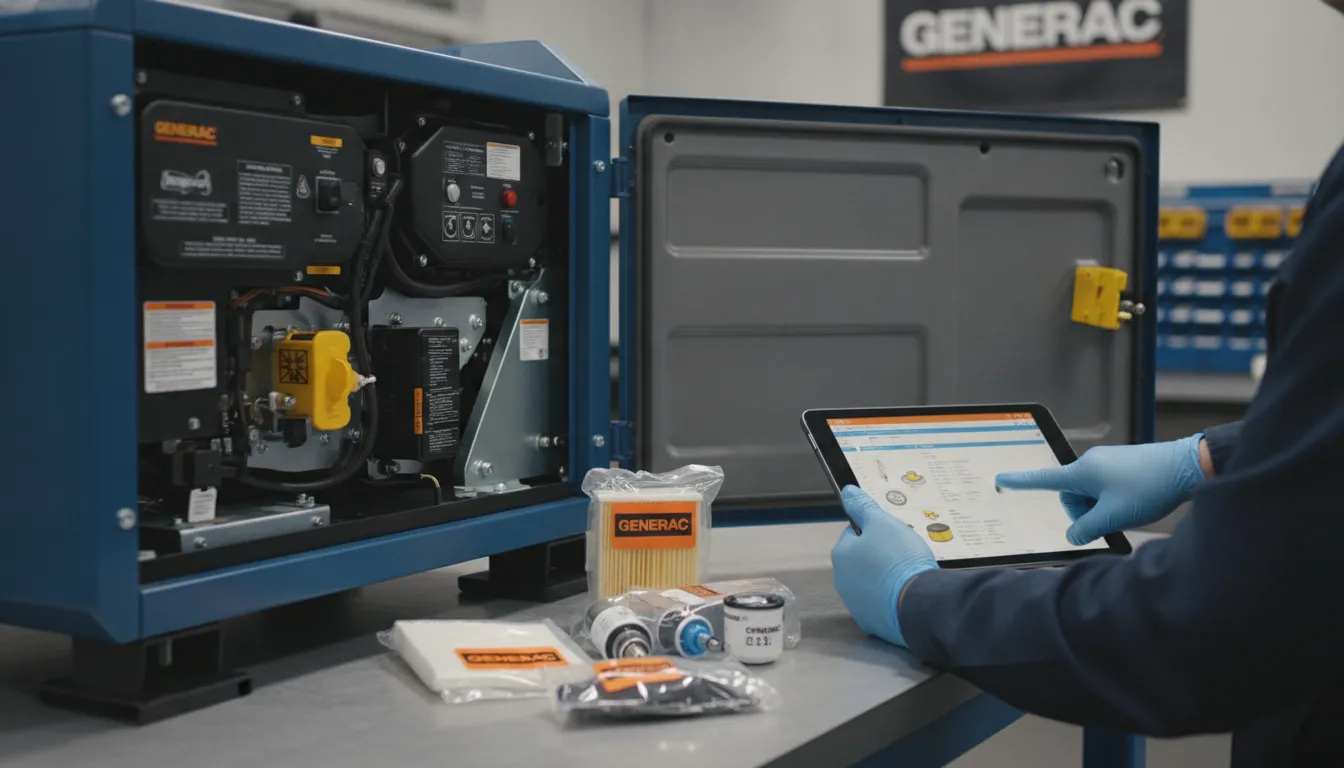
Engine parts help your generator start and run as designed. Common replacements include oil and air filters, spark plugs, gaskets, starter motors, and carburetor components. Maintenance kits may bundle several items, but what’s included varies by generator model and service task.
Check your owner’s manual for the correct specifications and maintenance schedule before ordering. A filter or spark plug that looks similar may have different dimensions or requirements. A Generac parts catalog can help you see examples of available engine parts and maintenance kits. If your generator is hard to start or runs unevenly, the problem may have another cause. Consider having a qualified technician assess it before replacing parts.
Electrical parts: fuses, control boards, wiring, sensors, and charging components
Electrical parts can include fuses, control boards, wiring, sensors, switches, and battery-charging components. These parts help the generator monitor operating conditions and manage power. They may be specific to a model or configuration, even when they look alike.
Compare the part number and specifications with your generator’s parts diagram before you buy. Differences in ratings, connectors, or control systems can affect fit and operation. Avoid choosing a control board or wiring assembly by appearance alone. If you’re unsure which part has failed, ask a qualified technician to diagnose the generator. Electrical troubleshooting can involve hazardous voltage, and incorrect installation may damage equipment or create a safety risk. A careful diagnosis can help you identify the right repair before ordering a replacement.
Fuel-system parts and accessories: hoses, regulators, batteries, covers, and connectors
Fuel-system parts depend on how the generator is configured. Common items include fuel hoses, regulators, connectors, and fittings. Batteries and protective covers may appear in parts catalogs, too, though they serve different functions: a battery helps start the generator, while a cover helps protect it from outdoor exposure.
Check the generator’s fuel type and connection details before ordering a fuel-system component. A part designed for one setup may not suit another, even within the same product family. Review the specifications and ask the seller to confirm compatibility if anything is unclear. As a Generac replacement-parts guide notes, aftermarket parts can raise fit and compatibility concerns. Verify that any replacement is suitable for your generator before installation.
Match parts to your generator type, model, configuration, and fuel system
First, identify whether you have a portable, standby, or another type of Generac generator. Use the complete model number to search for parts, and have the serial number available to help confirm model variations. Details such as fuel type and configuration can narrow your search further. The PartsTree Generac catalog lets you search by model number or browse by equipment category.
Before ordering, compare the listed part number and description with your owner’s manual or illustrated parts diagram. Check the required quantity and any notes about compatible models or replacement numbers. If a listing is unclear, ask the seller to verify the fit using your model and serial numbers. This check can help you avoid ordering a part that does not match your generator.
How Do You Find the Right Generac Generator Part?
Start with the generator’s exact identification details, then use them to check a parts diagram and confirm the part number. Taking a few minutes to verify compatibility can help you avoid ordering a component that looks right but won’t fit your unit.
Find the model and serial numbers on the generator’s identification label
Look for an identification label or metal tag on the generator, usually positioned away from moving parts. It lists the model and serial numbers you’ll need when searching for replacement parts. If the label is dirty or difficult to read, clean it gently and use a flashlight to check the characters rather than guessing.
Take a clear photo of the label and save it with your owner’s manual or maintenance records. You can refer to it when searching online or speaking with a parts seller or technician. PartsTree’s Generac parts listings offer a place to begin your search, but use your generator’s label to make sure you’re looking at the correct model.
Search by model number and use the serial number to check for variations
Enter the full model number in a parts catalog to find diagrams and listings for your generator. The Generac parts search on OrderTree lets you search by model and view illustrated parts diagrams. Check whether the catalog also asks for a serial number or serial range.
The serial number can help distinguish between versions of the same model. Components may differ between production runs, even when generators have similar model names. If the catalog shows multiple versions, compare its notes with the information on your generator’s label. When you can’t tell which listing applies, contact the seller with both numbers and ask them to confirm fit before you order.
Verify the part number, specifications, quantity, and replacement numbers
Compare the part number in the listing with the number shown in your generator’s parts diagram or owner’s documentation. Check relevant specifications, such as dimensions, voltage, connector type, and intended use. Confirm the quantity, too: a diagram may show several of the same component, while a kit may contain only one.
Some parts are listed under a newer replacement number. Before ordering, confirm that the replacement number is approved for your model and serial range. Generac’s official website can help you check information about parts and accessories. Save the product listing or order confirmation so you have the details on hand if you need to ask the seller about compatibility, returns, or an alternate part number.
Check compatibility, not just appearance
Parts can look alike but differ in dimensions, materials, electrical ratings, or connections. Use the exact part number and specifications to confirm a match, rather than relying on a photo or a general product description. This matters especially for electrical and fuel-system components, where an incorrect part may affect generator operation or create a safety concern.
If you’re considering an aftermarket component, review its compatibility details and the seller’s return policy. Share your generator’s full model and serial numbers if you need help confirming the fit. For control-panel, wiring, or other complex repairs, ask a qualified technician to identify and install the part. Sacramento-area homeowners can contact AAA Electrical Services for generator repair and installation; contact a parts seller directly for product availability.
How Do You Read Generac Parts Diagrams?
A parts diagram helps you identify a component and where it belongs, but it does not confirm that the part fits every Generac generator. Start with your generator’s full model number, then use the diagram and parts list together to verify the part number, quantity, and assembly notes. If details are unclear, ask the seller to confirm compatibility before ordering.
Find your generator’s full model number in an illustrated parts catalog
Find the complete model number on your generator’s identification label, then enter it in an illustrated parts catalog. Similar models can use different components, so don’t rely on the brand name or a partial model number. PartsTree’s Generac catalog lets you search by model number or browse by equipment type. Check that the catalog result matches your generator before opening its diagrams. Include every letter and number when searching, since even a small difference can point to a different configuration. If you can’t find a clear match, check the identification label again or contact the seller for help before selecting a part.
Match each diagram callout to its part number and description
Diagrams use numbered callouts to connect an illustrated component with its listing in a parts table. Find the number beside the part in the drawing, then locate that same number in the table to see the part number and description. The drawing shows where the component fits, while the listing provides the information you need to identify it. Use both rather than choosing a replacement by appearance alone. OrderTree’s Generac parts lookup offers illustrated diagrams to help identify compatible parts. If the catalog includes multiple views or assemblies, confirm you’re looking at the correct system, such as the engine or fuel system.
Check notes, quantities, and assembly details before ordering
Read the diagram notes and parts list carefully before placing an order. A listing may state how many of a component the assembly requires, note that hardware is sold separately, or identify a replacement part number. Check whether the diagram shows a complete assembly or an individual component, since these may have separate listings. Confirm that you’re viewing the diagram for your generator’s full model number, then compare the listed specifications with the item you plan to buy. These checks can help you avoid ordering the wrong quantity or a part that doesn’t include everything needed for the repair.
Ask the seller to confirm compatibility if a diagram or replacement number is unclear
If a callout is difficult to read, a part number appears to have changed, or the description doesn’t match what you need, contact the seller before ordering. Share your generator’s full model number and serial number, along with the diagram reference and part number you found. Ask the seller to confirm the replacement fits your specific unit and whether it includes any required hardware. OrderTree’s parts page provides customer support information for help identifying parts. For repairs involving wiring, control panels, or transfer switches, contact a qualified technician. Sacramento-area homeowners can reach AAA Electrical Services for generator repair and installation, not parts availability.
Where Can You Buy Genuine Generac Generator Parts?
Start with Generac’s official parts resources or an authorized dealer
Start with Generac’s official parts portal, which offers replacement components and maintenance packages. Search using your generator’s full model number, then compare the listed part number with the number in your owner’s manual or parts diagram. If you’re uncertain which model variation you have, ask an authorized Generac dealer to help confirm the right fit. Have the model and serial numbers ready when you contact a seller. These details can help distinguish between similar generator versions and reduce the chance of ordering a part that won’t work with your equipment.
Compare catalogs from OrderTree, PartsTree, and Ziller Electric
A few retailers provide searchable catalogs and diagrams for Generac parts. OrderTree’s catalog lets you search by model or part number and review illustrated diagrams. PartsTree lists genuine Generac OEM parts and provides diagrams to help identify components. Ziller Electric sells Generac parts and accessories, including some hard-to-find items. Compare listings by exact part number, not just by product photo or description. If a listing doesn’t clearly confirm compatibility, contact the retailer with your generator’s model and serial numbers before ordering.
Confirm OEM sourcing, stock, warranty terms, and return policies
Before placing an order, check whether the listing is for a genuine OEM part, if that’s what you need. Confirm availability, expected shipping time, warranty coverage, and the seller’s return policy. Pay attention to return deadlines, restocking fees, and restrictions on electrical or special-order parts. OEM parts are made to meet specifications for compatible equipment, while aftermarket parts can vary in fit and quality. Review the seller’s information and the component’s specifications before choosing. Keep your order confirmation and packaging until you’ve checked the part against your generator. This makes it easier to contact the seller if the item is incorrect or arrives damaged.
Contact AAA Electrical Services for Sacramento-area generator repair or installation, not parts availability
If you’re in the Sacramento area and can’t identify a generator problem, have a qualified technician diagnose it before ordering parts. AAA Electrical Services offers local generator repair and installation. The team can assess the issue and discuss service options, but contact Generac or a parts retailer for product availability and ordering questions. A replacement part may not solve the problem if the underlying cause is elsewhere, especially when wiring, controls, or transfer equipment are involved. To see which communities the company serves, check its locations.
How Do Generac OEM and Aftermarket Parts Compare?
When replacing a Generac generator part, you’ll typically choose between a genuine original equipment manufacturer (OEM) part and an aftermarket alternative. The best fit depends on your generator’s model, the component you need, the part’s specifications, and the support and warranty that come with it.
OEM parts are made or specified for compatible Generac models
Genuine Generac OEM parts are made for, or specified for, compatible Generac generator models. That can make it easier to match a replacement to the original, particularly for model-specific items such as control boards, sensors, and fuel-system components. Still, verify compatibility before ordering. Use your generator’s model and serial numbers to check the part number, and compare the listing with the information in your owner’s manual. A part that looks similar may have different connectors, dimensions, or ratings. Those details can affect whether it fits and works as intended. For model-specific components, confirming the exact part number is a practical first step toward a reliable repair.
Aftermarket parts vary in quality and fit, so check specifications and seller reputation
Aftermarket parts are made by companies other than Generac. Some are designed to fit specific generator models, while others may differ in materials, construction, or specifications. Before purchasing, compare the part number and details with the original, including dimensions, electrical ratings, connectors, and fuel compatibility. Look for a clear description, warranty information, and a seller that offers support and a straightforward return process. Be cautious with listings that provide little detail or claim broad compatibility without naming the supported models. A Generac replacement-parts guide also highlights the importance of checking fit and buying from a reputable source.
Compare compatibility, quality controls, price, and the risk of downtime from a poor fit
Price is worth considering, but it shouldn’t be the only factor. A lower-cost part can become more expensive if it doesn’t fit, causes another issue, or leads to repeat service and generator downtime. Compare the part number and specifications first, then weigh the seller’s quality information, delivery time, warranty, and return policy. If you rely on your generator for essential household needs, getting the right part promptly may matter more than saving a small amount upfront. When a listing leaves room for doubt, ask the seller to confirm compatibility with your exact model before placing the order. This comparison of OEM and aftermarket parts outlines factors such as fit, quality, and cost.
Review warranty terms and manufacturer requirements before choosing a part
Check the generator’s warranty documents and the replacement part’s warranty before making a purchase. Confirm what the part warranty covers, how long it lasts, and whether labor or shipping is included. Terms can vary by generator and component, so don’t assume that using an aftermarket part automatically affects your coverage. If the requirements aren’t clear, contact Generac or the seller and ask about the specific part and repair. Keep your receipt, part number, and installation records with your generator documents. For repairs involving wiring, a control panel, or a transfer switch, consider having a qualified technician assess the work. Sacramento-area homeowners can contact AAA Electrical Services for generator repair and installation.
Can You Buy Generac Generator Maintenance Kits?
Yes. Generac maintenance kits are available for some generator models, but the right kit depends on your generator type, engine, and service needs. Buying a kit can simplify routine upkeep by grouping compatible parts together, but it does not guarantee that every item required for a particular service is included.
Before ordering, find your generator’s model number and check the owner’s manual for its maintenance schedule and replacement-part specifications. Then compare those details with the kit listing. Pay close attention to the generator type, engine, included items, and any stated service interval. A kit designed for a portable generator, for example, may not suit a home standby model.
If the listing leaves compatibility or kit contents unclear, ask the seller to confirm them using your model number. For repair or installation help in the Sacramento area, AAA Electrical Services can assist with generator service.
Kits may include oil, oil and air filters, and spark plugs, depending on the model
A maintenance kit may include items such as oil, oil and air filters, and spark plugs. The contents vary by generator model and kit, so check the product description rather than assuming every bundle contains the same parts. Generac describes its portable generator maintenance kits as collections of components for maintaining compatible portable models.
Confirm whether your generator is portable or a home standby unit before shopping. Their engines and maintenance requirements can differ, and a kit for one type may not fit the other. If a listing does not clearly identify compatible models or show the included parts, contact the seller before placing your order.
Match the kit to your generator model, engine, and maintenance interval
Start with the model number on your generator’s identification label. Check the kit listing for that exact model or its compatible engine, since generators with similar names or appearances may use different filters, plugs, and other components. When a listing includes a model range, verify that your full model number falls within it.
Next, compare the kit with the service interval in your owner’s manual. Some kits are intended for a particular maintenance task or interval, while others include only selected components. Generac’s parts and accessories information can help you review options for compatible portable generators.
Check the kit’s contents, as bundles vary by model and service task
Read the full product listing before buying. Check which parts are included, the quantity of each item, and whether consumables such as oil come with the kit. A “maintenance kit” may be intended for a specific service task, not every maintenance item your generator needs.
If the details are unclear, ask the seller to verify the contents and compatibility using your generator’s model number. For a home standby generator, compare the listing with Generac’s guidance on standby generator maintenance. That extra check can help you avoid ordering a kit that omits a required component.
Follow the owner’s manual for service timing and approved replacement parts
Use your owner’s manual to determine when maintenance is due and which replacement parts meet your generator’s specifications. Service schedules differ by model and may depend on operating hours and other conditions. Follow the instructions for your generator rather than relying on a general schedule or a kit description.
Keep the manual nearby when comparing parts, and confirm that each item matches the listed requirements. If you’re unsure how to complete a service task, or the work involves electrical components, contact a qualified technician. Sacramento-area homeowners can reach AAA Electrical Services for generator repair and installation support.
What Should You Check Before Ordering Generac Parts?
A few checks before you order can save time and help prevent a mismatch. Use your generator’s documentation and a reliable parts catalog to verify the details, especially for components that vary by model or configuration.
Gather the model and serial numbers, diagram reference, and part number
Find your generator’s identification label and record the complete model and serial numbers before you start searching. Generators that look similar may use different parts, so a partial model name or product photo may not be enough to confirm a match. If you have an illustrated parts diagram, note its title and the callout number for the component you need.
Compare that information with the seller’s listing, including any replacement or superseded part number. PartsTree’s Generac catalog lets you search for parts and diagrams using equipment details. If the label is hard to read or you’re unsure which diagram applies, contact the seller or a qualified technician before ordering.
Confirm fit, specifications, quantity, availability, and shipping costs
Check that the listing matches your generator’s model and relevant specifications, such as voltage, dimensions, and connector type. Compare the listed part number with the number in your diagram, and look for notes about replacement or superseded numbers. Confirm how many components are included, whether the item is in stock, and when it is expected to ship.
Model-based diagrams can help you check that you’re looking at the right component. OrderTree’s Generac parts search provides model lookups and illustrated diagrams. Before placing your order, review shipping and handling charges and the estimated delivery time. Those details affect the total cost and help you plan if the generator needs repair before its next use.
Review return and exchange rules, especially for electrical or model-specific parts
Read the seller’s return and exchange policy before buying, especially for control boards, sensors, wiring, and other model-specific components. Some sellers restrict returns on electrical items, installed parts, or products with opened packaging. Check whether the part must be unused, if you need return authorization, and who pays return shipping.
Save a copy of the product listing and policy with your order confirmation. Rules can differ by seller and item, so don’t assume that a product is returnable just because the store accepts returns in general. PartsTree’s Generac catalog can help you confirm part details, but check the seller’s specific terms before purchasing.
Keep order records and packaging until you confirm the part fits
Keep your receipt, order number, product listing, and any messages with the seller until you’ve confirmed that the replacement matches your generator. Leave the packaging intact while you compare the part with the original and check its model-specific details. If something doesn’t match, having the records and packaging on hand can make it easier to ask about an exchange.
If a part number or diagram reference is unclear, contact the supplier before installation and provide your generator’s model and serial numbers. Ziller Electric’s Generac parts collection is one place to search listings and ask for help identifying a component. For electrical or fuel-system work, don’t install a part unless you’re sure it’s correct and the work can be done safely.
Ask about special orders if a part is unlisted or temporarily unavailable
If a part doesn’t appear in an online catalog, contact the supplier with your generator’s complete model and serial numbers, diagram callout, and any part number you have. Ask whether the item is temporarily out of stock, has been replaced by a newer part number, or can be special-ordered. Before paying, confirm the estimated delivery time and return terms.
Some suppliers may be able to help locate parts that aren’t shown in their online listings. You can inquire through Ziller Electric’s Generac parts collection. If you’re not sure which component has failed, avoid ordering based on a guess. Sacramento-area homeowners can contact AAA Electrical Services for generator repair or installation support.
How Can Sacramento’s Climate Affect Generator Maintenance?
Sacramento’s hot, dry summers can leave dust around outdoor equipment, while heat and long periods without operation make regular checks important. Follow the maintenance schedule for your generator’s exact model, and ask a qualified technician about repairs involving electrical parts.
Inspect filters and air intakes regularly for dust and debris
Dry, dusty conditions can leave buildup around a generator’s air intakes and filters. Check these areas regularly, especially during summer, and keep plants, leaves, and other debris clear of the unit. Follow the owner’s manual for instructions on cleaning or replacing filters. Avoid using a method or cleaning product the manufacturer hasn’t approved.
Routine inspections can help you notice buildup, damage, or changes in performance early. Generac’s home standby generator maintenance guidance outlines basic care for its standby and portable models. If you see damaged parts or hear unusual sounds, arrange an inspection with a qualified technician rather than attempting a repair you’re unsure how to complete.
Check fuel and battery condition after heat or long storage periods
Heat and extended periods without use can make fuel and battery checks especially important. Inspect them at the intervals specified in your generator’s manual, and watch for signs such as a slow start, warning light, or visible battery damage. Fuel storage requirements depend on the generator and fuel type, so use the manufacturer’s directions rather than a general storage rule.
Scheduled service can help identify fuel or battery issues before you need backup power. Generac maintenance plan information describes how routine servicing can address common maintenance concerns. If your generator struggles to start, displays an alert, or has an unusual odor, have a technician assess it before the next outage.
Prepare for outages by following the owner’s manual service schedule
A generator needs maintenance even when it isn’t running often. Follow the service schedule in its owner’s manual, which may be based on operating hours, elapsed time, or both. Depending on the model, routine care can include checking oil, filters, and the battery, as well as testing the unit. Keep a record of service and test runs so you can track when maintenance is due.
Generac’s maintenance instructions offer guidance for home standby and portable generators. Don’t wait until an outage is approaching to check whether your generator is ready. If you’re unsure how to perform a maintenance step or the unit doesn’t run as expected, a qualified technician can help. Sacramento homeowners can also learn about AAA Electrical Services’ generator repair and installation.
Follow your generator’s specific maintenance needs
Maintenance requirements vary by generator type, model, and fuel system. A portable generator, for instance, may have different service steps from a permanently installed standby unit. Use your model and serial numbers to find the correct owner’s manual, then follow its guidance for inspections and replacement intervals for items such as filters, spark plugs, and belts.
Don’t choose a replacement part based on appearance alone. Check that it matches your generator’s specifications, and ask the manufacturer or a qualified technician if you’re uncertain. For Sacramento-area homeowners who need help with generator maintenance or repairs, AAA Electrical Services can provide support suited to the equipment and the issue.
When Should You Get Help With Generac Generator Parts?
Ask seller support about compatibility, diagrams, or replacement numbers
If you’re unsure whether a part fits your generator, contact the seller before ordering. Share the complete model number and, if requested, the serial number. Seller support may be able to confirm compatibility, check whether a part number has been superseded, or help you interpret an illustrated parts diagram.
For example, OrderTree’s Generac parts resource lets you search by model number and view diagrams for compatible components. Compare the diagram’s part number and description with the listing you plan to order. Don’t rely on appearance alone, since two similar-looking parts may differ in fit or specifications. If the diagram or replacement number is unclear, ask the seller to verify the match before you buy.
Consult a qualified technician if you can’t identify the cause of a problem
A generator’s symptoms don’t always point to a single part. If it won’t start, for example, the cause could involve the battery, fuel supply, wiring, or another component. Replacing parts without finding the source of the problem can add expense and leave the generator’s issue unresolved.
Start with the checks described in your owner’s manual. If they don’t clarify what’s wrong, arrange an inspection with a qualified generator technician. Routine inspections can help identify developing issues before they interfere with operation. A generator maintenance guide also explains the value of regular checks, but follow your specific manual for service intervals and approved parts. When you call for help, share the model number, describe the symptoms, and mention any warning lights or recent maintenance.
Leave control-panel, wiring, transfer-switch, and complex repairs to a professional
Repairs involving a control panel, internal wiring, or a transfer switch require specialized knowledge. These components are part of the generator’s electrical system, and incorrect work can create safety risks or prevent the unit from operating properly. If a repair requires opening electrical enclosures, testing circuits, or changing transfer-switch connections, contact a qualified professional instead of attempting it yourself.
A technician can investigate the fault, identify the correct replacement part, and install it according to the equipment requirements. This can help prevent damage from an incompatible component or an improper installation. A Generac replacement-parts guide recommends professional assistance for complex repairs. Check your owner’s manual for safety instructions, and leave work beyond your experience to a trained technician.
Contact AAA Electrical Services for Sacramento-area generator repair and installation support
If you’re in the Sacramento area and your generator needs attention, AAA Electrical Services offers generator installation and repair for homeowners. A professional can assess the unit, help identify the service it needs, and explain possible next steps.
Before you call, gather the generator’s model and serial numbers. Note what happens when you try to start or operate it, along with any warning indicators, unusual sounds, or recent maintenance. These details can help the team understand your concerns and prepare for an assessment. Contact AAA Electrical Services for repair or installation support, rather than assuming the company stocks or sells a specific Generac part. The right solution depends on the generator’s model and condition, so an evaluation can help determine whether a component needs replacement.
Related Articles
- How to Extend the Lifespan of a Generator
- Residential Generator Maintenance Services for Reliable Home Power Backup
- Reliable Emergency Generator Service Near Me
- Small Generator Repair Near Me
- Generator Repair Near Me
Frequently Asked Questions
What information should I have before contacting a Generac parts seller?\ Have the generator’s complete model number and serial number ready. If you’ve found a part in a diagram, share its callout and part number, too. These details help the seller check the specific fit.
Are aftermarket Generac generator parts a good option?\ They can be, provided the part is designed for your exact generator and meets its specifications. Check the seller’s warranty and return terms, and ask them to confirm compatibility before buying.
Can I replace a Generac generator part myself?\ That depends on the part and your experience. Follow your owner’s manual for routine maintenance, but leave work involving wiring, control panels, or transfer switches to a qualified technician.
Will a maintenance kit include everything my generator needs?\ Not always. Kit contents vary by model and service task. Compare the included items with your generator’s manual and the product listing before ordering.
Where can Sacramento-area homeowners get help with generator repairs?\ AAA Electrical Services offers generator repair and installation support in the Sacramento area. Contact the company for service questions, and reach out to a parts seller or Generac for specific product availability.