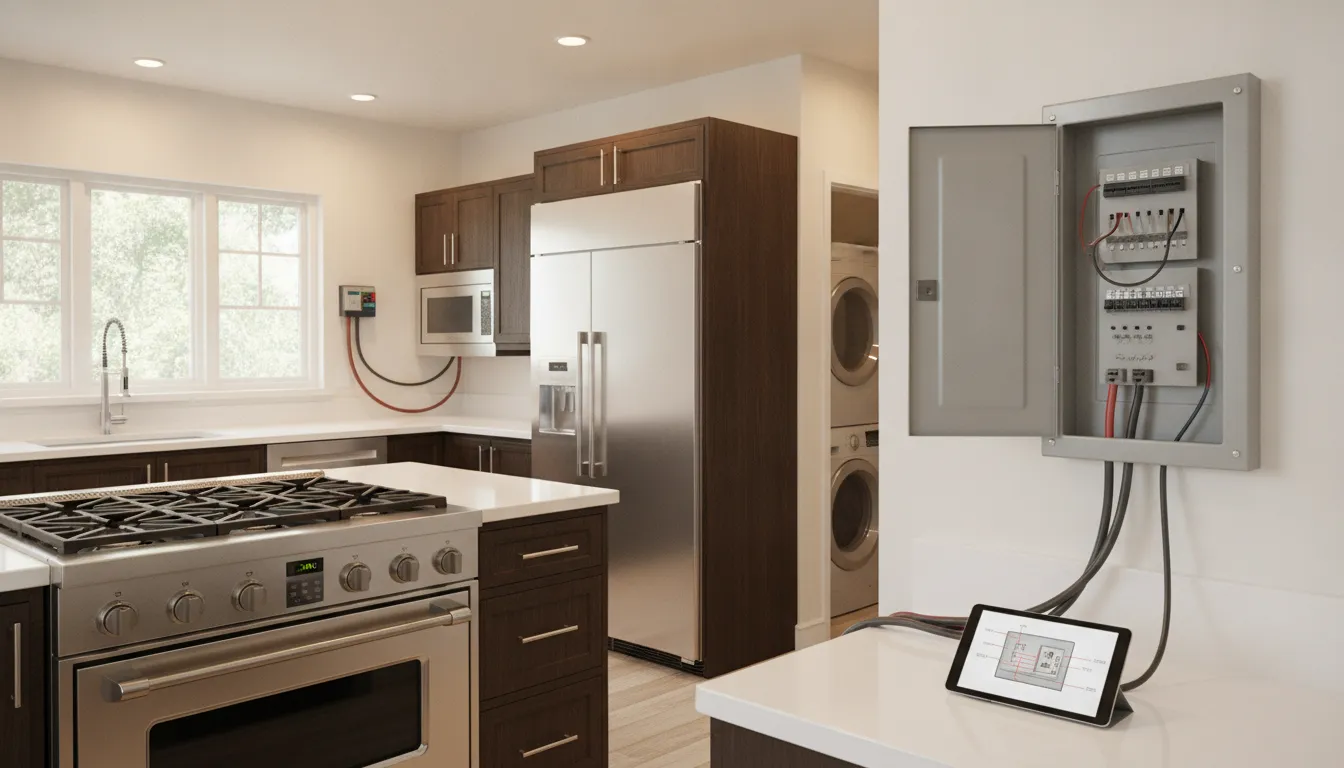
A breaker that trips once may result from a temporary overload. A breaker that trips every time you use the dryer, microwave, or air conditioner points to a deeper concern. Your home may have an overloaded shared circuit, undersized wiring, a failing breaker, or an appliance that needs its own power supply. Learning what appliances need a dedicated circuit can help you recognize when a standard outlet is not enough. High-demand appliances often require separate circuits to operate safely and reliably. If you notice warm outlets, buzzing, burning odors, scorch marks, or flickering lights, stop using the affected equipment and contact a licensed electrician for an inspection.
Key Takeaways
- Check appliance requirements before installation: Review the nameplate and manual for voltage, amperage, breaker size, wiring, receptacle, and disconnect requirements.
- Treat electrical warning signs seriously: Repeated breaker trips, flickering lights, warm outlets, buzzing, burning odors, and scorch marks may indicate an overloaded circuit or damaged component.
- Schedule a professional assessment for major upgrades: A licensed electrician can verify panel capacity, circuit protection, grounding, permits, and code requirements before installing equipment such as an EV charger, generator, HVAC system, or water heater.
What Is a Dedicated Circuit, and Why Does It Matter?
A dedicated circuit supplies electricity to one appliance or piece of equipment. It runs from the electrical panel to a single receptacle, disconnect, or hardwired connection, and it has its own circuit breaker. Unlike a general-purpose circuit, it does not share its available power with other outlets, lights, or appliances.
This setup gives high-demand equipment consistent power and reduces the risk of overloading the electrical system. Electric ranges, water heaters, air conditioners, EV chargers, and other major appliances commonly need dedicated circuits, but the exact requirements depend on the equipment’s rating, installation location, and manufacturer instructions.
If you are adding a new appliance or upgrading an older home, have an electrician review the electrical system first. AAA Electrical Services can assess your residential electrical installation needs, including circuit capacity, wiring, panel space, and required safety devices.
Compare Dedicated and Shared Circuits
A shared circuit can safely power several small loads, such as lamps, phone chargers, and standard household electronics. The concern begins when multiple high-demand appliances operate on the same circuit. For example, a toaster oven, countertop appliance, and portable heater could draw more current than the circuit can safely handle.
An overloaded circuit may trip its breaker to interrupt power. You might also notice flickering lights, warm outlets, buzzing sounds, or appliances that stop working. Repeated breaker trips should not be treated as a minor inconvenience. They can indicate excessive demand, damaged wiring, loose connections, or a faulty appliance.
A dedicated circuit separates a high-demand appliance from the rest of the electrical system. It can reduce breaker trips, overheating, and electrical damage. Dedicated appliance circuits are especially important for equipment that runs for long periods or draws substantial current.
Understand Volts, Amps, Watts, Breakers, and Wiring
You do not need to calculate your home’s electrical requirements on your own, but a few basic terms can make installation discussions easier:
- Volts describe the electrical pressure supplied to the appliance.
- Amps describe the amount of current the appliance uses.
- Watts describe the appliance’s power demand.
- The breaker protects the circuit from drawing more current than the wiring can safely carry.
- The wiring must match the circuit’s voltage, amperage, length, and installation conditions.
An appliance nameplate or installation manual usually lists voltage and amperage requirements. Some equipment also identifies minimum circuit ampacity, or MCA, and maximum overcurrent protection, or MOCP. These figures help an electrician select the appropriate conductors, breaker, receptacle, and disconnect.
A larger breaker is not a safe substitute for correctly sized wiring. Increasing the breaker size without evaluating the conductors can create an overheating and fire hazard. A licensed electrician can review the appliance specifications and existing electrical system. AAA Electrical Services also provides panel repair and installation when an older or undersized panel cannot safely support new equipment.
Account for High-Wattage Loads and Startup Surges
High wattage is one reason an appliance may need its own circuit, but it is not the only factor. Heating elements, compressors, pumps, and other motors can draw additional current when they start. This short increase is called a startup surge. The circuit must be able to handle that demand without unnecessary trips or excessive voltage drop.
Equipment that produces heat or runs for extended periods deserves particular attention. Electric ranges, water heaters, air conditioners, heat pumps, dryers, EV chargers, and workshop tools can place sustained demand on a home’s electrical system. Appliance guidance from Mr. Appliance identifies high-wattage, heat-producing, motor-driven, and long-running appliances as common candidates for dedicated circuits.
Continuous operation matters, too. An appliance that runs for several hours places a different demand on a circuit than one used for a few minutes. An electrician can evaluate the equipment’s running load, startup requirements, and expected operating time before selecting the circuit protection and wiring.
Use Dedicated Receptacles, Hardwired Connections, and Disconnects
A dedicated circuit may end at a standard receptacle, a larger appliance receptacle, a disconnect, or a hardwired connection. The correct setup depends on the equipment and its installation instructions. A refrigerator may connect to a dedicated receptacle, while an electric water heater or central air-conditioning system may be hardwired and require a nearby disconnect.
The receptacle must match the circuit’s voltage, amperage, grounding requirements, and plug configuration. Do not use an adapter to make an incompatible appliance fit an outlet. A heavy-duty extension cord does not turn a shared household circuit into a dedicated one, and major appliances should be connected according to the manufacturer’s specifications.
A disconnect allows power to be shut off near certain fixed equipment during maintenance or an emergency. Its type and location depend on the appliance and applicable requirements. AAA Electrical Services can determine whether your project needs a new receptacle, hardwired connection, disconnect, or another electrical connection.
Protect Safety, Performance, and Equipment
A properly installed dedicated circuit protects more than the breaker. It helps limit heat buildup in conductors and connections, reduces nuisance trips, and gives an appliance the stable power it needs to operate as designed. This is particularly important for equipment with sensitive electronics, compressors, heating elements, or motors.
Sharing a circuit can cause performance problems even when the breaker does not trip. Lights may dim when a motor starts, an appliance may fail to start, or voltage fluctuations may contribute to premature equipment damage. Warm outlets, discoloration, burning odors, buzzing, and repeated breaker trips require prompt attention. Turn off the affected equipment and arrange an electrical inspection instead of repeatedly resetting the breaker.
Dedicated circuits also support safer home upgrades, including EV chargers, generators, HVAC equipment, and high-capacity appliances. AAA Electrical Services offers generator installation and repair, EV charger installation, and electrical inspections for Sacramento-area homeowners who want new equipment connected safely.
Which Appliances Need a Dedicated Circuit?
A dedicated circuit supplies electricity to one appliance or piece of equipment. It does not share power with nearby outlets or other major loads. Many high-wattage appliances need dedicated circuits because they draw substantial current, run for extended periods, or create a strong surge when their motors or heating elements start.
Separating these loads can help reduce nuisance breaker trips, voltage drops, overheated wiring, and damage to connected equipment. However, an appliance’s size alone does not determine whether it needs a dedicated circuit. The correct setup depends on the appliance’s nameplate, installation manual, voltage, amperage, location, and connection method.
The National Electrical Code provides general requirements, while California and local Sacramento-area rules may add requirements for certain installations. Some equipment also needs GFCI or AFCI protection, a disconnect, weather-resistant components, or a hardwired connection. AAA Electrical Services can assess your wiring, panel capacity, and appliance requirements through its residential electrical services.
Electric Ranges, Ovens, and Cooktops
Electric ranges, wall ovens, and induction cooktops commonly need dedicated 240-volt circuits. Many models use a 40- or 50-amp circuit, but the correct rating depends on the appliance’s specifications. Smaller ovens and cooktops may have different requirements, so avoid assuming that every model uses the same breaker size.
These appliances can draw significant power when several burners and the oven operate at once. Sharing a circuit with countertop appliances, a dishwasher, or another kitchen load may cause trips or place stress on the wiring. During a remodel, an electrician may need to install a new cable, receptacle, breaker, or disconnect. The panel must also have enough service capacity for the added load.
Electric Dryers and Laundry Equipment
Most electric clothes dryers use a dedicated 240-volt, 30-amp circuit. Their heating elements create a significant continuous load, so connecting a dryer to a shared circuit is not appropriate. The receptacle, cord, wiring, and breaker must match the dryer’s installation instructions. Older homes may need updated wiring or receptacles before a replacement dryer is connected.
Washing machines commonly use a dedicated 120-volt, 20-amp circuit, although some installations permit a properly configured shared laundry circuit. The circuit must not also serve high-draw equipment. If the washer trips the breaker, the outlet feels warm, or the laundry room relies on an extension cord, arrange an inspection. Laundry circuit guidance explains why these appliances often need separate power.
Dishwashers, Disposals, and Built-In Microwaves
Dishwashers often require a dedicated 15- or 20-amp circuit, depending on the model and applicable requirements. Built-in and over-the-range microwaves commonly need a dedicated 20-amp circuit because they draw more power than many countertop models. A dishwasher and garbage disposal may share a properly designed circuit in some installations, but the appliance instructions and local code must allow it.
The connection method matters, too. A dishwasher may be hardwired or connected to a cord and receptacle in an accessible location. A disposal typically uses a switched receptacle below the sink, while a built-in microwave may connect to an outlet inside a cabinet. Wet-area installations require appropriate grounding and GFCI protection where applicable. Dedicated appliance circuit guidance explains why kitchen loads should be evaluated individually.
Refrigerators, Freezers, Ice Makers, and Wine Coolers
A refrigerator commonly uses a dedicated 15- or 20-amp, 120-volt circuit. Although its average power use may be modest, the compressor creates a startup surge each time it turns on. A dedicated circuit helps prevent that surge from tripping a breaker when other equipment is operating nearby.
Stand-alone freezers, ice makers, beverage refrigerators, and wine coolers may also need independent circuits, particularly when they operate continuously or sit in a garage or utility room. The manufacturer may prohibit extension cords or power strips. If one of these appliances repeatedly trips its breaker, the cause could be a failing compressor, damaged wiring, a loose connection, or an overloaded circuit. Appliance circuit recommendations provide additional examples of equipment that may need separate power.
Central Air Conditioners, Heat Pumps, Furnaces, and Air Handlers
Central air conditioners, heat pumps, electric furnaces, and air handlers typically need dedicated circuits because they combine high operating loads with substantial startup current. Many outdoor condensers use 240 volts, while an air handler or furnace may require its own 120- or 240-volt circuit. Breaker and conductor sizes must match the equipment nameplate and installation instructions.
HVAC equipment may also require a disconnect within sight of the unit and specific overcurrent protection. The circuit should not be shared with lights, receptacles, or other appliances. If an air conditioner repeatedly trips the breaker, do not replace it with a larger one. That can leave the wiring unprotected. An electrician can review the unit’s MCA and MOCP ratings, inspect connections, and determine whether the panel can support the system.
Electric Tank and Tankless Water Heaters
Standard electric tank water heaters commonly need a dedicated 240-volt circuit, often rated at 30 amps. The exact requirements depend on the tank’s wattage and installation instructions. Because the heating elements may operate for extended periods, the circuit must be sized for the equipment’s continuous load.
Tankless water heaters can require considerably more power. Some models need two or more dedicated 240-volt circuits, while others may require a service upgrade. A new installation may also need a nearby disconnect, updated wiring, or panel modifications. Never connect a high-demand water heater to an existing dryer, range, or general-purpose circuit. An electrician can assess your service capacity and complete the work through appropriate panel services.
EV Chargers and Charging Equipment
Level 2 EV chargers generally need a dedicated 240-volt circuit because they supply power for several hours at a time. Depending on the charger and vehicle, the circuit may require a 40-, 50-, 60-amp, or different rating. The breaker, conductors, receptacle, and charger must be compatible, and the installation may require GFCI protection.
An EV charger should not share a circuit with a dryer, range, water heater, or workshop equipment. Before installation, an electrician should inspect the service size, panel condition, available breaker spaces, and wiring route to the garage or outdoor charging location. Older panels may need repair or replacement first. AAA Electrical Services provides EV charger installation for Sacramento-area homeowners.
Sump, Well, and Sewage Ejector Pumps
Sump pumps, well pumps, and sewage ejector pumps often need dedicated circuits because they must start reliably during storms, flooding, or other emergencies. A pump that shares a circuit with a freezer, outlet, or another appliance could lose power when a different device trips the breaker. That may leave the home vulnerable to water damage or interrupt the water supply.
The circuit requirements depend on the pump’s horsepower, voltage, and location. Pumps in damp or wet areas may need GFCI protection, proper grounding, and a suitable receptacle or disconnect. Battery backups and alarms may need separate power considerations. If a pump trips its breaker, hums without starting, or runs intermittently, arrange an inspection promptly instead of repeatedly resetting the breaker.
Hot Tubs, Spas, Pool Pumps, and Outdoor Equipment
Hot tubs and spas usually need dedicated GFCI-protected circuits. Many larger units use 240 volts, while smaller models may have different requirements. Pool pumps, heaters, and outdoor water features may also require separate circuits, disconnects, bonding, and weather-resistant components. The correct installation depends on the equipment and its distance from the pool or spa.
Water and electricity create serious hazards, so outdoor equipment must be installed with careful attention to protection and placement. A patio receptacle or indoor circuit is not a substitute for a properly designed spa or pool circuit. An electrician can verify grounding, bonding, GFCI operation, conduit, and disconnect placement. An electrical inspection can identify issues before outdoor equipment is installed.
Generators, Large Dehumidifiers, and Fixed High-Load Equipment
Whole-home and standby generators require dedicated connections designed for the generator, transfer equipment, and selected household loads. The installation must prevent dangerous backfeeding into utility lines. It may also require a transfer switch, service-rated equipment, grounding, and sufficient clearance around the generator.
Large dehumidifiers, commercial-style air cleaners, compressors, and other fixed high-load equipment may also need dedicated circuits. These devices can run for long periods and create startup surges that affect nearby equipment. A permanently installed or high-capacity model often has different requirements from a small portable appliance. AAA Electrical Services offers generator installation and repair, including help evaluating the panel and connection equipment.
Garage, Workshop, and Utility-Room Appliances
Garage and workshop equipment often needs independent circuits because motors can draw considerable current during startup. Air compressors, table saws, welders, dust collectors, shop vacuums, and large power tools should not all operate on one general-purpose circuit. Sharing power can lead to tripped breakers, voltage drops, overheating, or poor motor performance.
Utility rooms may contain additional high-load equipment, including freezers, pumps, furnaces, and laundry appliances. Before adding workshop outlets, consider which tools will operate at the same time, not just the rating of one device. A new circuit may require additional wiring, GFCI or AFCI protection, and panel capacity. Extension cords and power strips are not permanent solutions for high-load tools or fixed equipment.
Know When Manufacturers Allow Shared Circuits
Not every appliance requires a dedicated circuit. Some smaller devices may share a circuit when the manufacturer permits it, the total load remains within the circuit rating, and the installation meets local code. Compact refrigerators, countertop appliances, and certain utility-room devices may have different options depending on the model.
Read the appliance’s installation manual and nameplate before deciding. Look for the required voltage, circuit rating, maximum fuse or breaker size, and any statement about dedicated power. A wattage rule alone is not enough because startup current, operating time, location, and protection requirements also matter. If the instructions are unclear, have a licensed electrician review the proposed connection, especially when several appliances will share a circuit or the home has an older panel.
How Do You Determine an Appliance’s Voltage and Protection Needs?
Determining an appliance’s electrical needs involves more than checking whether its plug fits an outlet. You must confirm the required voltage, amperage, wattage, circuit rating, wire size, protection devices, and available capacity in the electrical panel. These details help prevent nuisance breaker trips, overheated wiring, appliance damage, and unsafe installations.
Begin with the appliance nameplate and installation manual, then compare those requirements with the existing circuit. Large appliances, including EV chargers, water heaters, ranges, generators, HVAC equipment, and some pumps, may require a new circuit or panel upgrade. A licensed electrician can evaluate the complete installation and recommend the appropriate solution. AAA Electrical Services provides residential electrical services throughout the Sacramento metropolitan area, including circuit installation, panel work, inspections, and safety upgrades.
Read the Nameplate and Installation Manual
Find the appliance’s information label, which may be located on the back, inside the door, near the motor, or beside the wiring connection. The label can list voltage, amperage, wattage, phase, frequency, and other requirements. The installation manual may also identify the required breaker, wire size, receptacle, disconnect, or connection method.
Appliances rated at 1,000 watts or more may need a dedicated circuit, particularly when they run for extended periods. However, this figure is only a general warning sign. The manufacturer’s installation instructions should guide the installation because two appliances with similar wattage can have very different operating and startup demands.
Do not use the plug shape as proof that a circuit is suitable. A compatible receptacle does not confirm that the wiring, breaker, grounding, or available capacity meets the appliance’s requirements.
Check Voltage, Amperage, Wattage, MCA, and MOCP
Voltage indicates the electrical pressure an appliance requires, while amperage measures the current it draws. Wattage describes the appliance’s power use. You may also see MCA, or minimum circuit ampacity, and MOCP, or maximum overcurrent protection, on air-conditioning equipment and other high-demand appliances.
MCA helps determine the minimum conductor rating. MOCP identifies the largest permitted breaker or fuse. These values work together, so an electrician must review the entire label instead of choosing a breaker based on one number alone.
Large appliances generally should not share a circuit with another major load. As this dedicated-circuit guidance explains, high-power equipment needs an appropriately sized circuit to reduce overloading and maintain proper protection.
Distinguish 120-Volt and 240-Volt Equipment
Many household receptacles provide 120 volts, which is common for lighting, countertop appliances, refrigerators, and smaller laundry equipment. Larger loads, such as electric ranges, dryers, central air conditioners, water heaters, and some EV chargers, may require 240 volts.
A 240-volt appliance typically needs a properly configured two-pole breaker and a circuit designed for that equipment. It may also require a different receptacle, cable, cord set, or hardwired connection. Never use an adapter or improvised wiring to connect 240-volt equipment to a 120-volt outlet.
Some appliances can operate at either voltage, but only when the manufacturer specifically permits it. Check the nameplate and manual before installation. An electrician can verify whether the panel accepts the required breaker and whether the home’s service can handle the added load.
Account for Startup Surges and Continuous Loads
An appliance’s running amperage does not always represent its full demand. Motors and compressors can draw extra current for a short time when they start. This startup surge matters for refrigerators, freezers, pumps, air conditioners, heat pumps, shop tools, and generators.
You must also account for continuous loads that operate for an extended period. An appliance may appear suitable for a circuit during normal use but cause problems when another load runs at the same time. For example, a dishwasher and garbage disposal generally should not share a 15-amp circuit. A 20-amp circuit may be acceptable only when the combined calculated load stays within its limits, as explained in this electrician discussion.
Match the Breaker, Conductors, Receptacle, Cord, and Disconnect
Every part of the circuit must work together. The breaker protects the conductors, the conductors carry current, and the receptacle, cord, plug, or disconnect must be rated for the appliance and installation conditions. Installing a larger breaker without replacing undersized wiring can allow the wiring to overheat.
Hardwired appliances may require a local disconnect within sight of the equipment. Other installations may call for a particular receptacle configuration or factory-approved cord set. An electrician reviews the complete path from the panel to the appliance rather than focusing only on the outlet.
Correct wire size and circuit amperage are essential for safe operation. Appliance circuit information explains why the circuit must match the equipment, but a licensed electrician should confirm the design before installation.
Check Panel Capacity, Service Load, and Breaker Spaces
An open breaker space does not necessarily mean the panel can support a new appliance. The electrician should review the panel rating, existing loads, service size, breaker arrangement, and available spaces. A load calculation may show that the home needs a service upgrade before adding a high-demand appliance.
The panel’s condition also matters. Corrosion, heat damage, overcrowding, obsolete equipment, and loose connections can affect the safety of a new circuit. Review AAA Electrical Services’ panel repair and installation services if your panel needs evaluation before an appliance upgrade.
Never install a breaker simply because an empty slot is available. The breaker must be approved for that panel, installed correctly, and supported by enough service capacity for the home’s total electrical demand.
Apply GFCI, AFCI, Grounding, Bonding, and Surge-Protection Requirements
Protection requirements depend on the appliance, circuit, and location. GFCI protection is commonly required where electricity may contact water, including kitchens, garages, laundry areas, bathrooms, outdoor spaces, and other damp locations. AFCI protection may apply to circuits in living areas and other locations identified by the applicable code.
Grounding and bonding help provide a path for fault current, while surge protection can help limit damage from voltage spikes. The correct requirements depend on the equipment, circuit type, location, and local rules. A receptacle with test and reset buttons does not, by itself, confirm that the entire installation is correct.
Ask an electrician whether whole-home surge protection is appropriate for sensitive electronics, major appliances, solar equipment, or standby generators. AAA Electrical Services offers home surge protection as part of its residential electrical services.
Distinguish Plug-In and Hardwired Appliances
Plug-in appliances connect to a receptacle with a factory cord and plug. Hardwired appliances connect directly to circuit wiring through an approved junction box, disconnect, or equipment connection. Either type may need a dedicated circuit, depending on the equipment rating and manufacturer’s instructions.
A plug-in appliance is not automatically safe on any nearby outlet. The receptacle may share a circuit with other loads, or the wiring may not support the appliance. Hardwired equipment should not be opened, disconnected, or modified by an untrained homeowner.
An electrician can verify the circuit, connection method, grounding, and disconnect requirements. This assessment is especially important for ovens, HVAC equipment, water heaters, generators, pumps, and other appliances that operate at 240 volts or draw substantial current.
Don’t Rely on a 1,000-Watt Rule Alone
The 1,000-watt guideline can help identify appliances that deserve closer attention, but it cannot determine the correct circuit by itself. Voltage, amperage, operating time, motor startup, manufacturer instructions, local code, and the home’s existing electrical demand all affect the installation.
A lower-wattage appliance may still need a dedicated circuit because of its motor, location, or installation instructions. Several smaller appliances can also overload a shared circuit when used at the same time. On the other hand, some equipment may be approved for a shared circuit when the manufacturer and applicable code allow it.
Before installing a high-demand appliance, schedule a professional assessment. AAA Electrical Services offers same-day electrical service, upfront pricing, and trained technicians who can determine whether you need a new circuit, panel work, a protection upgrade, or another electrical solution.
How Can You Identify an Appliance’s Existing Circuit Safely?
Identifying an appliance’s circuit can help you determine whether it has an appropriate power supply, but the process requires caution. A circuit may serve one appliance, several receptacles, or a combination of lighting and equipment. Labels can also be outdated, especially in older Sacramento-area homes or after remodeling work.
You can inspect the panel directory, switch breakers off, and test accessible plug-in outlets. These steps provide basic information, but they do not confirm that the wiring, breaker size, grounding, or connections meet current requirements. The Electrical Safety Foundation International recommends taking electrical warning signs seriously and avoiding trial-and-error repairs.
Before testing, consider whether the appliance is essential. Turning off power to a refrigerator, freezer, sump pump, medical device, security system, or similar equipment could create another problem. If you are unsure which breaker controls an appliance, stop testing and contact a licensed electrician, such as AAA Electrical Services, for an assessment.
Review the Panel Directory and Breaker Labels
Start with the panel directory or the labels beside each breaker. Look for descriptions such as “range,” “dryer,” “water heater,” “air conditioner,” or “garage.” A label that names one appliance may suggest a dedicated circuit, but it is not proof. Some directories are incomplete, incorrect, or too general to identify every outlet and connection.
Compare the labels with the appliances in your home. If the directory lists a “kitchen outlet” circuit but does not mention the dishwasher, disposal, or built-in microwave, those appliances may still be connected to it. Do not assume an unused breaker position means the panel is ready for a new circuit. The panel may lack the required wiring, capacity, or compatible equipment.
If the labels are missing or confusing, an electrician can trace the circuits and update the directory. Accurate labeling makes repairs, emergency shutoffs, and future panel services safer.
Turn Off Breakers and Test Accessible Outlets
For a plug-in appliance, switch off the suspected breaker and check whether the appliance loses power. Use the appliance’s normal controls first, then verify the outlet with a working lamp or plug-in tester. Do not use a damaged tester, remove an outlet cover, or insert tools into a receptacle.
Test one breaker at a time and write down what turns off. If the appliance contains food, supports a sump pump, or performs another essential function, restore power promptly after testing. Never test a circuit by creating a short or connecting wires.
A breaker may control more than one room or outlet, even when the label names one appliance. If an outlet remains energized after you switch off the suspected breaker, stop and identify the correct disconnecting device. Contact a professional for electrical inspections if the circuit does not behave as expected.
Confirm Which Appliances and Receptacles Lose Power
Walk through the area and note every appliance, outlet, and light that loses power when the breaker is off. Check nearby rooms, cabinets, garages, and outdoor receptacles if they could connect to the same circuit. This process can show whether a supposedly dedicated circuit also supplies other loads.
A dedicated circuit should serve the appliance it was designed for, although some equipment may have specific manufacturer or code allowances. If a dishwasher shares power with countertop appliances, or a garage freezer shares a circuit with power tools, the combined demand may cause nuisance trips or voltage problems.
Do not rely only on whether an appliance turns on. Some equipment has separate controls, timers, heating elements, or hardwired components that may not be obvious during a quick check. Record what you observe and have a licensed electrician verify the setup when the circuit is unclear.
Recognize 120-Volt and 240-Volt Circuit Configurations
Most standard household receptacles provide 120 volts, but larger equipment may require 240 volts. Electric ranges, dryers, central air-conditioning systems, water heaters, and some EV chargers commonly use higher-voltage circuits. Their receptacles, breakers, conductors, and disconnects differ from those used for ordinary plug-in appliances.
A 240-volt circuit may use a two-pole breaker with connected handles, but its appearance alone does not confirm that the circuit is installed correctly. Do not remove the panel cover or test exposed terminals to determine voltage. Read the appliance nameplate and installation manual, then have an electrician verify the supply.
Connecting a 120-volt appliance to a 240-volt circuit, or connecting 240-volt equipment to an unsuitable circuit, can damage the appliance and create a serious hazard. If you are planning an EV charger, review EV charger installation services for Sacramento-area homes.
Have a Professional Test Hardwired Appliances
Some appliances connect directly to the home’s wiring instead of plugging into a receptacle. Examples include central air conditioners, furnaces, water heaters, garbage disposals, wall ovens, and certain ventilation systems. Testing nearby outlets will not identify every part of a hardwired appliance’s circuit.
A professional can trace the circuit, verify voltage, inspect the disconnect, and compare the breaker and conductors with the appliance’s requirements. They can also check for loose connections, improper splices, missing grounding, and other concerns without asking you to handle energized components.
Professional testing is especially important before replacing equipment or moving it to another location. A new appliance may require different amperage, conductors, overcurrent protection, or a separate disconnect. For generators and solar equipment, work with a qualified provider familiar with the complete installation, including generator services.
Treat Incorrect Labels and Open Breaker Slots as Concerns
An incorrect panel label does not always mean the electrical system is unsafe, but it makes testing and emergency shutoffs more difficult. If a breaker marked “dryer” turns off kitchen receptacles, or several breakers appear to control the same appliance, ask an electrician to trace and document the circuits.
An open breaker slot also does not automatically mean a new circuit can be added. The panel may be at its service-load limit, or it may not accept the breaker type you need. Older panels can have compatibility, grounding, labeling, or service-capacity concerns that are not visible from the outside.
Do not install a breaker simply because space appears available. A licensed electrician can evaluate the panel, service, wiring route, and appliance load before recommending a safe solution. AAA Electrical Services provides panel repair and installation for homeowners who need help assessing these conditions.
Never Remove the Panel Cover or Touch Exposed Wiring
The outside breaker handles are designed for normal operation, but the inside of an electrical panel contains energized parts that may remain live even when individual breakers are switched off. Removing the dead-front cover can expose you to shock, arc flash, and severe injury.
You do not need to remove the cover to read breaker labels or operate the handles. Keep your hands, tools, and test equipment away from openings, terminals, and exposed conductors. If a breaker feels loose, will not reset, shows damage, or makes noise, leave it alone and contact a licensed electrician.
Keep children and pets away from the panel during a basic visual check. If the panel is wet, damaged, hot, or located in an unsafe area, do not touch it. The Consumer Product Safety Commission’s electrical safety guidance explains why damaged electrical components require prompt attention.
Stop Testing for Heat, Sparks, Odors, or Damage
Stop immediately if you notice a warm outlet, hot breaker, burning odor, buzzing, crackling, sparks, scorch marks, melted plastic, frayed wiring, or discoloration. These signs can point to a loose connection, overloaded circuit, failing component, or arcing. Do not continue switching breakers to gather more information.
Unplug an affected appliance only if you can do so safely without touching damaged parts or standing in water. If there is smoke, active sparking, or a fire, leave the home and call emergency services. Never use water on an electrical fire.
When there is no immediate emergency, keep the affected circuit off and arrange a professional evaluation. An electrician can determine whether the problem comes from the appliance, receptacle, breaker, wiring, or panel. AAA Electrical Services offers same-day electrical service, upfront pricing, and a 100% satisfaction guarantee for Sacramento-area homeowners.
What Warning Signs Point to Circuit Problems?
Circuit problems often appear before a complete outage. You may notice a breaker that trips whenever you use a certain appliance, lights that dim when a motor starts, or an outlet that feels warmer than usual. These signs can point to an overloaded circuit, loose connection, failing appliance, incorrect wiring, or a panel that no longer meets your home’s electrical demands.
Pay attention to patterns. One isolated breaker trip may follow a temporary overload, but repeated interruptions need professional attention. A circuit that regularly struggles with an electric range, dryer, air conditioner, water heater, EV charger, or other high-load equipment may need a dedicated circuit or additional electrical work. AAA Electrical Services can assess your home’s wiring, panel capacity, breakers, and appliance connections through its residential electrical services.
Some warning signs require immediate action. Turn off the affected appliance and stop using the circuit if you notice heat, smoke, a burning odor, buzzing, visible damage, or sparks. Do not remove the panel cover or attempt to repair wiring yourself. The Electrical Safety Foundation International explains common home electrical hazards, including the risks associated with damaged components and overheating.
Watch for Tripped Breakers and Appliance Interruptions
A breaker trips when it detects more electrical current than the circuit can safely carry. If this happens once while several appliances are running, unplugging one device may resolve the immediate overload. However, frequent trips can indicate that an appliance needs its own circuit, the breaker is failing, or the wiring has another problem.
Notice what loses power when the breaker trips. If an appliance, nearby outlets, and lights shut off together, they may share a circuit carrying too much load. Refrigerators, freezers, microwaves, portable heaters, and equipment with motors or heating elements can place significant demand on a shared circuit.
Do not treat repeated trips as a minor inconvenience. They can point to an overload, short circuit, ground fault, or damaged wiring. A licensed electrician can identify the cause and determine whether the appliance needs new circuit installation.
Notice Flickering or Dimming During Startup
Lights that flicker or dim when an appliance starts may indicate that the circuit is struggling with the appliance’s startup demand. Refrigerators, air conditioners, pumps, and workshop equipment can draw more current for a moment when their motors turn on. If the circuit lacks sufficient capacity, nearby lights may respond with a noticeable flicker.
A brief, minor change is not always a serious problem, but repeated or pronounced dimming deserves attention. It can result from an overloaded circuit, loose connection, undersized wiring, or a fault within the appliance. Flickering across several rooms may also involve the electrical panel, service conductors, or incoming power.
Write down which lights flicker and which appliance starts at the same time. This information can help an electrician trace the issue. Never install a larger breaker to stop the trips or dimming, because the existing wiring may not be rated for the increased protection level.
Check for Warm Outlets, Breakers, Wiring, or Connections
An outlet, switch, breaker, or accessible electrical connection should not feel hot during normal use. Warmth can signal an overloaded circuit, loose terminal, damaged receptacle, or wiring that is carrying more current than it should. Even when an outlet still works, unusual heat can indicate a developing failure.
Stop using the outlet and unplug the appliance if you notice warmth, discoloration, melting, or crackling. Do not touch exposed wiring or attempt to tighten electrical connections. Components inside an outlet box or electrical panel may remain energized even when a nearby device is switched off.
Pay special attention to outlets behind large appliances, where damage can go unnoticed. A professional can inspect the receptacle, wiring, breaker, and total circuit load. If your home needs panel repair or replacement, AAA Electrical Services provides panel services for Sacramento-area homeowners.
Listen for Buzzing and Look for Odors or Scorch Marks
Buzzing, sizzling, or crackling from an outlet, switch, appliance, or electrical panel is not normal. These sounds may come from a loose connection, electrical arcing, a worn component, or a breaker that is not working correctly. A burning odor, brown mark, melted plastic, or scorch mark makes the warning even more serious.
Turn off the appliance if you can do so safely, then keep people away from the affected area. If you see smoke, flames, or active sparking, leave the home and call emergency services. Never pour water on an electrical fire.
Do not cover a small mark with paint or replace the visible component without finding the cause. The damaged outlet or switch may be only one part of a larger wiring problem. An electrician can inspect the circuit and determine whether the issue involves the appliance, receptacle, connections, breaker, or panel.
Identify Failed Starts, Low Power, and Poor Performance
An appliance that hums but does not start, shuts off during use, or operates with less power than usual may not be receiving stable electricity. A circuit problem can prevent a motor from starting properly or keep a heating element from reaching its intended temperature. A dryer may take much longer to dry clothes, while a pump may struggle to start.
Poor performance does not always mean the circuit is at fault. The appliance may have a worn motor, damaged heating element, blocked filter, or internal control problem. Check the owner’s manual and appliance nameplate for the required voltage and amperage before assuming the wiring is responsible.
If the appliance requires a specific voltage or dedicated circuit, do not connect it to another receptacle with an adapter. A licensed electrician can compare the equipment requirements with the breaker, wiring, receptacle, and available panel capacity.
Watch for Voltage Drops and Appliance Damage
Voltage drops can occur when a circuit is overloaded, wiring is undersized, connections are loose, or the electrical service cannot support the demand. You may notice lights dimming, motors slowing, displays restarting, or appliances shutting off when another device turns on.
Unstable power can damage sensitive electronics and equipment. Computers, refrigerators, HVAC systems, televisions, and control boards may experience premature wear when voltage repeatedly rises or falls. If an appliance has been damaged after flickering, an outage, or repeated breaker trips, disconnect it and have the circuit evaluated.
A home surge protection service can help protect electronics from certain voltage surges, but it cannot correct an overloaded circuit or faulty wiring. An electrician should identify and repair the underlying issue before installing protective equipment.
Address Overheated Wiring, Arcing, and Fire Hazards
Overheated wiring and electrical arcing can develop behind walls, inside outlet boxes, or in the panel. Arcing occurs when electricity jumps across a gap, often because of a loose connection, damaged conductor, deteriorated insulation, or faulty device. It may produce heat, buzzing, a sharp odor, or blackened areas.
Never ignore a breaker that trips repeatedly, especially when the circuit serves a high-wattage appliance. Overloads and arcing can damage insulation and create conditions that may lead to an electrical fire. Do not cover scorch marks or continue using a receptacle that feels hot.
If you suspect overheating, switch off the affected circuit only if you can do so safely and know which breaker controls it. Keep the appliance disconnected, then contact a licensed electrician. A professional can inspect accessible components, test the circuit, and recommend repairs or a properly sized dedicated circuit.
Don’t Repeatedly Reset a Tripped Breaker
A breaker reset is not a repair. If the breaker trips again after you restore power, the circuit is likely responding to a continuing problem. Repeatedly flipping the breaker can allow an overload, short circuit, ground fault, or damaged appliance to remain energized.
Before calling for help, you can unplug appliances from the affected circuit if they are cool, dry, and free from visible damage. Do not unplug anything that is smoking, sparking, melted, or producing a burning odor. Leave that equipment alone and request urgent electrical service.
Tell the electrician what happened, including how many times the breaker tripped, which appliances were running, and whether you noticed heat or unusual sounds. This information can help determine whether the problem involves the circuit, appliance, breaker, or panel.
Keep Major Appliances Off Extension Cords and Power Strips
Extension cords and power strips are not substitutes for properly installed appliance circuits. High-wattage equipment, including space heaters, electric dryers, refrigerators, freezers, microwaves, air conditioners, pumps, and cooking appliances, can overload them. Cords may also overheat when coiled, pinched, covered by rugs, or used in damp areas.
Plug major appliances directly into the receptacle specified by the manufacturer. If the cord cannot reach, do not use a household extension cord as a permanent solution. Ask an electrician whether the appliance needs a new receptacle, dedicated circuit, or different installation method.
Power strips do not create additional circuit capacity. Connecting several devices to one strip still places their combined load on the same branch circuit. For equipment that requires hardwiring or a disconnect, follow the manufacturer’s instructions and applicable electrical requirements.
Determine Whether the Appliance Itself Has Failed
Circuit symptoms can come from a failing appliance rather than the home’s wiring. A damaged motor, shorted heating element, worn compressor, or failed control board may trip a breaker or cause an outlet to heat up. Check the appliance’s nameplate and manual for its voltage, amperage, and circuit requirements.
If possible, test a small appliance on a known, properly functioning receptacle. Stop immediately if it trips the breaker, produces a burning odor, sparks, or becomes hot. Never test a high-voltage or hardwired appliance by moving it to another circuit. That work requires a qualified professional.
A useful diagnosis compares the appliance’s rated requirements with the circuit’s breaker and wiring, then checks whether other devices share that circuit. An electrician can determine whether the appliance or electrical system caused the interruption. That distinction can prevent an unnecessary appliance replacement or an unsafe circuit modification.
What Electrical Codes Govern Dedicated Appliance Circuits?
Dedicated appliance circuits must meet more than a breaker-size requirement. The installation also needs properly sized conductors, a compatible receptacle or hardwired connection, grounding, bonding, and any required protective devices. Requirements can vary based on the appliance, its voltage, whether it has a motor or heating element, and whether it is installed indoors, outdoors, or near water.
Sacramento-area electrical work generally follows the National Electrical Code, as adopted and amended by California, along with local permitting and inspection requirements. The California Building Standards Code provides statewide requirements, while the City of Sacramento explains its building permits and inspections process.
The code is only one part of the installation. The appliance nameplate and manufacturer’s instructions may specify the circuit rating, wire size, breaker type, disconnect, and connection method. A licensed electrician can review those details with the home’s existing electrical system instead of relying on a general rule.
Follow Current NEC, California, and Sacramento-Area Requirements
The National Electrical Code, or NEC, establishes widely used safety requirements for residential wiring. California adopts the NEC through its electrical code and may add state-specific provisions. Local authorities then manage permits, inspections, and enforcement for work completed in their jurisdictions.
Requirements may apply when you add a new circuit, replace a panel, remodel a kitchen, or install equipment outdoors. A circuit that was acceptable when a home was built may not meet the requirements for new work. This is especially important for electric ranges, HVAC equipment, water heaters, EV chargers, and other high-load appliances.
The NFPA electrical safety guidance offers general information for homeowners, but it does not replace a local code review. A licensed electrician can confirm which rules apply to your property and project.
Follow Manufacturer Instructions and Installation Specifications
Electrical codes establish basic safety requirements, but the appliance manufacturer may provide more specific instructions. The nameplate and installation manual can list the voltage, minimum circuit ampacity, maximum overcurrent protection, wire type, disconnect, and connection method.
These details are particularly important for HVAC systems, tankless water heaters, EV chargers, electric ranges, and appliances with motors or heating elements. Two appliances with similar functions may still require different circuit ratings. One EV charger may allow a receptacle connection, while another may require hardwiring.
Do not assume an existing circuit will work for replacement equipment. Compare the circuit with the new appliance specifications before installation. If the information conflicts or seems unclear, ask a licensed electrician to evaluate it before the appliance is connected.
Distinguish Kitchen Small-Appliance and Appliance-Specific Circuits
Kitchen countertop receptacles and major appliances serve different purposes. Small-appliance branch circuits typically supply portable equipment such as toasters, blenders, and coffee makers. Appliance-specific circuits serve fixed or high-load equipment such as dishwashers, garbage disposals, built-in microwaves, refrigerators, and electric ranges.
A nearby receptacle does not mean a built-in appliance can share that circuit. Several high-load appliances on one general-purpose circuit can cause nuisance trips, voltage drops, or heat at overloaded connections. The appliance manual may also require an individual circuit.
During a kitchen remodel, review the electrical plan along with the cabinet and appliance layout. This helps identify the need for new circuits, additional breaker spaces, GFCI or AFCI protection, or a panel upgrade before the walls are closed.
Meet Laundry, Bathroom, Garage, Outdoor, and Wet-Location Requirements
An appliance’s location affects the electrical protection it needs. Laundry rooms, bathrooms, garages, kitchens, patios, and other damp or wet areas may require GFCI protection. A GFCI device can disconnect power when it detects current flowing along an unintended path, helping reduce shock risk.
Laundry equipment also has specific demands. An electric dryer commonly uses a 240-volt circuit sized according to its nameplate, while a washer may require a separate 120-volt circuit. Garage freezers, outdoor pumps, workshop tools, and patio equipment may need weather-resistant equipment, suitable enclosures, or a nearby disconnect.
Concrete floors, moisture, exposed wiring, and outdoor conditions can increase risk. Have an electrician verify the circuit’s protection, receptacle rating, enclosure, and disconnecting means for the installation location.
Apply GFCI, AFCI, Grounding, and Bonding Standards
GFCI protection is commonly required where electrical equipment may come into contact with water. AFCI protection helps detect certain arcing conditions that could cause a fire. Whether these devices are required depends on the circuit, room, appliance, and code provisions that apply to the project.
Grounding and bonding provide additional protection. Grounding creates a path for fault current, while bonding connects conductive metal parts so they remain at a similar electrical potential. Both are important for appliances with metal enclosures, outdoor equipment, water heaters, and service equipment.
Do not remove the panel cover to check these components yourself. An electrical inspection from AAA Electrical Services can help identify missing or improper protection while keeping the assessment focused on safe, code-compliant operation.
Match Breakers, Conductors, Receptacles, and Disconnects
A dedicated circuit is a complete electrical system, not simply a larger breaker. The breaker must coordinate with the conductor size and the appliance’s required protection. The receptacle, cord, terminals, junction boxes, and disconnect must also be rated for the circuit’s voltage, amperage, environment, and connection method.
Installing a larger breaker on existing wiring is dangerous because the breaker may no longer protect the conductors from overheating. A receptacle that does not match the circuit or appliance can also create a poor or unsafe connection.
Some fixed equipment requires a disconnect within sight or close to the appliance. Before energizing the equipment, an electrician should verify every part of the circuit, from the panel and wiring to the final receptacle or hardwired connection.
Obtain Permits and Inspections for New Circuits and Upgrades
New dedicated circuits, panel modifications, service upgrades, and certain appliance installations often require electrical permits and inspections. Exact requirements depend on the project and the local authority having jurisdiction. A permit allows the work to be reviewed for code compliance and creates a record of changes made to the property.
Permits may be especially important for EV chargers, generators, solar-related equipment, service upgrades, and circuits added during a remodel. Do not assume that a project is exempt simply because the appliance plugs into a receptacle. The wiring, panel, or disconnect may still require review.
A licensed contractor can identify the approvals needed for the project and coordinate the inspection. AAA Electrical Services also offers financing options and plans for qualifying electrical work, which can help homeowners plan necessary upgrades.
Upgrade Dedicated Circuits in Older Homes and Remodels
Older homes may have limited service capacity, outdated panels, insufficient grounding, or wiring that was not designed for modern appliances. Adding a dedicated circuit without reviewing the existing system can place stress on the panel or leave other safety concerns unresolved.
The panel may not have available spaces, or the home may lack enough service capacity for an EV charger, electric range, heat pump, and other major loads operating at the same time. In some cases, the solution may involve a new circuit, subpanel, panel replacement, service upgrade, or rewiring.
A remodel provides a useful opportunity to review the electrical layout before walls and cabinets are finished. AAA Electrical Services provides panel repair and installation for homeowners who need a safer and more capable distribution system.
Confirm Requirements for Each Appliance and Location
No single dedicated-circuit rule applies to every appliance. Start with the nameplate and installation manual, then confirm the voltage, minimum circuit ampacity, maximum breaker size, receptacle or hardwire requirements, and any required disconnect.
Next, consider the installation environment. Water exposure, outdoor placement, finished walls, limited access, and the presence of other equipment can affect the circuit design and protective devices. The same type of freezer may have different requirements depending on whether it is installed in a dry utility room or a garage.
Heat pumps, hot tubs, EV chargers, and generators may require additional grounding, GFCI protection, bonding, or local disconnecting equipment. When the specifications are unclear, have a licensed electrician assess the appliance, circuit, panel, and installation location together before the equipment is installed.
When Should You Call a Licensed Electrician?
A dedicated circuit helps a high-demand appliance receive the power it needs without sharing capacity with other devices. However, determining whether you need one involves more than checking the appliance’s wattage. An electrician must consider the appliance’s voltage, amperage, startup demand, wiring, breaker, receptacle, and available capacity in your service panel.
Call a licensed electrician before installing equipment that may place a heavy or continuous load on your electrical system. This includes electric ranges, dryers, water heaters, HVAC systems, EV chargers, generators, and some workshop equipment. High-wattage and motor-driven appliances are among the most likely to need dedicated circuits.
You should also schedule service when you notice repeated breaker trips, flickering lights, warm outlets, buzzing, unusual odors, or scorch marks. These signs can point to an overloaded circuit, loose connection, damaged wiring, or an appliance problem. If you live in the Sacramento metropolitan area, AAA Electrical Services can assess your system and recommend a safe, code-compliant solution.
Call Before Installing a High-Wattage Appliance
High-wattage appliances often require more power than a general-purpose household circuit can safely provide. Electric ranges, dryers, water heaters, air conditioners, EV chargers, and some workshop equipment may need a dedicated circuit with specific wiring and overcurrent protection.
Schedule an electrical assessment before installation rather than waiting for the breaker to trip. Your electrician can review the appliance specifications, calculate the expected load, inspect the service panel, and determine whether the existing wiring can support the equipment. They can then install the appropriate circuit, receptacle, disconnect, or hardwired connection.
Avoid using an extension cord or power strip as a substitute for permanent electrical work. These products may overheat when used with large, continuous loads. Planning the circuit before delivery can also help prevent installation delays and unexpected changes to your home.
Get Help With EV Chargers, Generators, HVAC, Water Heaters, and Solar
Several home systems require careful electrical planning because they use substantial power or connect directly to your home’s wiring. EV chargers commonly need a dedicated 240-volt circuit. Generators require proper connection equipment, transfer controls, grounding, and safe separation from the utility supply.
HVAC systems, electric water heaters, heat pumps, and solar equipment also need circuit protection that matches the manufacturer’s instructions and electrical ratings. A qualified electrician can assess the existing panel, available breaker spaces, service capacity, and wiring before installation.
For solar equipment, professional maintenance can identify damaged connections, failed components, and other electrical concerns. AAA Electrical Services’ solar checkup service can help Sacramento homeowners keep their systems operating safely.
Call After Trips, Flickering, Heat, Odors, or Scorch Marks
A single breaker trip may happen because of a temporary overload. Repeated trips, however, deserve professional attention. They may indicate that an appliance needs its own circuit, the circuit is overloaded, the breaker is failing, or a wiring connection has become loose.
Flickering or dimming lights can occur when a large appliance starts, but they can also signal voltage problems or an unsafe connection. Stop using an outlet if it feels warm, smells unusual, buzzes, or shows discoloration. Scorch marks, melted plastic, smoke, and sparks require immediate attention.
Do not repeatedly reset a breaker to keep an appliance running. Turn off the affected equipment and arrange an inspection. If you see smoke or active arcing, leave the area and contact emergency services when necessary. Frequent breaker trips, flickering lights, and warm outlets should not be ignored.
Address Outdated Panels and Limited Service Capacity
Older electrical panels may not have enough capacity for modern appliances, home offices, heat pumps, EV charging, or other high-demand equipment. Some older homes also have limited breaker spaces, aging components, aluminum wiring, or panels that are no longer suitable for the home’s electrical needs.
Adding a dedicated circuit without reviewing the overall system may not solve the problem. Your electrician may recommend a panel repair, panel replacement, subpanel, service upgrade, or rewiring in part of the home. The right option depends on the existing equipment, calculated load, home layout, and planned appliances.
AAA Electrical Services provides panel repair and installation for homeowners who need to improve electrical capacity or address panel concerns. An inspection can help you make an informed decision before purchasing new equipment.
Get Electrical Help During Home Renovations
Renovations are a practical time to review your home’s electrical system. New kitchens, laundry rooms, garages, additions, and converted living spaces often require additional circuits, outlets, lighting, or equipment connections.
Contact an electrician before walls are closed or cabinets are installed. Early planning makes it easier to route wiring, place receptacles, meet clearance requirements, and coordinate electrical work with plumbing, HVAC, and construction schedules. It may also reduce the need to cut into finished walls later.
Ask about electrical service before adding an electric range, built-in microwave, dishwasher, disposal, dryer, water heater, hot tub, or workshop equipment. A licensed professional can identify the required circuit and help confirm whether permits or inspections apply to the project. Consulting an electrician before adding a high-power appliance is also recommended by electrical service professionals.
Learn What a Dedicated-Circuit Assessment Includes
A dedicated-circuit assessment starts with the appliance’s installation manual and nameplate. The electrician reviews the required voltage, amperage, breaker size, conductor size, receptacle type, and manufacturer-specific instructions.
Next, they inspect the service panel and identify the home’s existing circuits. They may calculate the expected electrical load, check available service capacity, look for open breaker spaces, and trace wiring to determine whether the appliance already has a dedicated connection. They also consider the location, including kitchens, garages, laundry rooms, bathrooms, outdoors, and other areas with added protection requirements.
The final recommendation may include a new circuit, panel work, a disconnect, GFCI or AFCI protection, or repairs to existing wiring. This process is similar to the dedicated-circuit assessment steps used to evaluate the current system, calculate load, and plan the circuit.
Know the Limits of Homeowner Electrical Testing and Repairs
You can safely perform a few basic checks, such as confirming whether an appliance is plugged in, reviewing the panel directory, or resetting a breaker once after a temporary overload. Do not remove the panel cover, touch exposed wiring, test energized conductors, or replace breakers unless you are qualified to do so.
Electrical systems can remain dangerous even when the main breaker is off. Incorrect connections can cause shocks, equipment damage, fire, or code violations. A breaker that fits the panel does not necessarily match the circuit’s wiring or electrical load.
If you are unsure which breaker supplies an appliance, or if a hardwired appliance has lost power, contact a licensed electrician. Professional testing equipment and training allow the technician to identify the problem without exposing you to unnecessary risk. Electrical work is not a suitable DIY project, particularly when it involves the service panel or concealed wiring.
See How AAA Electrical Services Helps Sacramento-Area Homeowners
AAA Electrical Services provides residential electrical services throughout the Sacramento metropolitan area. The company can help homeowners evaluate circuit capacity and complete electrical work for appliances, renovations, safety concerns, and larger home systems.
Services include new circuit installation, EV charger installation, panel repair and installation, generator work, lighting, surge protection, solar maintenance, switches, outlets, and electrical inspections. You can view AAA Electrical Services’ locations to find service information for your area.
The team focuses on clear recommendations and practical solutions. Whether you need one appliance circuit or a broader assessment of your home’s electrical system, an inspection can clarify the next steps before a small concern becomes a larger repair.
Work With Licensed, Background-Checked, Drug-Tested Technicians
Electrical work involves your home’s wiring, appliances, and personal safety, so the person you invite into your home matters. Look for a company that uses licensed technicians and maintains clear standards for hiring and training.
AAA Electrical Services sends licensed, background-checked, and drug-tested technicians to residential service appointments. This gives homeowners added confidence when a technician needs to inspect a panel, enter a garage or utility room, or complete work inside the home.
You should also expect the technician to explain the problem, outline available options, and answer questions before starting the work. A professional service visit should leave you with a clear understanding of what needs attention, why it matters, and what the recommended repair includes.
Get New Circuits, Panel Services, and Electrical Inspections
A new dedicated circuit may be the right solution when you install a high-demand appliance, but the work should include more than adding a breaker. The electrician must match the circuit components to the appliance and verify that the panel and service can support the additional load.
AAA Electrical Services can help with new circuit installation, panel services, electrical inspections, outlets, switches, lighting, and other residential needs. An inspection may uncover loose connections, damaged components, incorrect labeling, overloaded circuits, or outdated equipment.
Ask for an inspection if you are buying an older home, preparing for a renovation, adding an EV charger, or noticing recurring electrical problems. Finding issues early can make planning easier and may help protect your appliances and home.
Receive Same-Day Service, Upfront Pricing, and a 100% Satisfaction Guarantee
Electrical concerns are not always convenient to schedule, particularly when a kitchen appliance, HVAC system, or other essential equipment is affected. AAA Electrical Services offers same-day service when available, helping homeowners address urgent concerns without unnecessary delays.
Before work begins, the technician provides clear upfront pricing so you can understand the recommended service and expected cost. This approach helps you compare options and make a decision without guessing what the final invoice may include.
AAA Electrical Services also provides a 100% satisfaction guarantee. For larger projects or unexpected repairs, financing options and plans may help eligible homeowners manage the cost of necessary electrical work. Ask about terms and availability during your appointment.
Get 93% of Repairs Completed on the Spot When Possible
AAA Electrical Services completes 93% of repairs on the spot when possible. That can save you a second appointment when the required parts, access, and scope of work are available during the initial visit.
The technician first diagnoses the concern and explains the recommended repair. Some projects, such as a panel replacement, service upgrade, extensive rewiring, or specialized equipment installation, may require additional planning, permits, or parts. In those cases, the electrician can explain what happens next.
For routine circuit, outlet, breaker, and wiring repairs, same-visit completion may help restore safe operation sooner. If you need ongoing maintenance and service support, review the company’s VIP membership options to see whether a plan fits your household.
Related Articles
- How to Wire a Circuit Breaker
- Install New Circuit Breaker Safely and Efficiently with Expert Tips
- How to Choose the Right Size Circuit Breaker
- Best Ways to Future-Proof Your Home’s Electrical System
- How to Prevent Overloaded Circuits
Frequently Asked Questions
How can I tell if an appliance needs its own circuit?\ Check the appliance nameplate and installation manual for voltage, amperage, circuit rating, and connection requirements. Equipment with heating elements, motors, compressors, or long operating times often needs a separate circuit. When the instructions are unclear, have an electrician compare the appliance requirements with your panel and existing wiring.
Can I use a larger breaker to stop an appliance from tripping?\ No. A larger breaker may allow more current than the wiring can safely carry, creating an overheating and fire risk. The electrician should identify the cause of the trip and determine whether the appliance needs a dedicated circuit, wiring repair, breaker replacement, or panel work.
Is an empty space in my electrical panel enough for a new appliance circuit?\ Not necessarily. The panel must accept the correct breaker, and your home’s service must have enough capacity for the added load. An electrician should also inspect the panel’s condition, wiring, grounding, and available spaces before installing equipment such as an EV charger, water heater, or electric range.
What should I do if an outlet feels warm or a breaker keeps tripping?\ Stop using the affected appliance and avoid repeatedly resetting the breaker. Warmth, buzzing, discoloration, burning odors, and repeated trips can indicate an overloaded circuit, loose connection, damaged wiring, or a failing appliance. Contact a licensed electrician for an inspection, and seek emergency help if you see smoke, flames, or active sparking.
Can AAA Electrical Services install a dedicated circuit in the Sacramento area?\ Yes. AAA Electrical Services provides residential circuit installation, panel services, EV charger installation, generator work, inspections, surge protection, and other electrical services throughout the Sacramento metropolitan area. Its licensed, background-checked, and drug-tested technicians offer upfront pricing, same-day service when available, and a 100% satisfaction guarantee.